Tuesday, December 20, 2022

Criminal Intel Files Show Facial Recognition, Warrantless Surveillance in Minnesota

Minneapolis, MN – Documents obtained via a series of public records requests from the Hennepin County Sheriff’s Office (HCSO) provide rare insight into police intelligence gathering. The documents include case numbers in which facial recognition was used, details about systems that gain access to vehicle entertainment systems, geospatial intelligence, cell phone snooping and more.

Many drug and other task forces as well as more routine law enforcement operations within the region receive intelligence from investigators within the Criminal Intelligence Division (CID) and Criminal Information Sharing and Analysis (CISA) units. Within this division is the High Intensity Drug Trafficking Areas Investigative Support Center (HIDTA ISC). Amid these units the Real Time Analysis Center (RTAC) is a hub for tactical operations planning.

The Hennepin County Sheriff’s Office leases office space in downtown Minneapolis where HIDTA and CISA units work side by side, serving as a clearinghouse and command center both supporting criminal intelligence gathering as well as real time field operations.

Homeland Security equates these operations with fusion centers. This multi-agency investigative effort combines various intelligence pipelines from hundreds of police and other sources and is bolstered by data mining and state-of-the-art surveillance technology.

HIDTA operations, like the North Central HIDTA, exist across the United States with little public scrutiny. Locally, the conversation around police use of facial recognition largely features police officials explaining that it’s a powerful tool they only use for the most pressing investigations. Now, the dataset Unicorn Riot is making public shows over 1,600 facial recognition searches in 1,395 days for investigations including “property crimes,” and other arguably lesser offenses.

This report covers a range of technologies used by criminal intelligence analysts and investigators within the County-maintained facility that’s used as part of a multitude of police operations across the region. The legal threshold to perform cellphone surveillance in particular, but also regularly run facial recognition and other invasive technologies, are clearly lacking as is shown by the documentation obtained. The federal HIDTA program enables this data-driven approach to policing alongside the County’s criminal intelligence units, pooling access to resources, data and analysis. 

Note: the files featured here are all available in the Resources section at the end. Use our new tabs to peruse HIDTA-related files.

Sections: The Police Web37,000 RequestsFacial RecognitionBerla: Data Mining AutomobilesOperations and Tactical PlanningLicense Plate ReadersCell Phone DataCellebrite and Phone ExtractionMinimal OversightResources


The Police Web: CID, CISA, HIDTA ISC, Etc.

The log of facial recognition searches spans roughly 1,300 days from January of 2019 to late October 2022. The log indicates investigators ran 1,677 facial recognition searches since Jan. 2019.

Of those searches, 921, or 54%, were not associated with any case numbers. It’s therefore unclear from the data if those particular searches were in furtherance of legitimate law enforcement functions.

HCSO’s website says the Criminal Intelligence Division (CID) provides “timely and accurate analysis of criminal information to area law enforcement. The division analyzes information to identify crime patterns, forecast criminal trends, generate investigative leads, assist with identification and apprehension of suspects involved in criminal activity” and provide threat information.
Any group with “Intelligence” in their name will naturally include a litany of acronyms – bear with us.

“CID contains many units that support criminal intelligence and crime analysis, including the Criminal Information Sharing and Analysis (CISA) Unit, North Central High Intensity Drug Trafficking Areas (HIDTA) Minnesota Investigative Support Center (ISC), Hennepin County SHIELD public/private sector partnership program, and more.”

Hennepin County Sheriff’s Office – CID About Page

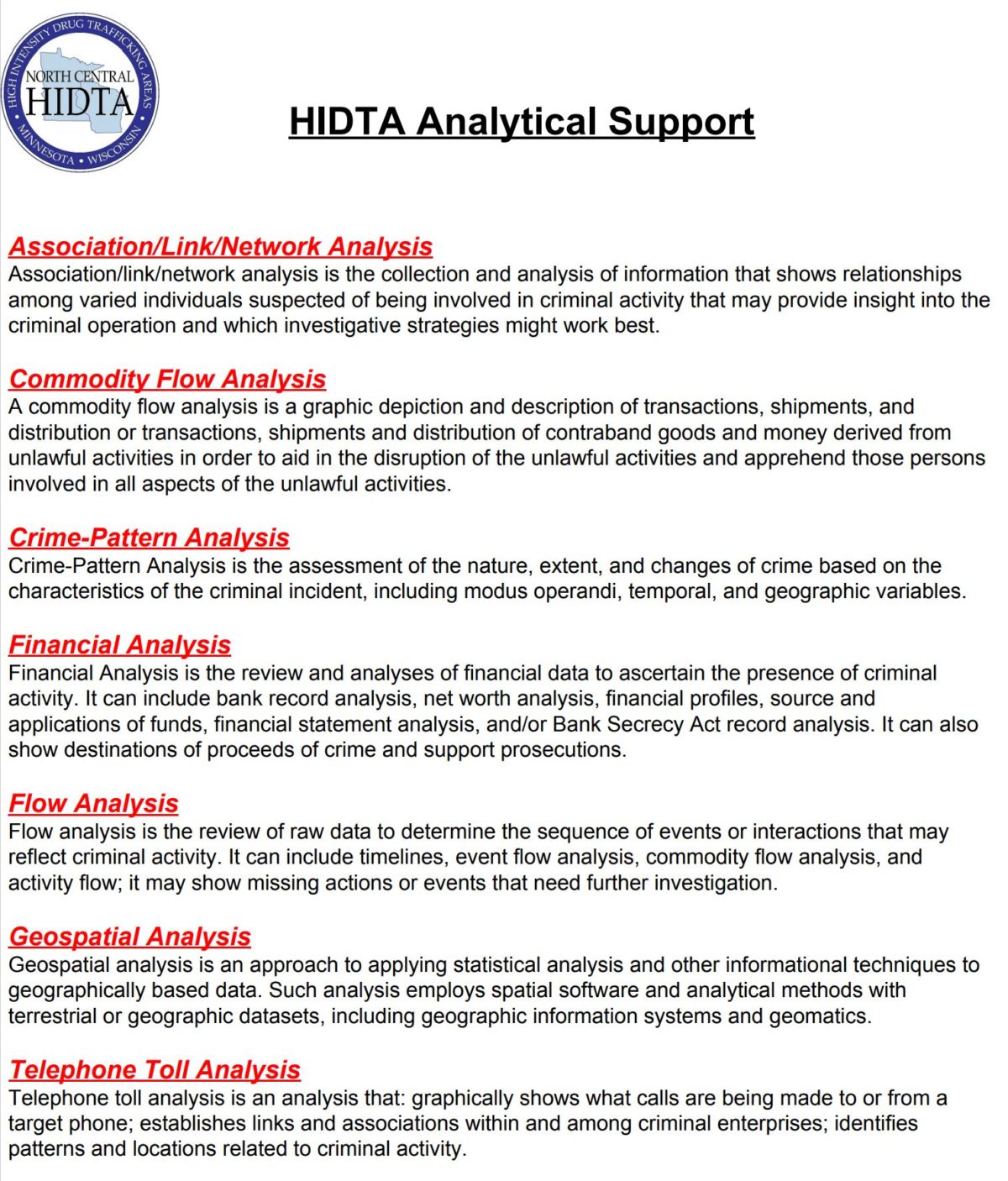
Another briefing document explains that “The ISC initiative is led by the Hennepin County Sheriff’s Office.” Furthermore, the ISC supports investigations into violent and drug crimes and also “financial” and “other major crime investigations.” The County explained that the “other crimes” set includes offenses such as burglary and property crimes. See the background video HCSO released for more.
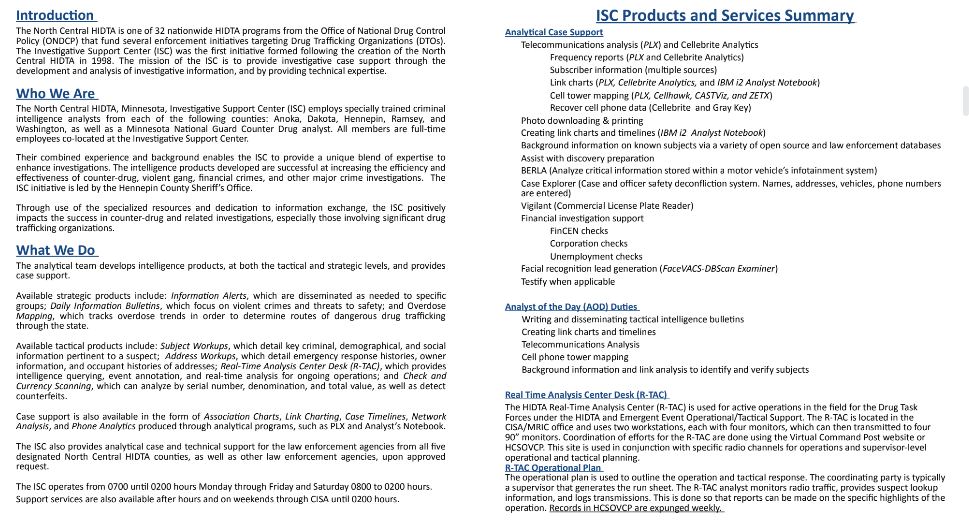
Summary of the ISC “Products and Services”.

The High Intensity Drug Trafficking Areas (HIDTA) program was created by an act of Congress in 1988 during the Reagan-era expansion and federalization of the War on Drugs. HIDTA assists “law enforcement agencies operating in areas determined to be critical drug-trafficking regions of the United States.” 

HIDTAs exist in all 50 states and US territories, wielding a vast array of surveillance tools and operations including over 1,500 DEA special agents. HIDTA task forces include federal, state, county and local law enforcement officials. These efforts are assisted by electronic surveillance, license plate readers, data-brokers, aerial surveillance, confidential informants, cellphone analytics, social media intelligence, and more. 

In 2021 the HIDTA annual budget was $290 million and “President Biden’s FY 2023 budget calls for a historic $293.5 million in funding for the HIDTA program,” according to Whitehouse.gov. Overall, the Drug Enforcement Agency’s (DEA) ever-expanding budget now exceeds $3 billion. Tax dollars are not the only revenue stream for the DEA who seize property and currency to the tune of hundreds of millions of dollars a year via asset forfeiture.

Learn more about Homeland Security asset forfeiture via our leaked ICE-HSI manual in #Icebreaker Part 2.
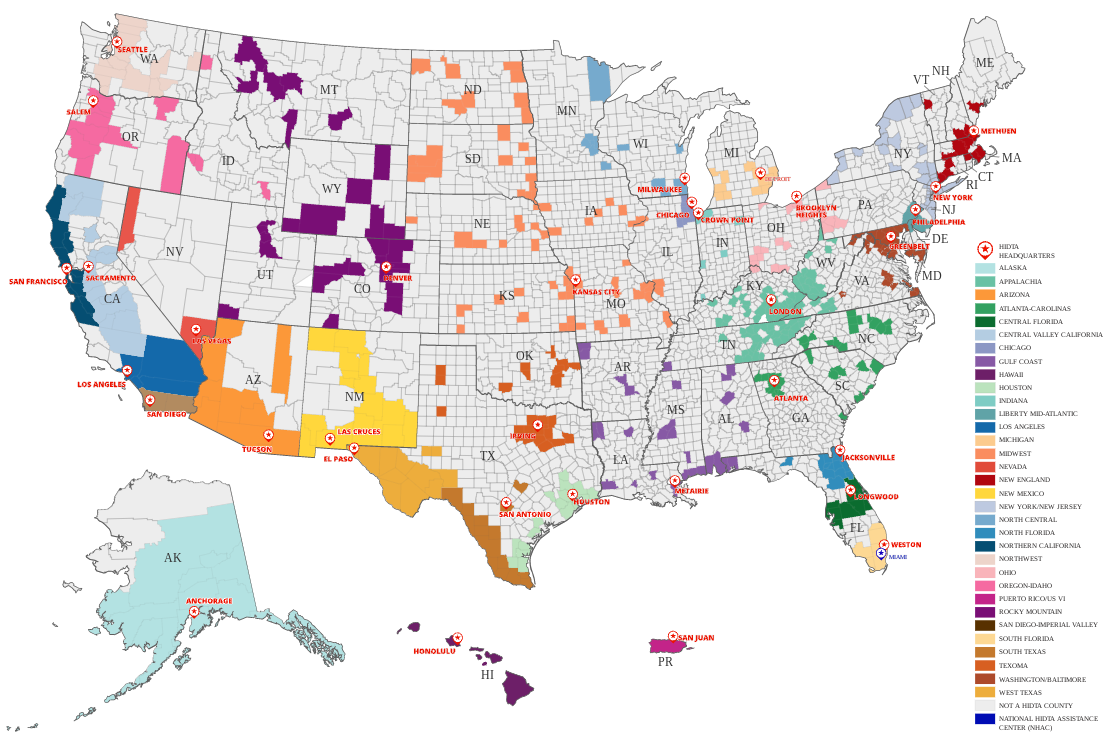
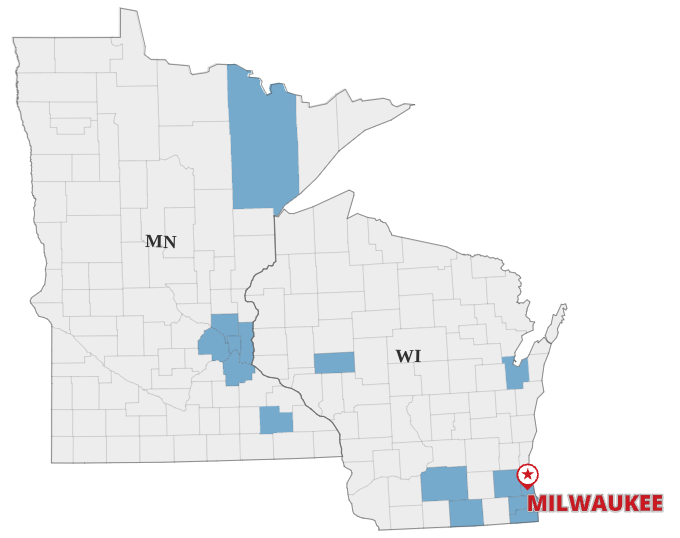
HIDTA-designated counties exist in all 50 states – basically all medium to major population centers in the country. Source: DEA Website.

In addition to federal agents, the local HIDTA program – North Central HIDTA – employs “specially trained criminal intelligence analysts” from “Anoka, Dakota, Hennepin, Ramsey and Washington” counties and a “Minnesota National Guard Counter Drug analyst” according to the documents.

2020: Plane Seized As Part of Counter Drug Asset Forfeiture Mission Used to Resupply Police with Riot Munitions During George Floyd Uprising


37,000 support requests keep HIDTA – ISC busy

Via data practices requests, Unicorn Riot found that ISC provided support for over 37,000 requests from law enforcement partners.

Unicorn Riot obtained data detailing the names of law enforcement organizations that requested investigative support from the ISC; the dates and types of cases in which the center provided real time support through the RTAC; spreadsheets logging facial recognition searches with attached case numbers, and more records. 

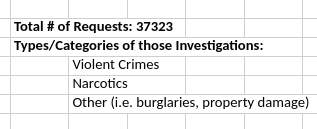
Violent crimes and narcotics investigations were bolstered by the group, along with a vague category labeled as “Other” which included burglaries and property damage. These requests from other law enforcement organizations for some kind of support from the ISC totalled 37,323 according to Hennepin County logs. While no date range was given for that number, it shows the dependency investigators across Minnesota (and beyond) have on surveillance and analysis by the ISC.
These operations run more or less around the clock, processing and poring over scraped data of all kinds. There doesn’t appear to be a type of digital information which criminal intelligence operatives lack access to – they also routinely receive information from Customs and Border Protection (CBP) and other federal partners.

A Look Behind The Curtain – Facial Recognition in Minnesota

Before UR obtained these documents, an in-depth understanding of how local authorities have used facial recognition was not available. But now, with thousands of cases to observe, it’s possible to illustrate the extent of the technology’s use by regional law enforcement.

Facial recognition is heavily used by CISA/HIDTA investigators for “lead generation.” Finding possible suspects by comparing images and running queries against drivers license databases, or jail booking photos, for example, is one such method of lead generation. Facial recognition is commonly used in conjunction with images posted on social media. These documents also show that a majority of the searches since 2019 did not have case numbers associated, which paints a picture of open and unregulated use of facial recognition. 

“Face recognition surveillance presents an unprecedented threat to our privacy and civil liberties. It gives governments, companies, and individuals the power to spy on us wherever we go — tracking our faces at protests, political rallies, places of worship, and more.”

American Civil Liberties Union

Lacking any data to verify a legitimate justification for nearly 1000 searches in around 1300 days shows a lack of transparency and accountability within these programs. It also displays a clear pattern of frequent reliance on a technology that can be both invasive and misleading – especially for communities of color. Automating surveillance amplifies biases and rapid adoption of these technologies has occurred behind closed doors devoid of adequate public oversight.

On Feb. 12, 2021, Minneapolis banned its police department from using facial recognition for surveillance, but that didn’t stop the law enforcement agency from using the controversial technology. The ban’s passage was delayed due to Mayor Jacob Frey’s failure to sign the bill itself, meaning it took five days (excluding Sunday) for the ban to become law following council passage the previous Friday. In effect the ban became law on Feb. 18.
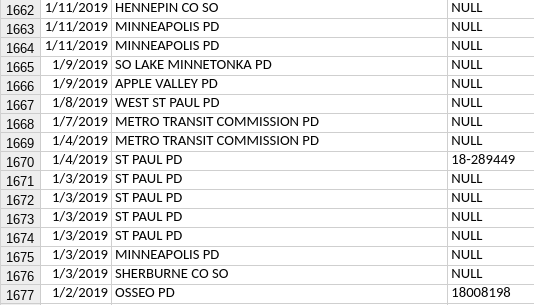
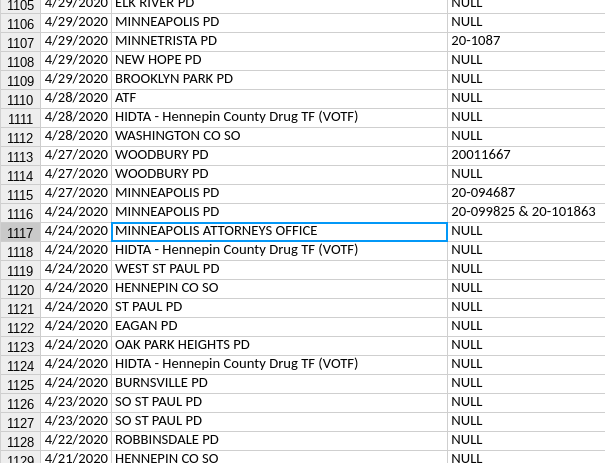
Most facial recognition searches conducted by analysts since 2019 did not have a case number associated with the search in official logs, instead simply said “NULL.”

Records show that four days after City Council passed the ban, the Minneapolis Police Department (MPD) requested a facial recognition search and listed the reason as “null.” The request’s justification being listed as “null” prevents the public from knowing any information about the search other than that MPD requested it be performed.

The department requested a similar search 11 days post-ban. According to Minneapolis officials, the search ran nearly two weeks after the ban was passed. This request was in support of a homicide investigation.

The Minneapolis City Attorney’s Office shows up with 16 facial recognition searches in the logs as well. Data requests for specifics about those and other cases are pending and will be examined in future reports. After inquiring about several other requests, Minneapolis explained that one of the cases was, “child neglect/endangerment (inactive),” and another, “theft, case closed.”

State law does not forbid facial recognition surveillance, and in some cases, MPD appears to have circumvented the local ban by outsourcing requests to other agencies. This could potentially shield MPD from liability over those searches, as one city cannot regulate another city’s police force. A joint Minneapolis and external agency search occurred as recently as Sept. 2022. The facial recognition ban does not stop the MPD from “complying with the National Child Search Assistance Act… or other federal statutes requiring cooperation in the search for missing or exploited children.”

Civil rights advocates in Minnesota foresaw this problem. Munira Mohamed of the ACLU of Minnesota, who advocated for the banning of police facial recognition in Minneapolis, asked, “If you pass a local law curtailing police abuse, how do you know they can’t skirt around that with the help of another agency?” Mohamed also said, “we need to halt the use of these surveillance technologies until there are meaningful laws and oversight that can regulate it and protect everyone’s constitutional rights.”

Law enforcement throughout the state requested facial recognition searches. Police in Robbinsdale, an adjacent suburb to Minneapolis, requested over two dozen facial recognition searches since 2019 and most don’t have case numbers attached. 

The University of Minnesota Police Department (UMPD) also requests these searches and works with the MPD submitting requests that would otherwise not be legal. The UMPD has requested at least seven searches since the start of 2019. 

The FBI, DEA and many federal task forces appear in the logs numerous times. Some other examples from the data – Since Jan. of 2019, the Brooklyn Center Police Department requested these searches 33 times; Edina, 69 times; Champlin 7; Bloomington 42; Elk River 14; Richfield 23; St. Louis Park 30; Metro Transit Police Department  42; and Zumbrota 1.  “Other Agency” is listed 24 times.


Berla: Deep Data Mining on Automobiles in Minnesota

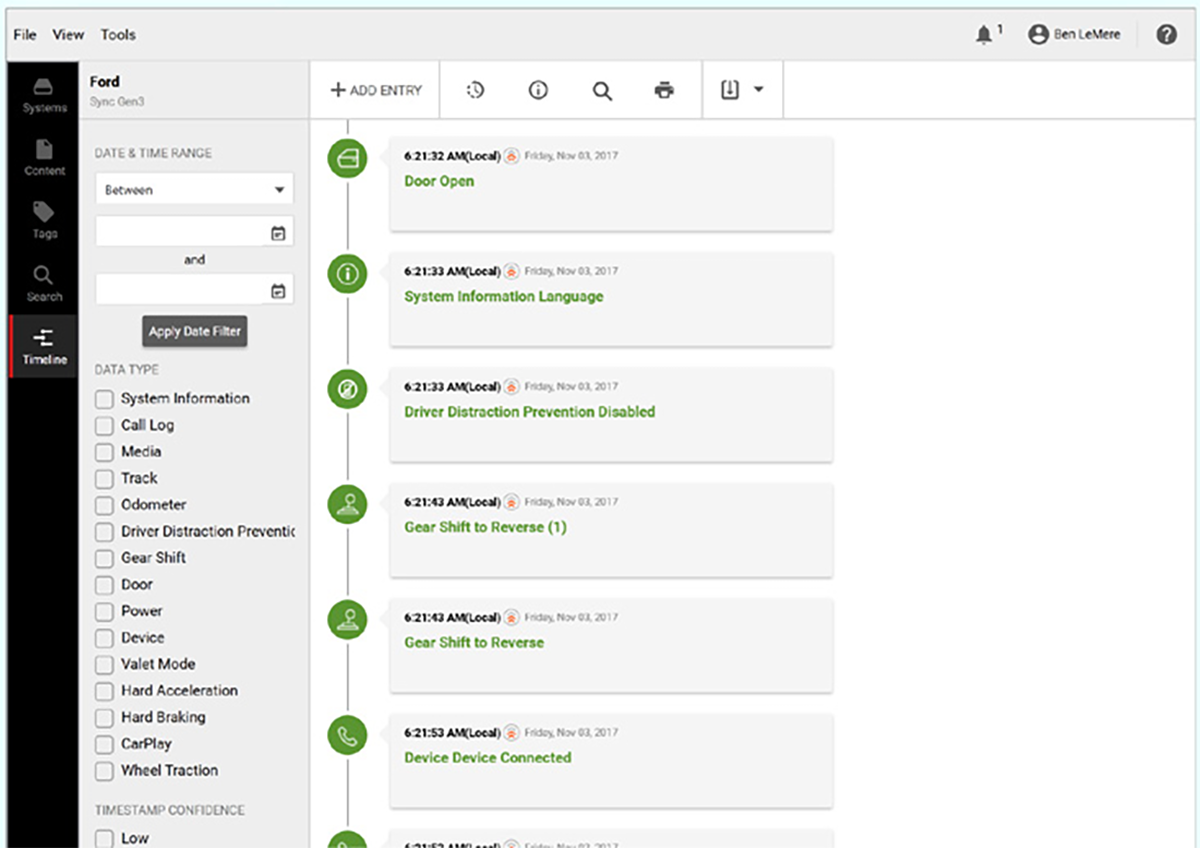
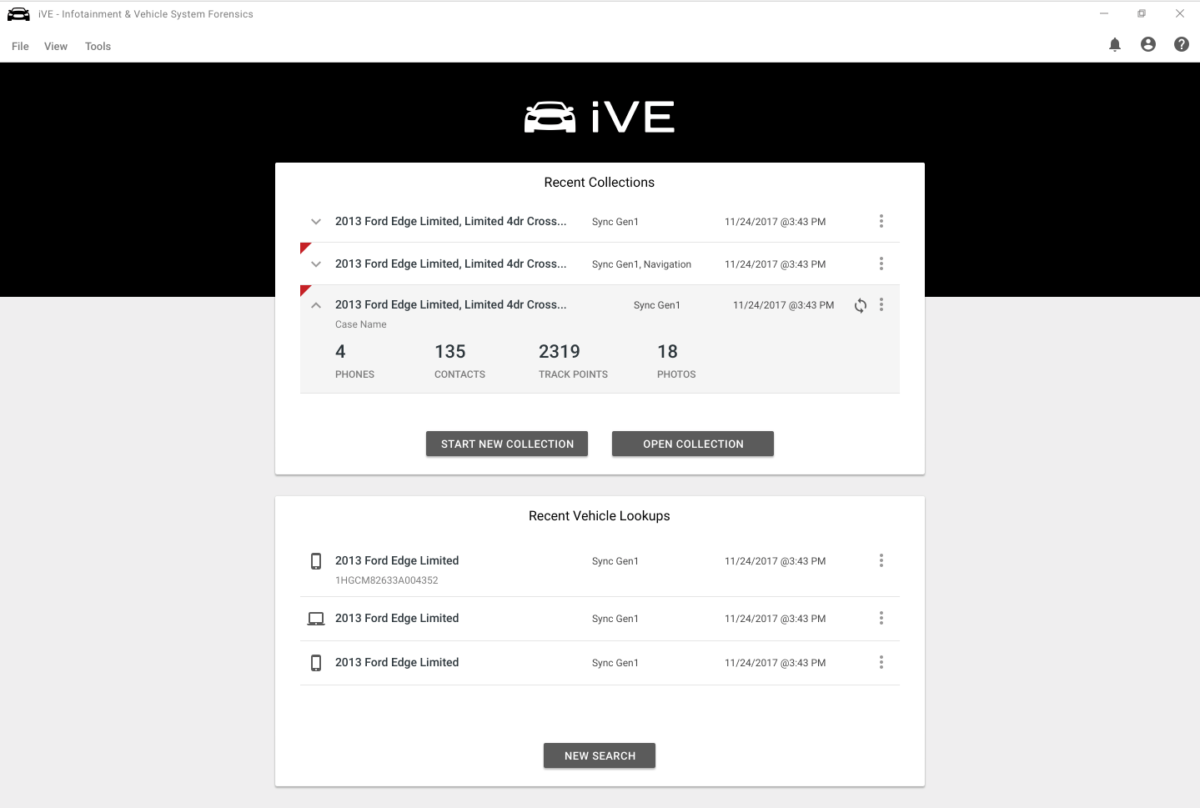
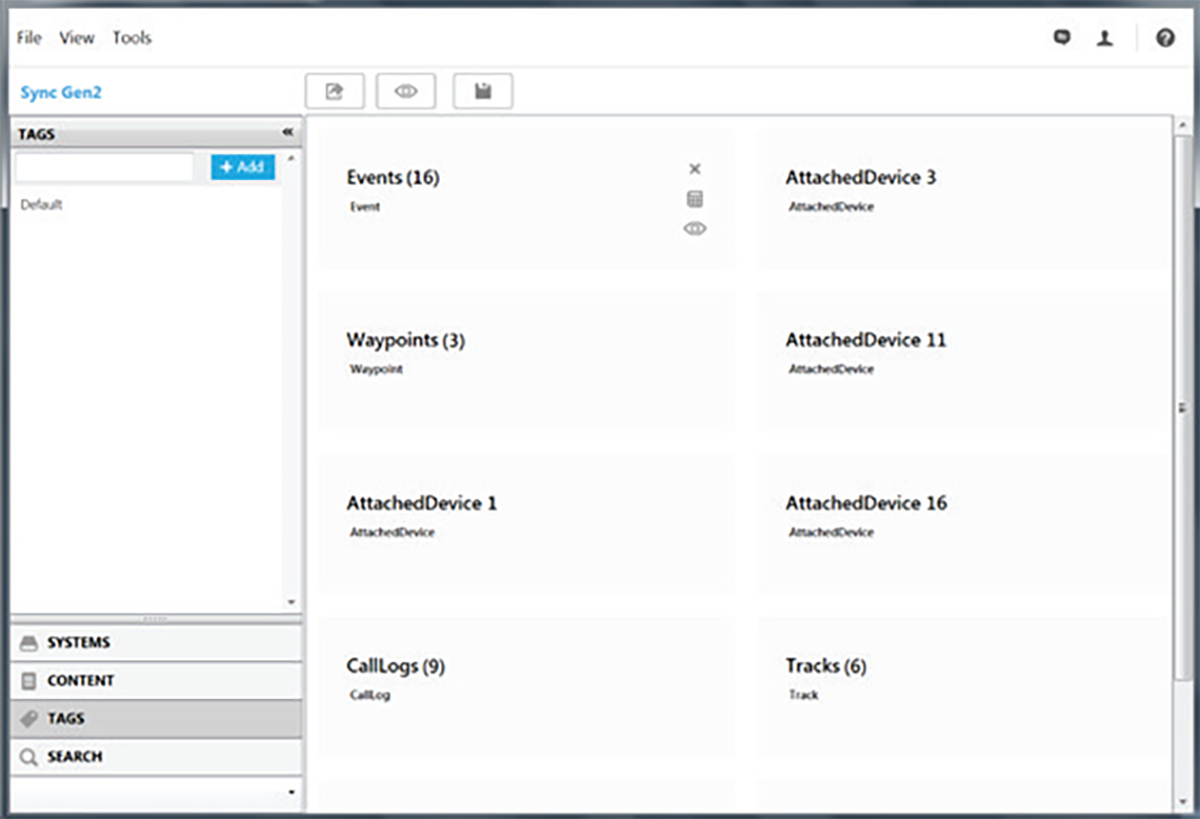
In late 2021, investigators started a new form of data mining using a vehicle forensics software called Berla. The surveillance tool, “breaks into a vehicle’s data systems to find, organize and analyze a vast range of information that often includes far more than what the car generates itself,” according to CyberScoop. Data generated by the vehicle, including GPS and other revealing information such as when doors were opened and closed, can reportedly be exploited by Berla.
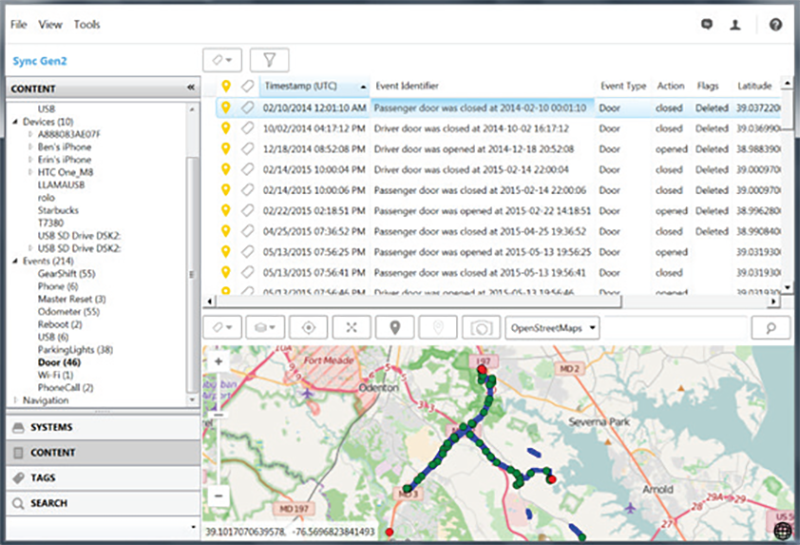
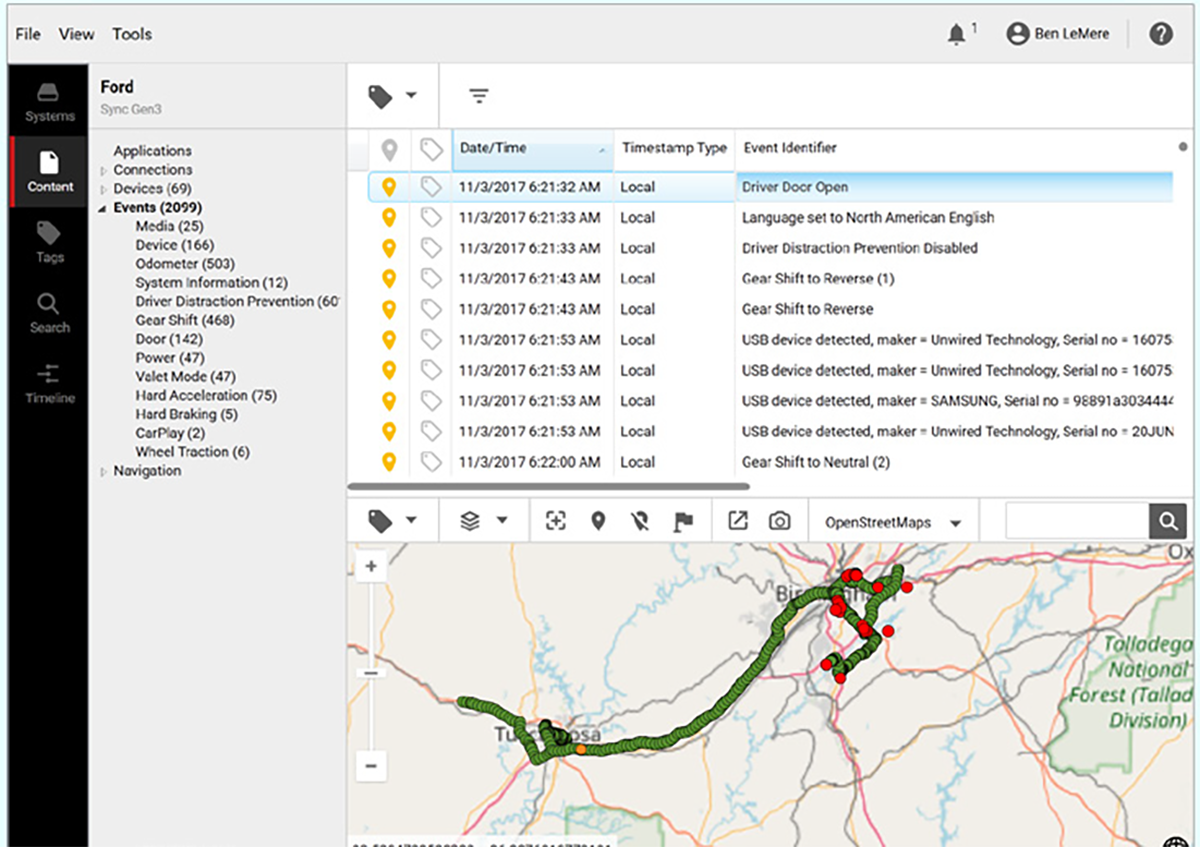
Berla also leverages information stored within vehicles from cellphones and other devices that had connected to the vehicle at one point in time, such as Bluetooth phone connections.

Unicorn Riot discovered Hennepin County records show 33 Berla usages since August of 2021 in furtherance of violent crimes, narcotics and unspecified other investigations, including burglaries or property crimes. The images included above were extracted from Berla promotional materials.


Operations and Tactical Planning: The Real Time Analysis Center

One of the “desks” used during live operations is the RTAC (Real Time Analysis Center) which is critical to “Emergent Event Operations and Tactical Support,” as stated in a HIDTA briefing document. RTAC functions as a command hub for “operational and tactical planning” using large monitors, communications networks and the other systems the ISC can access.

The dataset reveals RTAC was used in support of 462 law enforcement operations from June 5, 2019 to Oct. 26, 2022. The primary type of operation supported by RTAC during that time frame was “narcotics,” which was cited a total of 264 times. The data also show RTAC was used 177 times in “violent crimes” investigations, and again in 21 cases labeled as “other.”
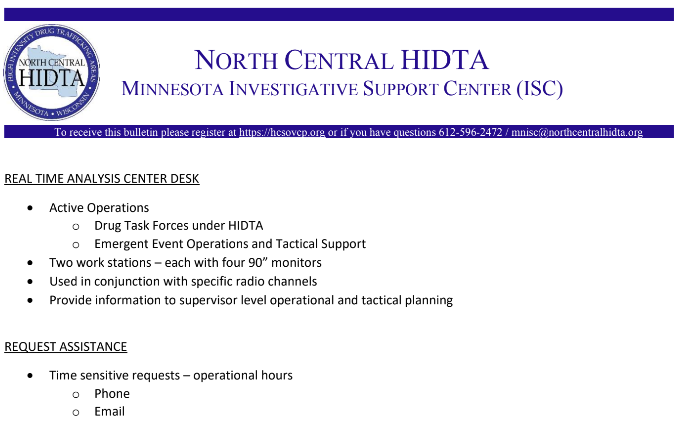
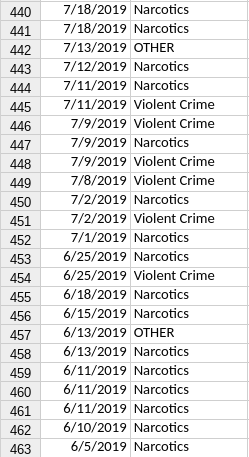
An excerpt of the HIDTA RTAC support log.

License Plate Readers Data Sharing

A presentation put together for a Minnesota Association of Criminal Intelligence Analysts (MACIA) conference explained, “Please keep in mind that many [agencies] have to pull case files, write reports, or otherwise document every LPR search they do, so please limit requests to cases where all the other vehicle search sources will not get you what you need. Also this should be obvious but requests must be related to an active criminal investigation.”
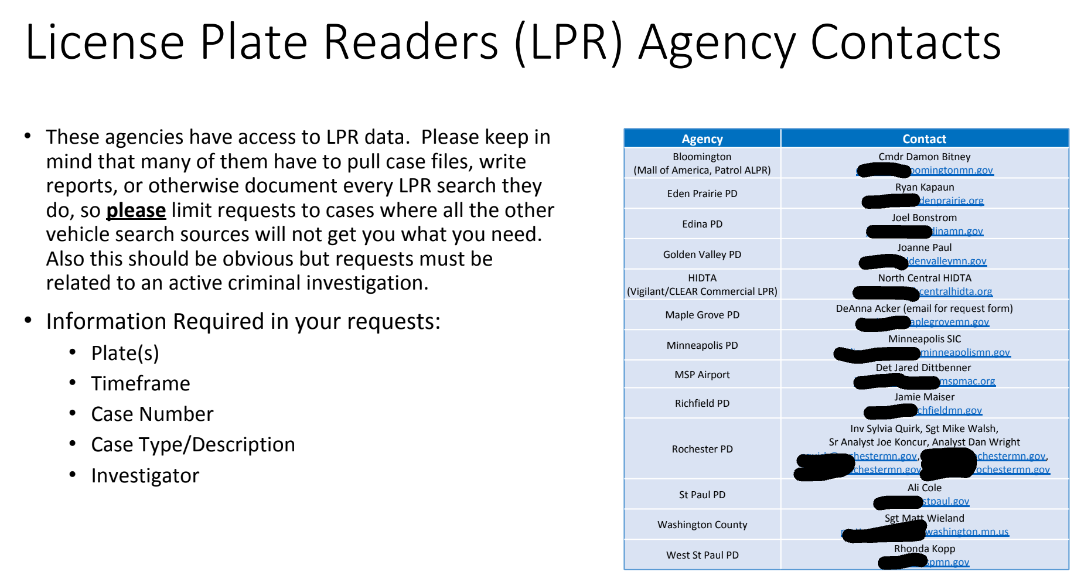
The presentation slide includes a table of point people to contact for license plate reader queries and reveals that HIDTA uses multiple LPR vendors including Vigilant and CLEAR. Vigilant sells, “a nation-wide database of license plate reader data via a secure web-based application and allow intelligence agents to analyze the movement of targeted vehicles as they travel on the nation’s highways,” according to DHS documents obtained by Vice.


Cell Phone Data

Another prime component to these intelligence operations is the analysis of vast swaths of data collected by this constellation of surveillance systems. Call Detail Records (CDRs) reveal a large amount of information about the people using the phone being analyzed – not just who is being called, when and for how long, but also how entire networks of people operate.

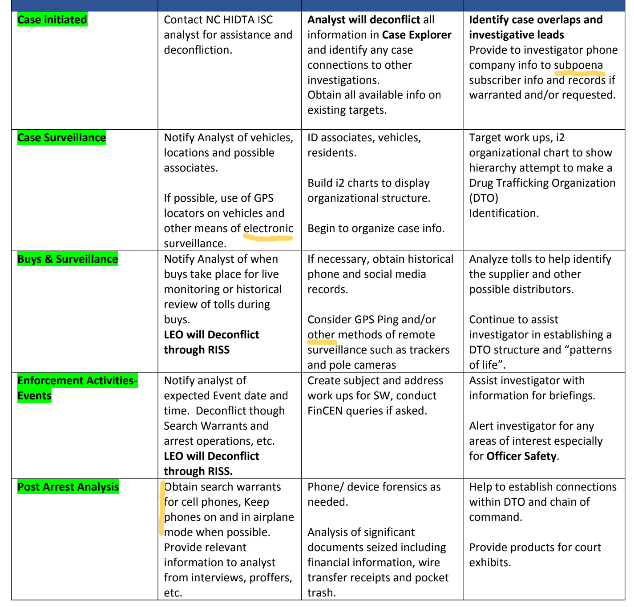
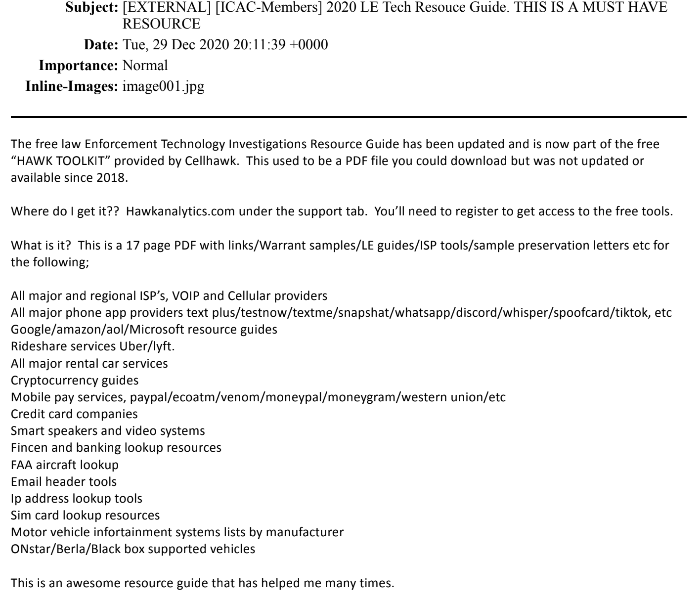
One document released as part of this investigation describes establishing “patterns of life,” a common term from War on Terror-era drone assassination campaigns. Using tools and systems like CellHawk and IBM’s Analyst Notebook, agencies piece together digital breadcrumbs, perform link-analysis and pick apart other surreptitiously obtained data. 

More about Analyst Notebook: – 2016 interview with Chris Soghoian, Denver police use NSA-grade software, and in anti-terrorism task force job description

Officers need not physically possess the phones being surveilled as cell carriers turn over highly detailed call logs, GPS and other data without any warrant thanks to a little known section of federal code. 28 CFR Part 23 permits law enforcement in the United States to hoover up incredibly sensitive information from Americans under the very low bar of “reasonable suspicion,” despite the Fourth Amendment requirement that searches be backed by probable cause. 

More on the problematic policies that govern this type of surveillance on both the local and federal level, and Hennepin County’s convoluted definition of reasonable suspicion from this reporter can be found in the report on Cellhawk, police surveillance of cell phones, and county-level ‘reasonable suspicion’ policies for The Intercept in 2020. The county has a Cellhawk subscription capable of storing over 250,000 call detail records. 


Cellebrite and Phone Extraction Tools

Tools to extract data from phones already seized by police perform functions similar to surveillance occurring “in the field” and also provide a trove of potential evidence. Cellebrite is one such forensic extraction device and investigators are instructed to “keep the phone on and in airplane mode when possible,” according to documents obtained during this investigation. Oftentimes, according to the documents, Cellebrite or another extraction device will scoop the data from phones and analysts then use other programs to visualize and otherwise make sense of the information.
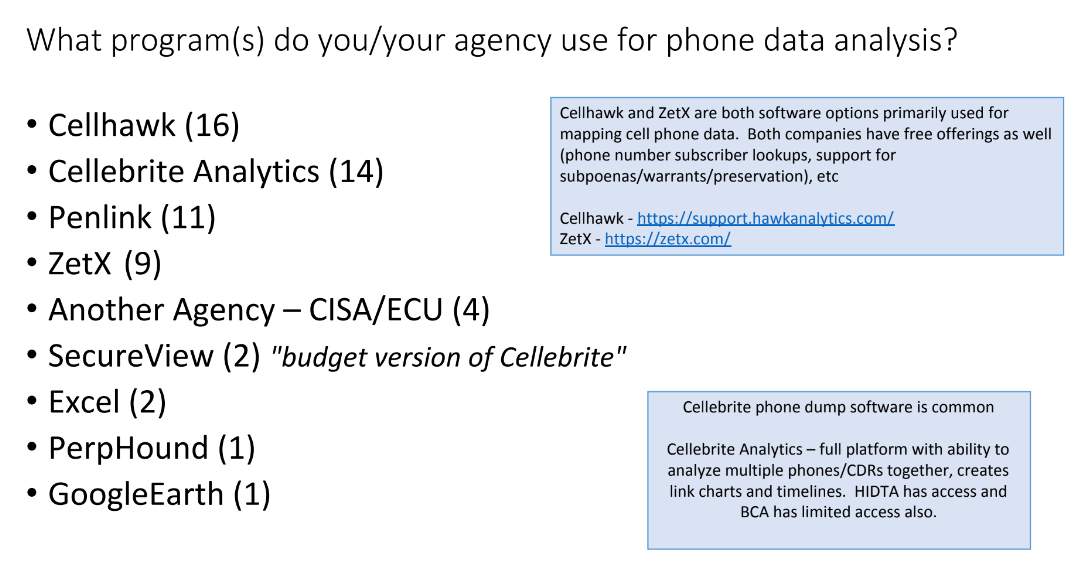
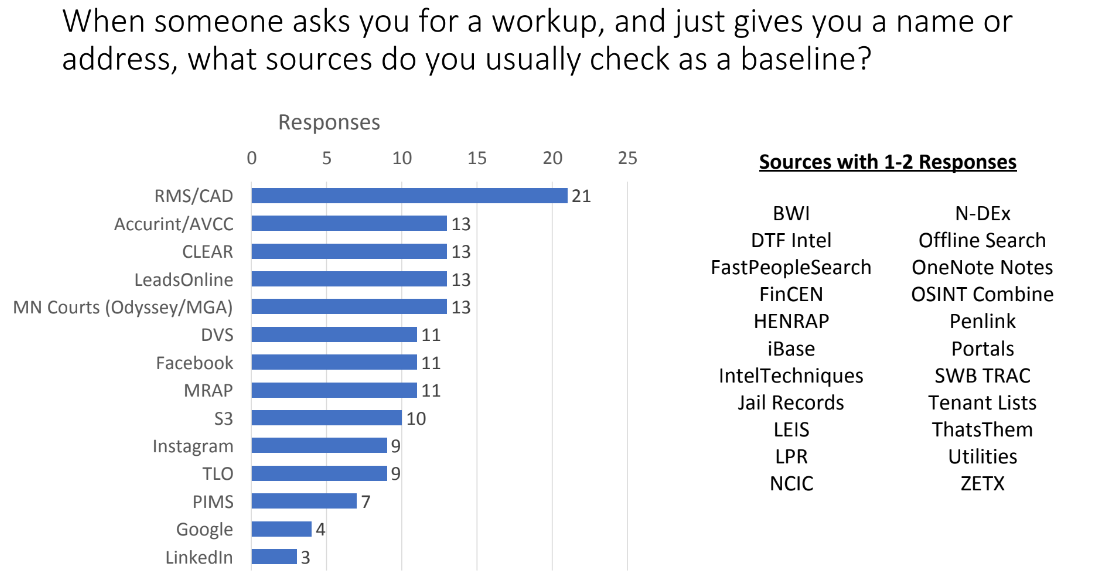
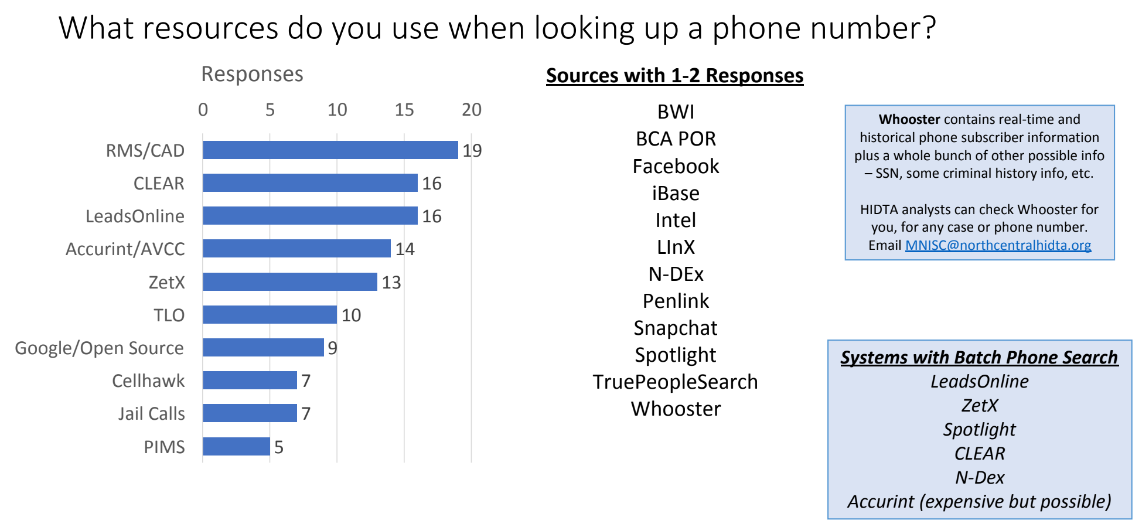
Surveys from a criminal intelligence analyst conference obtained by Unicorn Riot show which products police in Minnesota use to spy on cell phones and collate their data. Giant data brokers like CLEAR and LexisNexis offer an array of products.

One popular system is Accurint, which is marketed by the company as, “cutting-edge investigative technology that can expedite the identification of people and their assets, addresses, relatives and business associates by providing instant access to a comprehensive database of public records that would ordinarily take days to collect.” A summary of the “Hawk Toolkit” from Cellhawk also turned up.

With massive and growing police budgets, the market for domestic surveillance tech grows every year.
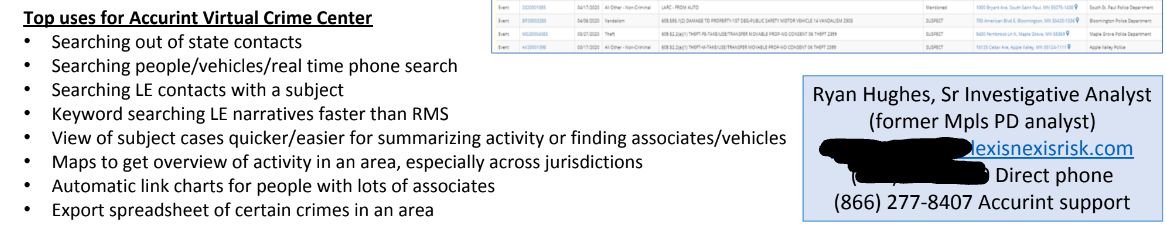
Uses for Accurint Virtual Crime Center

Criminal intelligence analysts fuse information from dozens of partner agencies including Customs and Border Protection. Intelligence networks provide information and assets belonging to federal agencies are routinely deployed in furtherance of domestic policing – including spy tech, aircraft and more.


Increasing Reliance on Aerial Surveillance

Since there are many drug, gang and other task forces running operations at any given time, aerial surveillance has become much more common in the Twin Cities in the last several years. 

As recently as November and December of this year, Minneapolis residents could look up and see ‘DAGGER04,’ a Wisconsin National Guard RC-26 circling parts of the city for hours at a time. The last time a C-26 flew surveillance over the Twin Cities was during the beginning of the unrest following the murder of George Floyd.
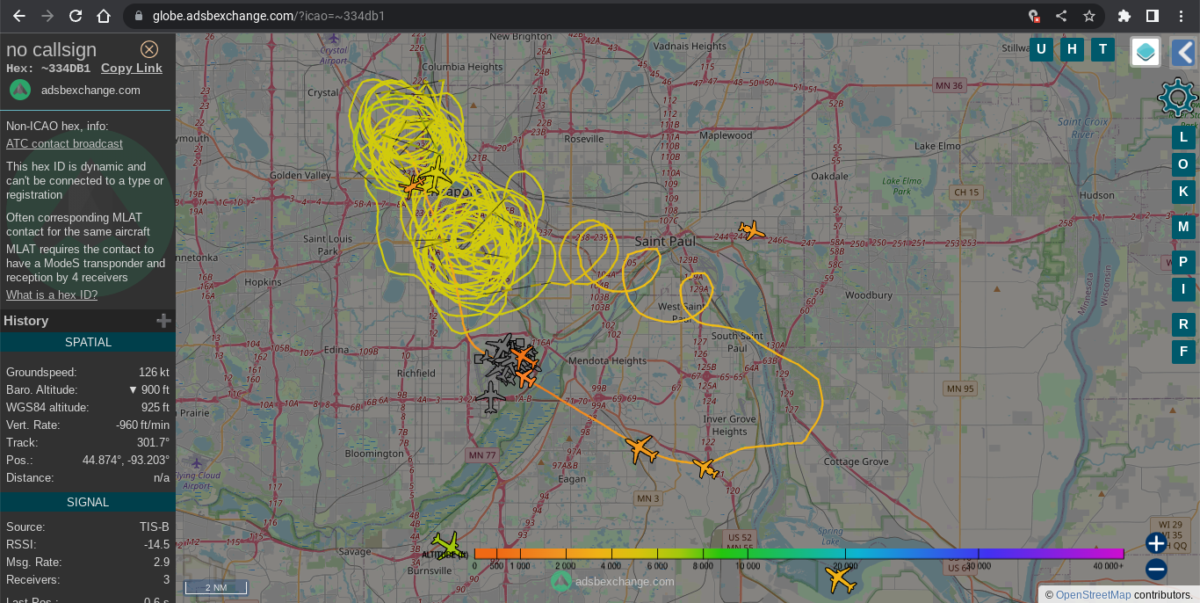
A Wisconsin National Guard surveillance plane watches Twin Cities residents in November 2022. Source: ADSBExchange.com

Wisconsin is a member of North Central HIDTA and therefore National Guard assets from the region are available for operations. DEA, FBI, DHS/CBP, and State Patrol spy planes and helicopters are also spotted circling or revealed through Air Traffic Control transmissions on an increasing basis. 
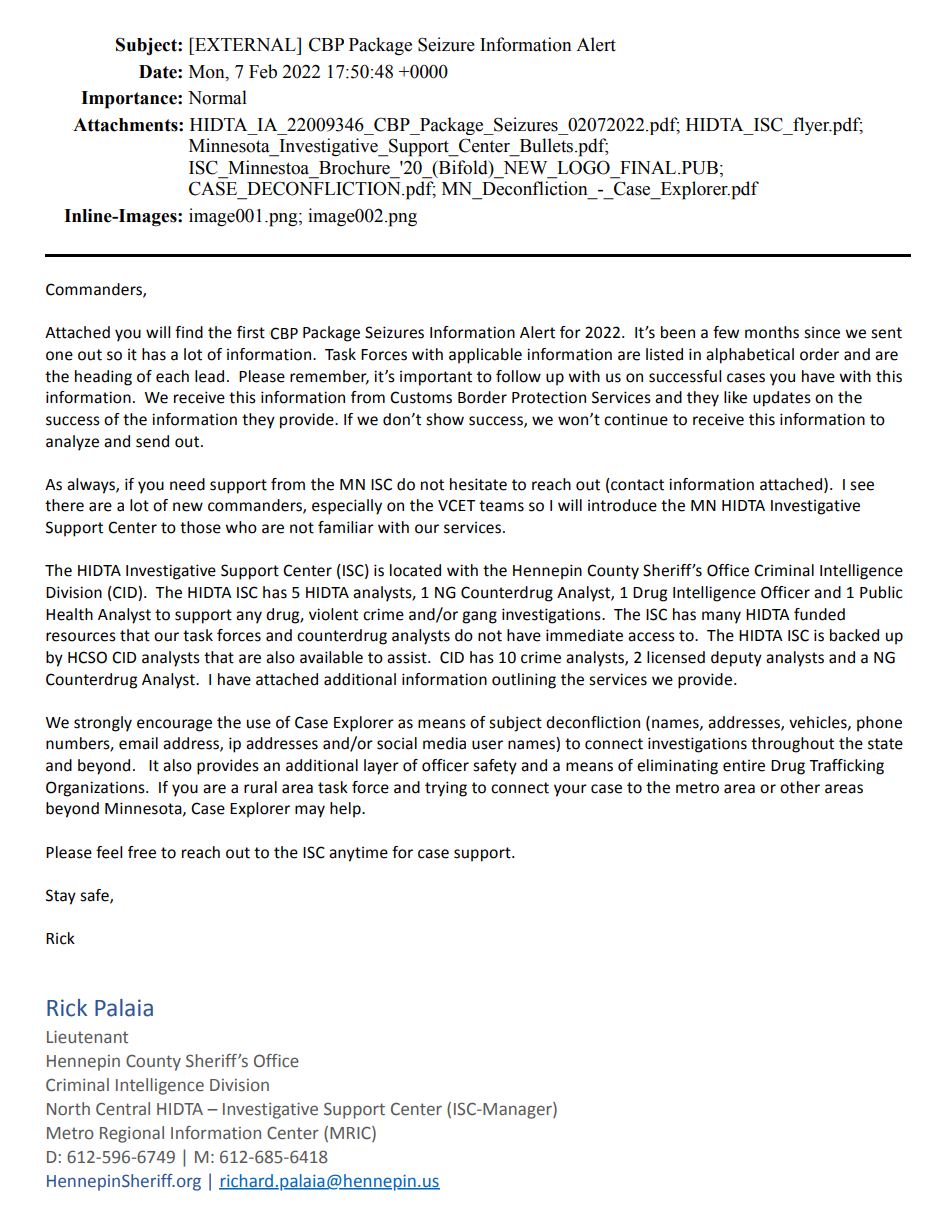
An email from ISC leadership to task force commanders and others explaining the ISC in their own words and reminding them of the extensive support available.

Widespread Operations, Minimal Oversight

North Central HIDTA ISC and CISA are rarely, if ever, mentioned by news reporters or elected officials. The consequences of a highly capable, intricately networked group with routine access to some of the most powerful surveillance tools in history is a source of fundamental concern given the lack of oversight. Private cellphone and other incredibly revealing data is obtained without warrants and investigators are using facial recognition on a daily basis.

The intelligence created by these groups is valuable to investigations across multiple states yet the recordkeeping is lacking. Over half of the facial recognition searches since 2019 were listed as “null.” Furthermore, Minneapolis specifically is violating the spirit of one of the only reforms – a ban on facial recognition –of the infamous police department following their murder of George Floyd.


More Resources

Researchers, reporters, anyone interested in exploring the data find the files below. Please give appropriate credits/citations:


Sam Richards is an investigative reporter focusing on surveillance, protests and more. Find him on Twitter as @MinneapoliSam. Cover composition by Dan Feidt for Unicorn Riot.

Follow us on Twitter, Facebook, YouTube, Vimeo, Instagram, Mastodon and Patreon.

Please consider a tax-deductible donation to help sustain our horizontally-organized, non-profit media organization:

supportourworknew

The post Criminal Intel Files Show Facial Recognition, Warrantless Surveillance in Minnesota appeared first on UNICORN RIOT.


by Unicorn Riot via UNICORN RIOT

New video by Unicorn Riot on YouTube - go check it out ;-)


Watch on YouTube here: Greek Police Evict Mundo Nuevo Squat in Thessaloniki
Via Christian Gasper

Monday, December 19, 2022

The Far-Right Fascination With The Electric Grid

Over the past three years, government agencies have warned that white supremacists and other far-right actors are the most significant domestic threat to the United States’ security. One of the pillars of that threat is the targeting of crucial infrastructure, including the electric grid. There is a decades-long history of endeavors to push the country into chaos by damaging electrical stations, and right wing actors have been convicted of such plots since at least 1999. A recent uptick in sabotage attempts across the U.S. is suspected but not confirmed to be tied to far-right plots.

Moore County, NC experienced a blackout in early December 2022 that affected more than 45,000 residents after two local substations were sabotaged in a way resembling white supremacist plots against vulnerable infrastructure.

The events in Moore County were especially dramatic as both of the substations suffered extensive damage from gunfire. According to authorities, the attacker(s) clearly understood how to effectively disable critical equipment. In light of this incident, as well as numerous others in recent months, the Federal Energy Regulatory Commission (FERC) has ordered a study of the physical security measures protecting the country’s electrical grid:

“In light of the increasing number of recent reports of physical attacks on our nation’s infrastructure, it is important that we fully and clearly review the effectiveness of our existing physical security standard to determine whether additional improvements are necessary to safeguard the Bulk Power System.”

Rick Glick, FERC Chairman

Under both the Trump and Biden administrations, there have been a variety of instances where the federal government published data proving that white supremacy was a growing domestic threat. Some examples include:

  • October 2020: The DHS published its Homeland Threat Assessment, which had gathered information from law enforcement and intelligence providers nationwide. The assessment concludes that “racially and ethnically motivated violent extremists––specifically white supremacist extremists (WSEs)––will remain the most persistent and lethal threat in the Homeland.”
  • June 2021: The NSC, working with the White House, published a National Strategy for Countering Domestic Terrorism (PDF). Similarly, it states that “racially or ethnically motivated violent extremists (principally those who promote the superiority of the white race) are assessed as presenting the most persistent and lethal threats.”

Despite these warnings, a Senate report (PDF) released in November found that neither the DHS nor the FBI have taken appropriate steps to combat far right domestic terrorism. “In 2019,” it claims, “DHS publicly acknowledged white supremacist violence as a major threat to national security for the first time, despite being aware internally of the severity of the threat for 10 years.” A detailed assessment (PDF) by the DHS Office of Intelligence and Analysis produced in 2009 ended up being dismissed “due to political pressure.”

Recently, multiple electrical substations across the nation have been intentionally damaged or vandalized, warning both the industry and government of more frequent attempts.

In a December 13, 2022 hearing of the House Subcommittee on Civil Rights and Civil Liberties, Eric Ward, director of the Western States Center, an Oregon-based human rights nonprofit, warned the U.S. was now “an environment where individuals feel empowered to carry out political violence on their own in an increasingly unpredictable way“:

“Reports of attacks on electrical infrastructure in North Carolina, Oregon and Washington are raising the stakes. Law enforcement is reportedly investigating posts by extremists on online forums that encourage attacks on critical infrastructure. Whether the North Carolina attack was intended to disrupt a local LGBTQ event, this [happened] after a series of attacks on the LGBTQ community in recent weeks and months.”

Eric Ward, Director, Western States Center, witness to the House Oversight Committee, Subcommittee on Civil Rights and Civil Liberties Hearing on “Confronting White Supremacy (Part VII): The Evolution of Anti-Democratic Extremist Groups and the Ongoing Threat to Democracy,” December 13, 2022

Accelerationists Pitch Sabotage Campaigns Online

Given the dramatic effect it would have nationwide, destabilizing the electric grid has been of particular interest to racist and far-right actors looking for crises to exploit. Additionally, they have pointed out how security surrounding power facilities is relatively easy to overcome. This summer, a document spread among neo-nazi Telegram channels detailing, among other things, how to cause chaos by disabling the electrical grid. The author calls power stations “sitting ducks” and points out most substations are “largely unprotected and often in remote locations.” 

The author disparages more shocking events like mass shootings as inferior to attacks on substations, typically called “soft” targets. While violence is celebrated and encouraged, the author says disabling electricity is “unquestionably more effective” at pushing civilian populations into chaos and division.

There is a lengthy history of far-right adherents targeting the country’s infrastructure as part of a grandiose plan for white nationalist revolution and an authoritarian reset of society. This is typically called “accelerationism,” but online neo-nazi subcultures understand it to be the “Siege” or “Siege Culture” mindset; this sect of the neofascist movement is concentrated online in Telegram channels. The name comes from the title of the book “Siege,” an anthology of zine-like essays by American neo-nazi James Mason. (Siege is a common term on far-right and related chat servers on Unicorn Riot’s DiscordLeaks data journalism platform.)

In his book, Mason promotes “friction” and “chaos,” urging readers toward violent revolt and terrorism. By acting in smaller group cells, fascist accelerationists would hope to push society into collapse. Such a collapse would then allow heavily armed far-right groups to impose their vision for society onto a desperate and vulnerable civilian population.

Some groups and individuals have attempted to act on those calls. ‘The Base,’ though now mostly defunct, was a high-profile neo-nazi network run by Rinaldo Nazzaro which pushed for infrastructure attacks. And in New Zealand, a man with neo-nazi ideology was arrested in March 2020 for allegedly planning to attack a substation. Slotting these attacks into the “political extremism” paradigm is an August 2022 report from George Washington University’s “Program on Extremism”. (PDF)


Government Pushes Warnings re: Utility Attacks; Atomwaffen Prosecutions

The DHS has made specific note of the far right’s interests before. In January 2022, a leaked intelligence bulletin said:

“[Domestic violence extremists] have developed credible, specific plans to attack electricity infrastructure since at least 2020, identifying the electric grid as a particularly attractive target given its interdependency with other infrastructure sectors.” 

Two incidents, both thwarted, stand out as being particularly associated with far-right groups or individuals:

  • August 2021: Four men with connections to the neo-nazi terror group Atomwaffen Division were charged with conspiracy to damage property after being found to have researched and planned an attack on an unspecified power station. The men, two of whom were former Marines, collected and stole explosive materials and firearms. Additionally, one of the men had a written list of locations near transformers and substations, presumably targets. The damage to the power grid that could have been caused was estimated to be more than $100,000. 
  • February 2022: Three men plead guilty to conspiring to provide material support to terrorists after admitting that they had each planned to attack separate electrical facilities. They spread neo-nazi propaganda, helped recruit extremists online, practiced shooting, and discussed starting a race war in the chaos that would ensue from widespread power loss. The FBI concluded that the attacks were based on “their adherence to racially or ethnically motivated violent extremist views.” 

Many attacks remain unsolved and have yet to be linked to racist/far-right agendas, but the right’s long history of plots against electrical infrastructure reveal a clear desire and willingness to sabotage these sites to further their ideals. 


Pacific Northwest a Far-Right Hotspot

On December 2, the FBI sent a memo to Washington law enforcement warning about a number of attacks that have recently occurred in the Pacific Northwest:

“Power companies in Oregon and Washington have reported physical attacks on substations, using hand tools, arson, firearms and metal chains possibly in response to an online call for attacks on critical infrastructure. In recent attacks, criminal actors bypassed security by cutting the fence links, lighting nearby fires, shooting equipment from a distance or throwing objects over the fence and onto equipment.”

-FBI memo (via Oregon Public Broadcasting)

Six incidents are reported to have occurred in the Pacific Northwest:

  • In Puget Sound, two substations were vandalized in late November, but suffered no extensive issues.
  • In Clackamas, OR, two substations were attacked in late November. One was damaged to the point where it will cost hundreds of thousands of dollars in cleanup and repairs.
  • In Woodland, WA, two substations were vandalized in mid-November, but have since been repaired. 

For decades, white supremacists have sought to reshape the Pacific Northwest into a white ethnostate (PDF). Since the 1970s, numerous neo-nazi and white nationalist groups have been fighting to bring about the “Northwest Territorial Imperative,” the idea of a racist haven, cut off from the rest of the U.S. Historically, there has been a sizable amount of activity in the area from notorious racist organizations such as the KKK and Aryan Nations.

More recently, groups like Identity Evropa (American Identity Movement), Patriot Front, and the Proud Boys have made names for themselves there. In 2018, Unicorn Riot reported on “Cascadian Coffee Company,” a key Discord server with elements from multiple far-right groups in the Pacific Northwest.

On the opposite side of the country, the state of Florida has experienced six substation “intrusions” recently. Duke Energy, the same company that owned the substations attacked in North Carolina, filed reports with the U.S. Department of Energy showing that all six stations were intruded within the span of thirteen days.

  • On September 10 and 13, an intruder broke into the Bay Ridge substation.
  • On September 18, an intruder “targeted” the Orange Blossom substation.
  • On September 21, an intruder “targeted” the Zephyrills substation
  • On September 21, an intruder managed to trip equipment in the Zephyrills North substation causing a nine-minute outage.
  • On September 22, an intruder caused a two-minute outage by tripping equipment in the East Clearwater substation.

In contrast to the North Carolina and Pacific Northwest incidents, the Florida intruders didn’t bother to damage equipment, but instead reconfigured it to cut the power. Based on the knowledge intruders had to disable equipment, inside involvement is suspected. Questions prevail about connections to the far-right, but as of now nothing has been proven.


Appendix: Power Grid Sabotage Chatter in Leaked Discord Logs, 2018-2021

Content Advisory: Violence, Bigotry, Sexual Assault

Messages from 12 far-right and racist Discord chat servers logged in Unicorn Riot’s DiscordLeaks journalism database show discussions about targeting power grids taking place over the last 4 years. While the conversations vary in seriousness, they demonstrate how the concept of power grid sabotage is firmly lodged within the mental pantheon of online neofascist subculture. 

‘The Right Cafe’

In one chat group called ‘The Right Cafe,’ used by far-right gamers, racists and neo-nazis, one user with a since-deleted account wrote in November 2018 that they were “waiting for the day when we will blow up all the power grid.

Similar conversations in January 2019 in ‘The Right Cafe’ echoed the same theme, in which a Discord user with the chat handle ‘Commisar Femto’ wrote “I support terrorism but I have aspects on when to use it.” ‘Commisar Femto’ went onto say that in his view, “the system needs to be brought down and fast” and that a “quick blow” on “the power grid… will cripple the system.” ‘Commisar Femto’ also wrote a message praising the “day of the rope,” a reference to a scene from the neo-nazi sci-fi fantasy novel ‘The Turner Diaries’ in which all Jews and People of Color are killed in a violent uprising to create a whites-only utopia. 

In a vetting channel for a separate Discord server, ‘Commisar Femto’ described himself as a “white american” and “fascist/NS [national socialist]” whose political goals include a “fascist totalitarian ethnostate.”

‘FreedomφClub’

In another far-right chat server called ‘FreedomφClub’ (the name is taken from the writings of Unabomber Ted Kaczynski), a Discord user posting under the name ‘Tato’ pontificated on January 15, 2020 that “the best way to disenfranchise massive amounts of people is to wait for conditions to deteriorate to the point where you can just toss a pamphlet at them and then they’re down.”

Another racist discord user with the chat name ‘thenwerd’ (a not-so-subtle reference to the infamous anti-Black slur) replied “*ahem* power grid” – later suggesting that a “saboteur squad” could “yeet a pipe bomb into a substation.” The conversation then went on to include ‘Tato’ and ‘thenwerd’ discussing saving money and getting out of debt in order to be able to afford to plan an attack. 

Messages by ‘Tato’ strongly imply that he lives in Canada; as of Jan. 2020 he said he was studying agricultural science

‘Zeducation’

In the discord chat server ‘Zeducation,’ created by Minnesota-based far-right Youtuber Tyler Zed, some of Zed’s fans discussed sabotaging power grids in their area.

A username ‘Negan’ wrote on March 5, 2021 that he wanted to “destroy the power grid.” Chat participant ‘DrewDaPilot’ replied with an apparent interest and desire to participate: “I could take down the power grid for my county if I wanted to. All I need is someone to break into the local power distribution center and add a raspberry pi into their internal network…. tldr; its easy.”

A January 2021 report by Unicorn Riot found that 6 people involved in the ‘Zeducation’ Discord server claimed to have been involved in the January 6, 2021 attack on the U.S. Congress.

‘Nick Fuentes Server’

On August 8, 2018, a chat participant using a since-deleted account in a Discord server created by neo-nazi Nicholas J. Fuentes encouraged Fuentes and others in the chat to “blow up federal buildings” and “blow up your local power grid.”

‘NEWS AND POLITICS’

On February 24, 2020 two Discord users – ‘luke5135’ and ‘BigAL’ – discussed power grid attacks in ‘NEWS AND POLITICS,’ a server tied to the far-right and neo-nazi-affiliated /pol/ board on 4chan.

“War is more logistics and strategy than killing” wrote ‘luke5135.‘ “You have to know what to do and then kill,”Big_Al‘ reflected. ‘Luke5135’ then suggested a plot to “take out the entire U.S. power grid” – and claimed to “know a place [where] I could take the entire power grid around me.”

‘Carpathid’s Imperium’

In ‘Carpathid’s Imperium‘, a neo-nazi chat named in reference to the tabletop miniatures game Warhammer 40K, a user with a since-deleted account encouraged other chat participants to “read Siege and take down a power grid.”

‘Call-In Show Server’

In a ‘Call-In Show Server’ created by bigoted far-right anti-LGBTQ commentator Matt Christiansen, a chat user posting as ‘AlexandertheBased‘ described himself as “heavily armed” and claimed he had plans to start tampering with the grid.”AlexandertheBased‘ wrote that he hoped a power blackout in winter conditions would cause 90 % [of people] to die of exposure here. Others discussing the idea with ‘AlexandertheBased‘ fantasized about being able to “control the fucking power grid and create a rape based economy.”

‘Athens’

On September 9, 2019, Discord user ‘Arthur Grayborn’ posted in ‘Athens,’ a far-right “free speech” chat, about his thoughts weighing different approaches to attacking power grids at a national versus municipal scope. “Take out four or five major power plants and you knock out half the nation’s electric gridWhereas a smaller scale model would be far more resilient. Take out four or five power plants and four or five cities are without power.”

‘gear queer’

In ‘gear queer,’ a racist/far-right 4chan-affiliated chat for gun and body armor enthusiasts, several Discord users also discussed hitting power stations. 

On December 3, 2019, usernames ‘Cataclysmo’ and ‘glacial pace’ debated the strategic implications of a campaign to knock out electrical utility services. 

Cataclysmo‘ was skeptical about the effectiveness of targeting various infrastructure points simultaneously, speculating that “if enough substations were hit at once, someone would notice and send people to the remaining ones just to strengthen them.” ‘glacial pace’ felt that such a plan could still work as long as those involved were sworn to secrecy: “like yeah you could do it. if you had 20 people who did everything perfectly, and didn’t talk.”

Also in the ‘gear queer’ chat, later, on February 27, 2020, someone chatting on Discord as ‘Ann Hiro’ claimed that they “implied to” an acquaintance that “I was going to bomb the power grid so the elite can’t forward their agenda.” The chat handle ‘Ann Hero’ is a play on “anhero,” an older artifact of 4chan slang that is shorthand for committing suicide. 

‘RobertGrulerEsq’

In the chat server ‘RobertGrulerEsq,’ created by Arizona-based far-right attorney and Kyle Rittenhouse apologist Robert Gruler, a Discord username ‘Dreadnaught’ ominously claimed on December 18, 2020 that “If the Right decided to revolt, the power grid will be down very quickly. Food is going to disappear and we are all going to be in a position where we will be forced to chose sides.” 

Predictions by ‘Dreadnaught’ of a right-wing revolt appear to not have been entirely inaccurate, as less than three weeks later, thousands of far-right Trump supporters stormed the US Capitol in a nearly-successful antidemocratic coup attempt. The crowd that stormed the Capitol included at least four members of Gruler’s chat server, if their messages claiming participation that day are accurate. 


Luke Huizenga is a freelance journalist covering white supremacy, far-right fringe movements, and the growth of online extremism. You can follow him on Twitter: @huizengard. Chris Schiano and Dan Feidt of Unicorn Riot contributed additional reporting.

Title photo composition by Dan Feidt for Unicorn Riot. Photos by Chris Schiano for Unicorn Riot and Archives New Zealand for Wikimedia Commons.

The post The Far-Right Fascination With The Electric Grid appeared first on UNICORN RIOT.


by Unicorn Riot via UNICORN RIOT

New video by Unicorn Riot on YouTube - go check it out ;-)


Watch on YouTube here: SWAT Teams Attack Atlanta Forest Encampments, Activists Charged with “Terrorism”
Via Christian Gasper

Sunday, December 18, 2022

SWAT Teams Attack Atlanta Forest Encampments, Activists Charged with ‘Terrorism’

Atlanta, GA – On Tuesday and Wednesday this week, SWAT teams and other armed police officers from eight different federal, state, county, and city police agencies conducted a raid on those camping out in the Atlanta forest in hopes of preventing the construction of a 85-acre police training facility that opponents have dubbed “Cop City.”

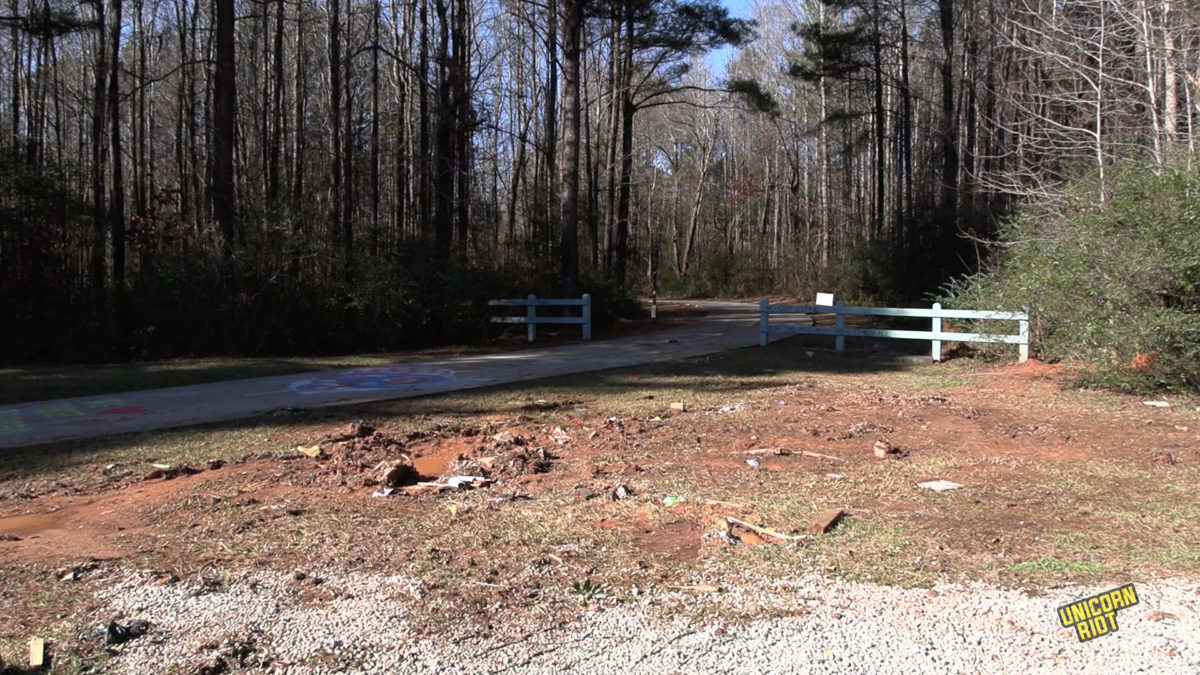
During the raid, police shot tear gas and plastic bullets and forced people out of the forest at gunpoint. Police in Bobcats and other heavy equipment destroyed treehouses, a communal kitchen, and other infrastructure built by those dedicated to the defense of the forest. 

An encampment structure stands tall before the raid (left). The structure was completely demolished and removed during the raid (right). Credit: Sasha Tycko

By the end of the two-day operation, a total of 12 people were arrested, according to police. At least six of those have been charged with a host of felonies, including state-level domestic terrorism charges, according to the Atlanta Solidarity Fund.

At a hearing Thursday, Magistrate Judge Claire Jason denied bond to five of the arrestees charged with felonies.

“Each of you have been charged with domestic terrorism,” Jason said, appearing to read from a document on her screen. “Generally the information that I have on the affidavit of warrant…You did participate in actions of DTAF, Defend the Atlanta Forest, a group that’s been classified by the United States Department of Homeland Security as a domestic violent extremist group.”

Those involved in the movement to defend the forest deny that the group Defend the Atlanta Forest even exists. Writing on Twitter Friday from the handle @DefendATLForest, those running the platform explained, “’Defend the Atlanta Forest’” is the name of a movement and it is also the username of a submission-based social media platform. It is not a group. We do not organize any actions and we don’t know the people who do.”

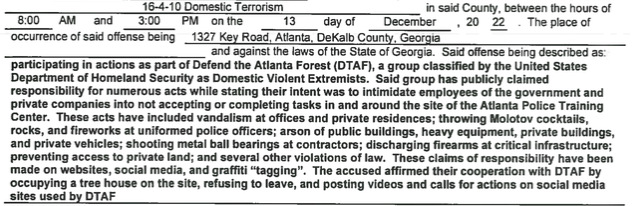
The Department of Homeland security did not respond to questions from Unicorn Riot regarding the alleged domestic violent extremist group classification. However, arrest warrants and affidavits obtained by the Atlanta Journal-Constitution indicate that those arrested are being charged with domestic terrorism simply due to their affiliation with the “group.” The documents state that the Department of Homeland Security classifies “Defend the Atlanta Forest” as “Domestic Violent Extremists.”

Section of an affidavit claims “Defend the Atlanta Forest” are “Domestic Violent Extremists” according to the U.S. Department of Homeland Security (Source)

Some affidavits say the offense is “16-10-24 Domestic Terrorism,” however as of 2021 that Georgia state law does not include any references to domestic terrorism — it only pertains to “obstructing or hindering law enforcement.” Another affidavit says the offense is “16-4-10 Domestic Terrorism,” although this appears to be a mistake by prosecutors and the judge, as that section is currently repealed according to Justia.com. However, there is a domestic terrorism statute on the books in Georgia.


Cop City Opponents Aim to Stop Construction

The encampments and tree sits within the 380-acre expanse of forest have been constructed, destroyed by police, and reconstructed several times throughout the year. Those living in the trees and supporting them from afar are trying to prevent the razing of the forest and the construction of the Atlanta Police Foundation’s Public Safety Training Center, currently scheduled to open in late 2023.

The facility carries a price tag of $90 million for its initial phase. In September 2021, Atlanta’s City Council approved a proposal to construct the facility within a huge swath of forested land in unincorporated DeKalb county southeast of Atlanta, some of which is owned by the City of Atlanta. 

​​Other sections of the forest are also in danger of destruction. Last year, film company executive Ryan Milsap, former owner of Blackhall Studios (recently rebranded Shadowbox Studios), was given forty acres of forested land called Intrenchment Creek Park just west of the planned police facility in a controversial land swap. Opponents of Milsap responded to an escalation he made on July 30, 2022 by setting a work truck on fire.

Milsap has stated publicly that he plans to raze the forest to build 1.2 million square feet of sound stage, which would make it the largest film studio in the state.

“I want to be clear, the people that the police are attacking with plastic bullets with chemical weapons, as recently as yesterday, these people were not involved in threatening anybody,” said Marlon Kautz of the Atlanta Solidarity Fund at a press conference on Wednesday. 

“They were not involved in endangering anybody. They were sitting passively in trees trying to express a political position. And for sitting in trees, trying to conduct a non-violent protest, they were attacked by police, arguably tortured with chemical weapons.” 

Marlon Kautz, Atlanta Solidarity Fund

On Tuesday night, in the midst of the raid, activists called for a protest at the Dekalb County Jail where those who had already been arrested were held. They beat drums, shouted, and chanted so that those held behind the jail’s walls could hear them. In response, detainees in the jail banged on windows, waved, and even lit a fire. 

This is not the first time people have been arrested and charged with crimes for protesting against the project, but it is the first time authorities have charged protestors with domestic terrorism. The first arrests associated with the movement came in September 2021 when activists were protesting outside the homes of several City Council members in the midst of the council’s vote to approve the Cop City project. The protests were held at City Council members’ homes because the meeting took place remotely.


A Trend Continues: Leftist Activists Get Pinned with Terrorism Charges

There is a longstanding precedent for terrorism charges being used against animal rights and environmental activists. According to a 2019 study by The Intercept, of the 70 federal prosecutions of animal and environmental activists they identified, the government sought terrorism enhancements in 20. Overall, the use of terrorism charges has risen dramatically in recent years, peaking in 2020. The rate of federal terrorism prosecutions has increased 388% since 2017. 

Watch our mini documentary – Defending the Atlanta Forest: Behind the Movement to Stop Cop City

Although the FBI is involved in the repression of the movement to save the forest, those arrested Tuesday face state-level terrorism charges, brought by the Georgia Bureau of Investigation (GBI)

However, activists associated with the campaign to save the forest have raised doubts over whether these charges will actually stick.

“The GBI knows that these charges will not hold up in court, and they are not intended to: the point is to raise the stakes of protesting,” said a spokesperson for the Defend the Atlanta Forest campaign in a press release.

“Their goal is to create a chilling effect across the city, scaring off anyone concerned about police militarization and the climate crisis from taking action.”

Defend the Atlanta Forest Press Release 

Despite the rhetoric currently being wielded by the GBI and other law enforcement agencies, which seek to portray the movement to defend the forest as a militant fringe group, the Cop City project remains wildly unpopular among a broad segment of Atlantans, including those who will be forced to live closest to it. Even a local preschool has gotten involved in the fight to save the forest.

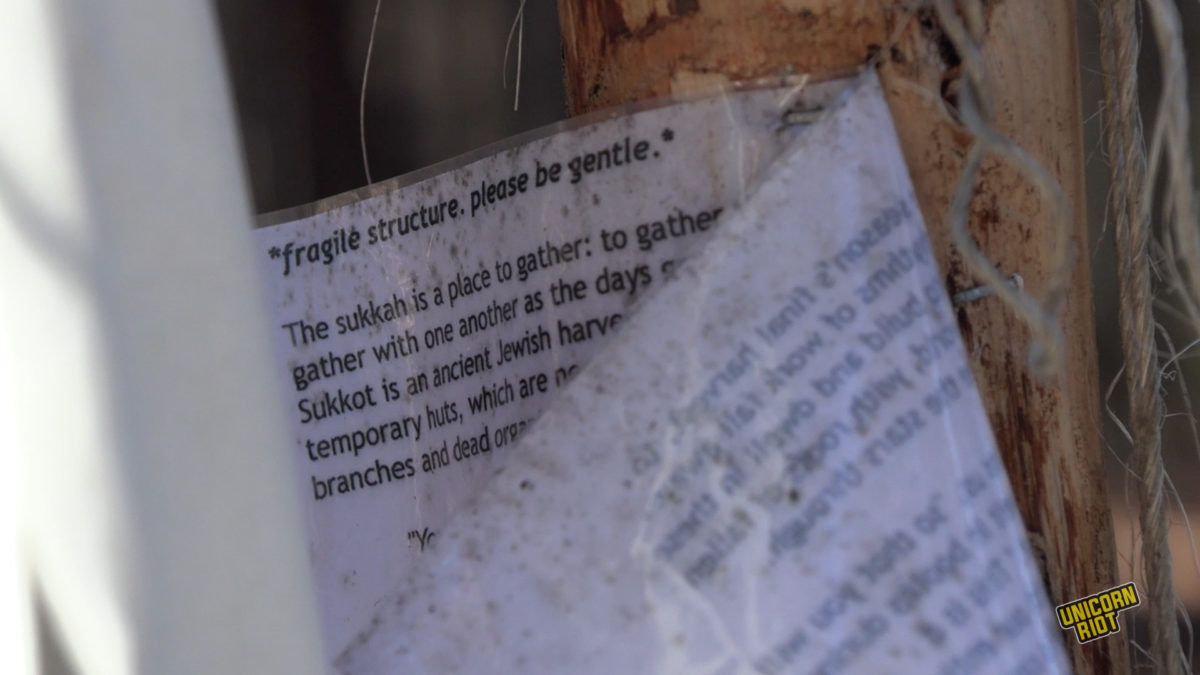
A sukkah (a traditional Jewish hut) at the encampment was destroyed during the raid. Credit: Sasha Tycko

Activists say police are escalating the level of violence and repression they are using against the movement as its success and popularity grows. Kautz, of the Atlanta Solidarity Fund, told reporters Wednesday:

“When the Stop Cop City movement began, police tried to use intimidation to dissuade activists. And when that didn’t work, they began making baseless arrests, which the Atlanta Solidarity Fund has documented and is providing legal support to defend people in those cases.”

Kautz continued: “When the baseless arrests failed to discourage people from speaking out about the problems that they saw with Cop City, we got to where we are now, with the police using open brutality to try to suppress them.”

“Are we going to end up in a situation where the police are murdering protesters in order to advance, not public safety, but their particular political agenda?”

Marlon Kautz

In June 2022, Atlanta Police officers were caught justifying the use of lethal force against protestors who used molotov cocktails to defend themselves and the forest in the midst of a police raid. (Although no forest defenders were charged during the raid for molotovs or incendiary devices.)

“I told you, deadly force encounter,” said one officer. “That’s why I brought it up, as long as we’re all on the same page, Molotov cocktail’s a deadly force encounter.”

A “deadly force encounter” is a situation in which officers are legally allowed to shoot to kill.

Despite the harsh repression, activists have pointed out that the project they are trying to stop holds the potential to unleash even more police violence on their communities.

“At least five people were arrested, two were forcibly removed from their treesits at gunpoint and many more were tortured with chemical weapons,” said Jasmine Burnett of Community Movement Builders, an Atlanta community organizing group at the Wednesday press conference. “This is just a fraction of what our communities will experience if Cop City is built.”

Although the Atlanta Police Foundation has tried to portray the expansion of their powers as an effort to protect poor and working class communities and communities of color, those opposing the project say the police will never work to combat the real issues they’re facing. 

“We recognize that cop city is not being constructed so that the police can learn tactics to go after the corporations that are polluting our neighborhoods,” said Burnett, “or practicing wage theft against low wage workers, or go against the developers that are exploiting our communities and literally forcing people out of their homes due to rising rents and property taxes.”

“No, they’re going to be learning urban warfare tactics to harass our communities, to surveil us, to prevent us from doing things like gathering here today and letting the public know what’s going on.”

Jasmine Burnett

Unicorn Riot's coverage on the movement to defend the Atlanta Forest:
  • [Mini Doc] Defending the Atlanta Forest: Behind the Movement to Stop Cop City (Oct. 9, 2022)
  • “Cop City” General Contractors’ Offices Attacked (May 19, 2022)
  • Police Raid Atlanta Forest Occupation (May 18, 2022)
  • Atlanta Fights to Save Its Forest (May 14, 2022)

  • Follow us on Twitter, Facebook, YouTube, Vimeo, Instagram, Mastodon and Patreon.

    Please consider a tax-deductible donation to help sustain our horizontally-organized, non-profit media organization:
    supportourworknew

    The post SWAT Teams Attack Atlanta Forest Encampments, Activists Charged with ‘Terrorism’ appeared first on UNICORN RIOT.


    by Unicorn Riot via UNICORN RIOT
    New video by Unicorn Riot on YouTube - go check it out ;-)


    Watch on YouTube here: European Diplomats Visit Masafer Yatta, Israeli Forces Continue Ethnic Cleansing of Palestinians
    Via Christian Gasper