Even though it’s not technically winter until Dec. 21, we are celebrating it early! For a limited time, you can stock up on Unicorn Riot gear at a discount during our Winter Merch Sale!
Unicorn Riot is audience-supported and with your merchandise purchase, a portion of the cost is directly donated to our organization to help us operate. From December 10 through December 16, our entire merch store is on sale! You can spread Unicorn Riot cheer with a fresh hoodie, longsleeve, or whatever your heart desires, while also helping to sustain our ad-free independent nonprofit media organization.
We just added two new designs to our store that showcase our logo in two different styles!
(A note: The website is only printed on the back for tees and tanks)
Also a note about the sizing for clothing: We’ve changed the labeling of “Men’s” to “Apparel” and “Women’s” to “More Apparel.” The clothing under Apparel will fit slightly larger than the items under More Apparel. Thank you and enjoy our new merch!
UR Logo V1 on black regular t-shirt
UR Logo V2 on white regular t-shirt
Grab yourself a travel mug for those snowy strolls or to show off your support of independent media at work!
Sweatshirts, hoodies, longsleeves and more! Get cozy with our merch!
Cuddle up under one of our blankets to enjoy a movie or to watch a Unicorn Riot stream or videos!
UR Woodland Creatures V1 (black ink) on sherpa blanket
UR Woodland Creatures V2 (green ink) on fleece blanket
The UR Woodland Creatures design was created exclusively for UR by Nicole DeBarber.
Mask-up with our original designs for indoor or outdoor winter festivities!
UR Logo V1 on ultra premium face mask (side view)
UR Logo V1 on ultra premium face mask (front view)
UR in Space on performance double layer neck gaiter
UR Woodland Creatures V1 (black ink) on performance double layer neck gaiter
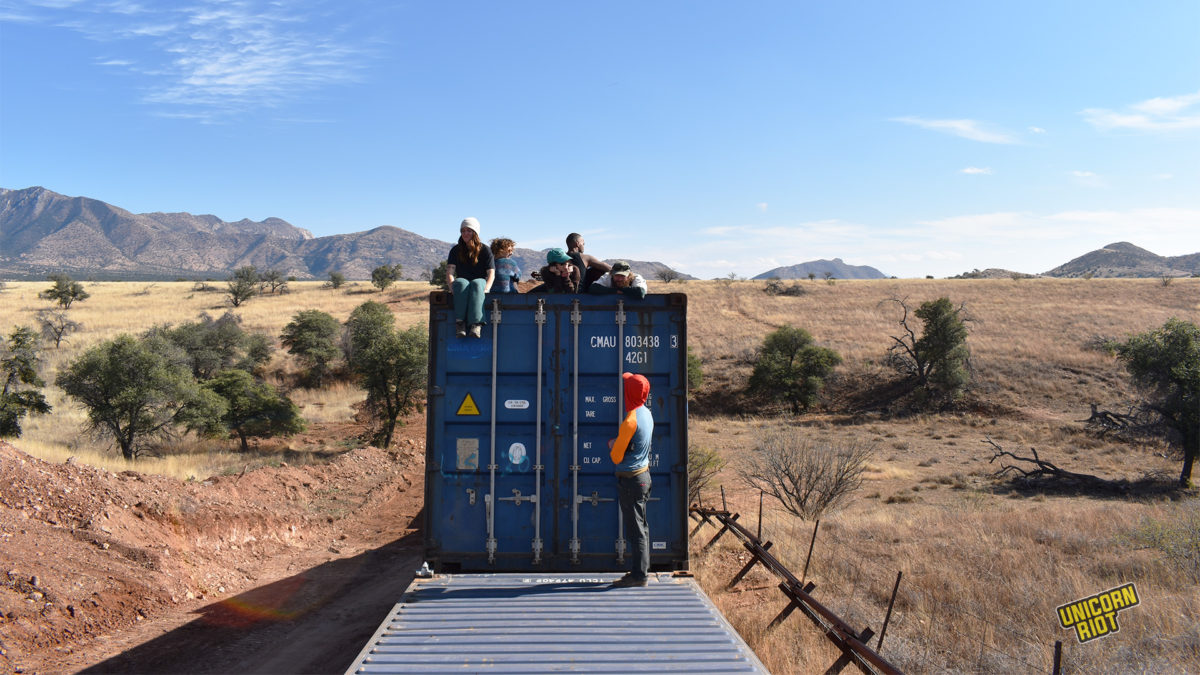
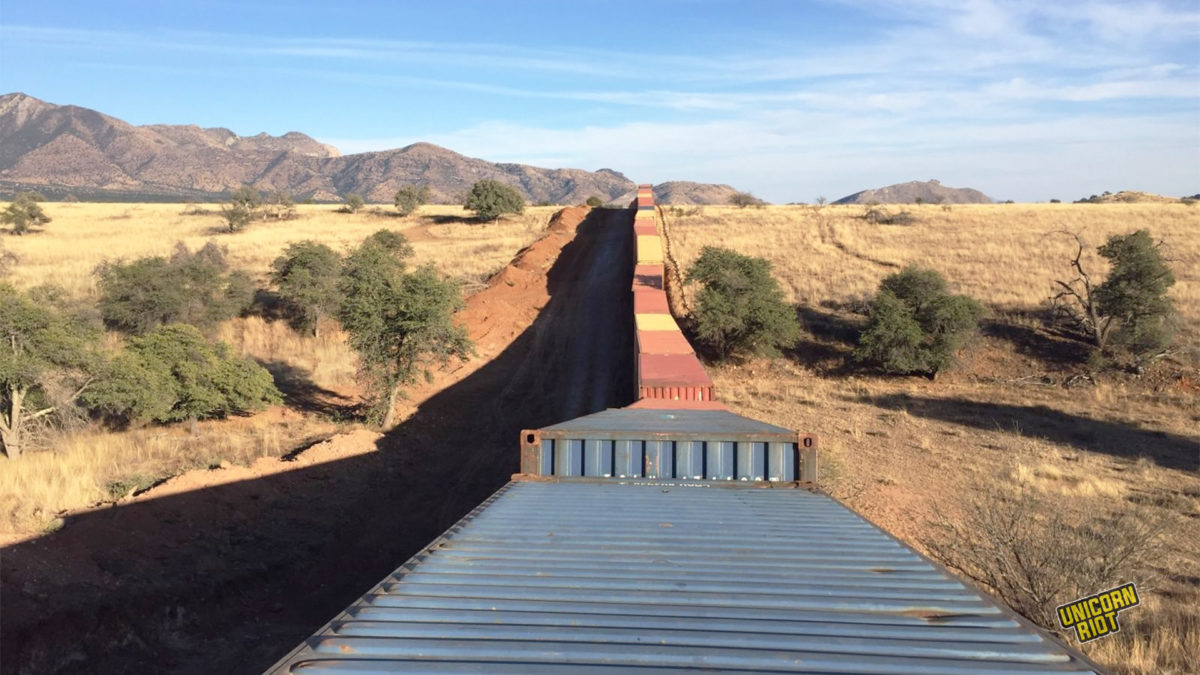
Cochise County, AZ – Seventeen feet above the ground, towering over the native Sonoran grasses and oak saplings of the surrounding bajadas, a group of young people stretched out languidly in the sun, chatting and laughing and playing guitar. In a line to their east, the double-stacked shipping containers beneath them stretched out for over a mile; to their west, the wild grassland lay undisturbed.
On Thursday, at the southern base of the Huachuca Mountains along the U.S./Mexico border, there was little sign of the fight that had unfolded in previous days. The quiet morning stood in contrast to the international geopolitical drama unfolding through this expanse of oak grassland stretching off into Mexico.
Locals say this area is usually quiet, with no evidence of the border crisis they hear about on the news.
In the distance, the crack of a quail hunter’s shotgun disappeared into the silence.
But cutting through the otherwise pristine terrain is a gash of splotched red, blue and yellow stretching patternless through the countryside—column after column of shipping containers stamped white with serial numbers and indecipherable codes, remnants of their nautical journeys.
“They could plant one here but, we’re here,” said Carlee, a blockade participant, as she perched on the edge of a shipping container in the empty space where the next container would lay. As she spoke, she watched long, white clouds drift over the far-off mountains of Mexico.
Blockaders perch atop a stack of shipping containers dumped in the desert by Arizona Governor Doug Ducey in violation of federal law. (Photo: Ryan Fatica).
Since Nov. 29, a loose collection of locals, environmental activists, hippies and migrant solidarity workers have been putting their bodies in the way of the machines. They have successfully delayed the work crews for a week and a half, who had been rushing to drop as many shipping containers into the wilderness as possible before Arizona Governor Doug Ducey leaves office in early January.
What began as a tentative experiment in disruption, escalated to a full-fledged encampment earlier this week. When workers switched to night shifts so they could work unimpeded, blockaders started camping on the site to keep watch.
“We would have two people on each machine trying to stop them,” said Carlee. “And they would just kind of maneuver around people and get really close. And they tried, but we stayed up all night, just making sure that they wouldn’t start moving and going down the hill to excavate more of those trees over there.”
Ary, another blockader, said that at first the workers refused to stop working despite the danger posed to those standing in their way. “At first, they were really driving their machines around us really fast,” explained Ary, as he lay among his friends atop the stacked containers. “Even just the other night, they were still doing that and digging the ground right from under our feet with their excavators, driving very close to people. I think that that just really shows how much money means to these people rather than human life.”
Thursday was the first day the workers didn’t come to the site at all. A private security guard working with the contractors remained on site, sitting in his truck and sometimes chatting casually with protestors to pass the time.
On Friday, workers reported to the site and asked that blockaders allow them to remove their heavy equipment. They loaded up the machines and drove off down the road. For now, at least, it appears the campaign has successfully shut down destruction at this site. Whether work will continue at another section of the border remains to be seen.
“This is what winning looks like,” a protester commented.
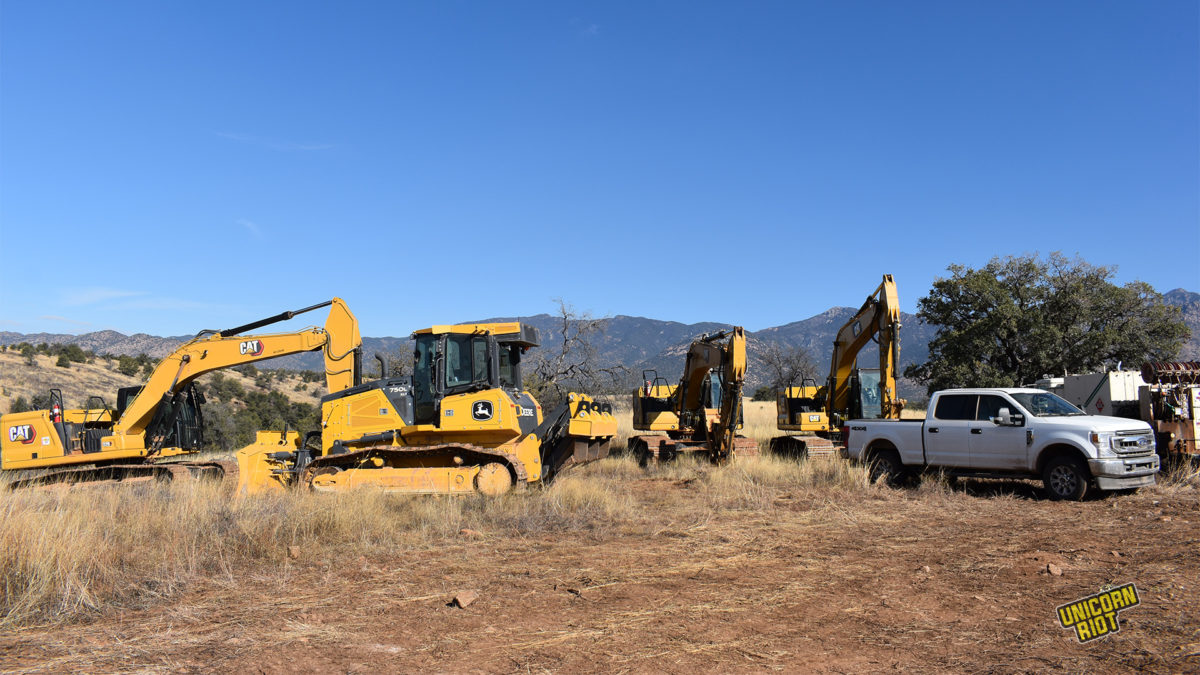
Construction equipment sat motionless Thursday as a blockade encampment prevented further destruction. (Photo: Ryan Fatica)
“It’ll get built if no one’s standing here,” said Logan, seated atop the double-stacked containers. “At the very least we’re able to sit here and stop as much of this from occurring while whatever forces above us decide what they’re going to do.”
In Jan., Governor Ducey will be replaced by incoming governor-elect Katie Hobbs, a Democrat who has said she will remove the shipping containers when she takes office. But for his last few months in power, since he started dumping miles of shipping containers along the border near Yuma, Arizona in August, Governor Ducey’s $95 million gubernatorial swan song has raged through the mountainous terrain in Southern Arizona, destroying miles of wilderness in its path.
“This is not really even a wall,” said Ary, referring to the stack of shipping containers beneath him. “I look at it like this monument to xenophobia. It’s like art. It’s like this really, really fucked up art piece that the Republicans are making here.”
The stack of containers, which stretches through southern Cochise County, was created by AshBritt, a disaster response contractor based in Southern Florida. The company has been working under contract with the State of Arizona since at least August when they started to build a 3,820-foot long strip of double-stacked shipping containers along the border in Yuma. On Oct. 23, the company signed an additional contract with the state to begin work in Cochise County.
AshBritt conducts operations across the country in the wake of natural disasters, from Hurricane Katrina in 2005 to Hurricane Sandy in New Jersey in 2012. In 2018, AshBritt came under fire from watchdog groups and the Federal Elections Commission for an illegal donation to a pro-Trump super PAC.
More than a mile of double-stacked shipping containers cut the oak grassland in two in southern Cochise County, Arizona. (Photo: Ryan Fatica).
Despite nearly two weeks of disruption by those seeking to block the makeshift wall, law enforcement has refused to intervene, in large part because it’s unclear what, if any, laws the blockaders are breaking. The destructive operation they are blocking is taking place on the Coronado National Forest, which falls under the jurisdiction of the federal government. The National Forest Service released a statement Nov. 30 warning visitors to the forest to stay away from the construction. According to the statement, the federal government views the construction project as “unlawful” and potentially dangerous.
Despite these proclamations, federal officials have refused to intervene—in the shipping container piling or its opposition. On Thursday afternoon, five law enforcement agents from the U.S. Department of Agriculture drove past the encampment. When approached by a camper, they identified themselves as federal agents, but said that as far as they could tell, the encampment was not in violation of any federal laws, which allow camping on national forest land.
With the feds apparently refusing to act and acres of precious wilderness at stake, people are choosing to act directly rather than waiting for those in power to sort out their tangled web of jurisdictional disputes and political power games.
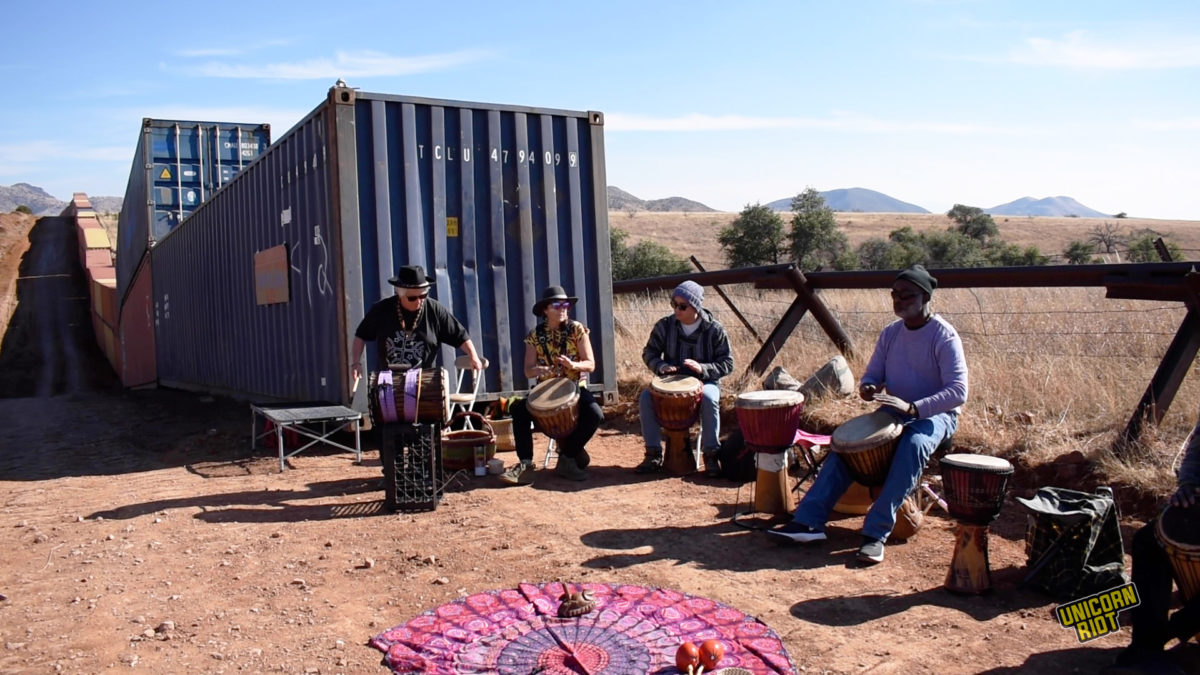
Drummers block the path of border wall construction Thursday with workers no where in sight. (Photo: Ryan Fatica).
“This is exciting to me because it’s one of the times that we are seeing direct action make a tangible difference in real time,” said Egg, who came down from Tucson to participate in the encampment.
The blockaders expressed a variety of reasons why they were motivated to act: concern about wildlife corridors for jaguars and other creatures, destruction of precious wilderness, government overreach, the perception that the project is motivated by racism and xenophobia, and solidarity with migrants.
“Endangered species come through here, people come through here,” said Logan, a blockader, referencing the riparian corridor of oak and juniper stretching north to south down from Miller’s Peak. “All life has moved, has migrated, historically. That’s just part of the way the world works. I think cutting it off doesn’t make any sense. It’s very disruptive to communities, both human and non-human. It’s important to keep open the free flow of life.”
“This border right here is a deep laceration of separation,” said Ary. “It is a line that makes an ‘other.’”
Scott County, MN – “Whenever Lee shows up, I feel so much safer,” says Toshira Garraway, fiancé of Justin Teigen who she claims was found beaten to death, covered in dog bites, and his body thrown in the dumpster after an encounter with Saint Paul Police in 2009. Garraway is the founder of Families Supporting Families Against Police Violence, which closely works alongside those most impacted by police murders. As the momentum around reopening cases involving police violence and the pressure to charge police with murder intensifies, so does the need for protection.
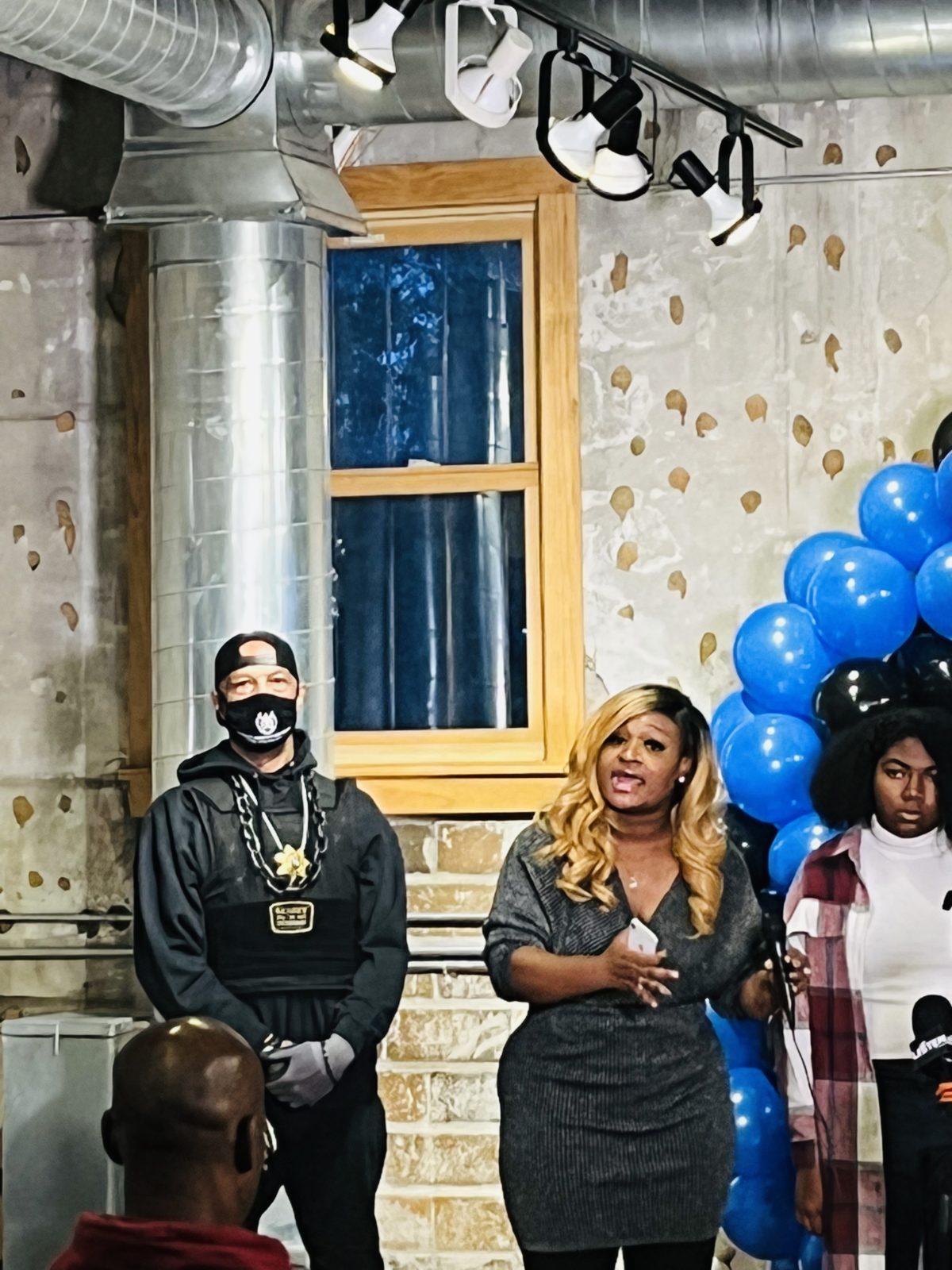
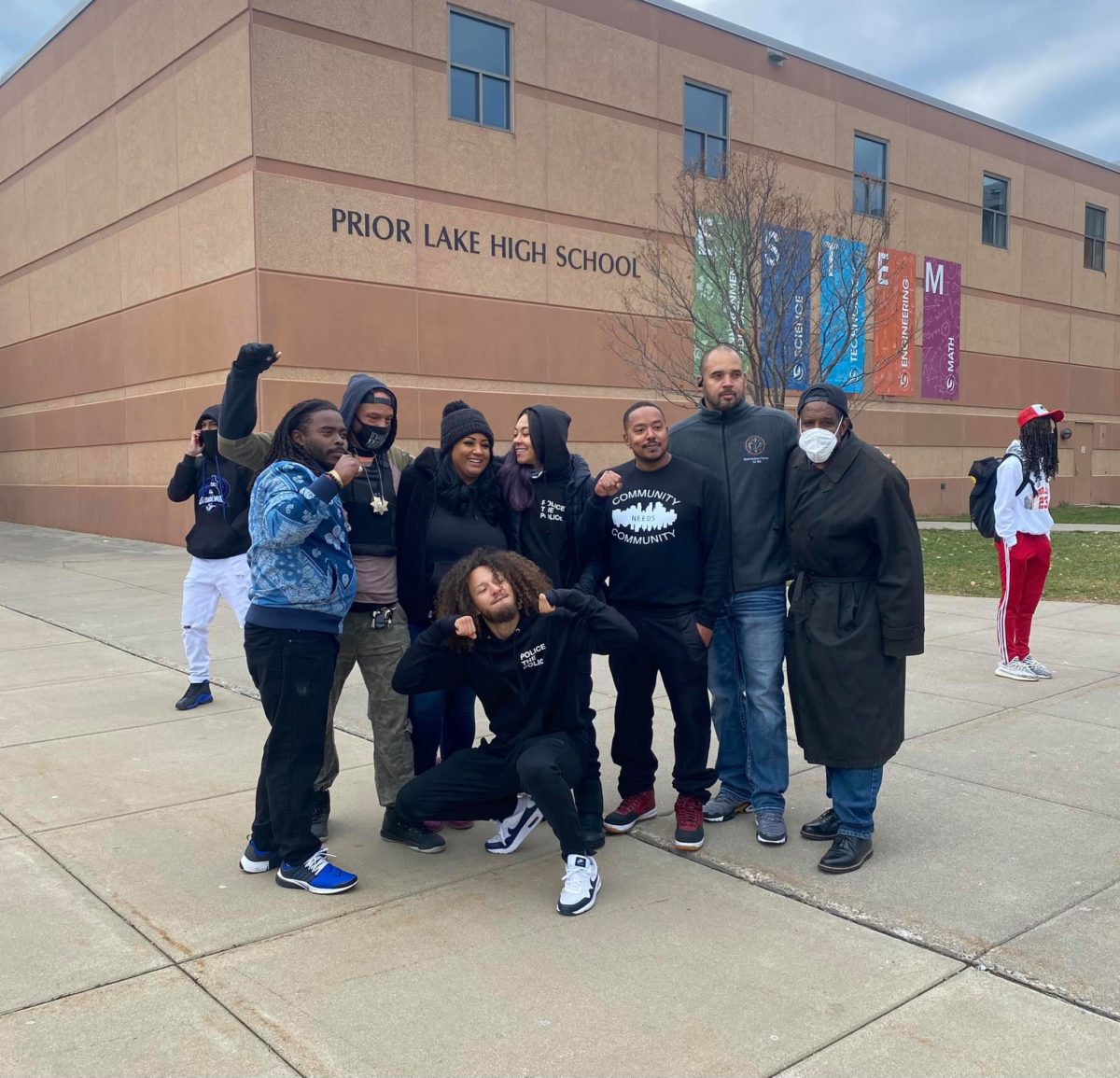
Coleman seen left, Garraway second from right
“Lee picks up every time I need armed protection because we’re out here getting death threats. Over the years, he has shown up to hundreds of events protecting Impacted Families,” said Garraway.
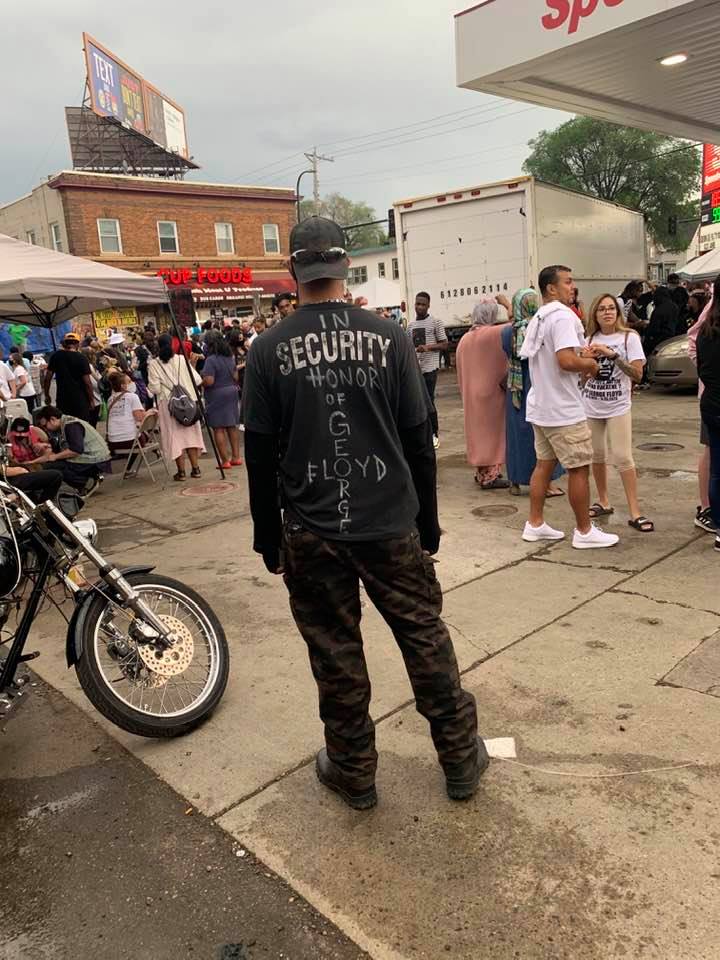
Since the police killing of George Perry Floyd and the uprising and movement that followed, armed security for protesters seeking police accountability has been more of a need. Lee Coleman, standing tall with a mask and chain with a badge on it, has been widely seen in the movement space since then. The local community sees him as a constant force providing safety.
Coleman contracts with several police accountability movement organizers in the city and is currently defending himself against the Savage Police Department in Scott County, Minnesota. He was charged with a gross misdemeanor for carrying a firearm on school property, a charge that doesn’t normally apply to federally licensed private security officers when contracted to work. If found guilty, Coleman would face up to three years in jail, a fine of $10,000, and he would lose his ability to carry, forcing him out of his 30-year career in protective services.
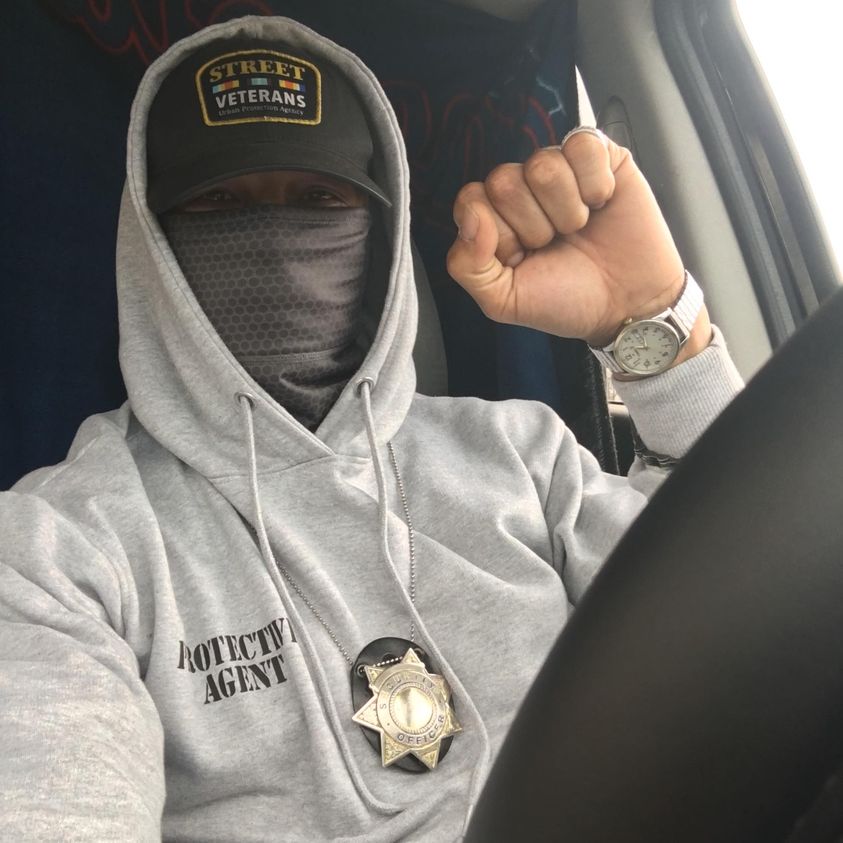
As a Certified Private Protection Officer, Coleman operates through Street Veterans Urban Protection Agency, an organization he co-founded with Ricky Wafford during the uprising in response to the murder of George Floyd. Coleman has dedicated decades to protecting his community and standing up to the systems, with the last two years focused primarily on protecting activists and organizers. In particular, he’s had a focus on impacted families of police violence and other leaders in organizations fighting for system change like Visual Black Justice and Black Lives Matter Minnesota.
Coleman told Unicorn Riot he’s even protected “Shaq, Kevin Garnett, Randy Moss, Woody Harrelson, Steve Guttenberg, plus folks at the US Bank Stadium, [and] the Delta 360 Lounge.”
Coleman wearing a hat with the Street Veterans Urban Protection Agency logo
“When George Floyd was murdered, I was out on the streets almost every day for two years, protecting that space with my bare hands and my chest, without even getting paid most of the time, and I’ll keep doing it because that’s just what I do. And when the city was on fire, I was out there with my AR-15 risking my life against white supremacists and others who wanted to commit acts of violence against our community.”
Lee Coleman, Street Veterans Urban Protection Agency Security
Coleman doing security at George Floyd Square
And November 11, 2021—the day Coleman’s firearm was seized—was no different.
That day, there was an emergency protest at Prior Lake High School in Savage following a viral video targeting Nya Sigin, a 14-year-old student who was called the N-word six times, as well as other racist epithets, and told to kill herself. The 58-second video showed one white girl laughing with another voice in the background, both repeating things like, “No one likes [N-word]… you can fucking rot in hell…no one likes [N-word]… fucking kill yourself right this time.” The video continued on to describe various forms of suicide.
When Garraway found out about the press conference in Prior Lake, where hundreds of people gathered to speak and chant “Nya is beautiful,” she decided to call Coleman for added protection. “This is obviously a school with a lot of white supremacy and I wanted everyone to feel safe, especially the students, and Lee makes us all feel safer,” Garraway said. “He’s my right hand and I like providing extra public safety when we gather.”
Coleman told Unicorn Riot that he was unaware he was going to a school when Garraway called him. When he arrived at the address given and saw he was on school grounds, he knew not to enter the building armed. As long as he was protecting his community outside of school hours when classes were not in session, he felt confident that he could legally do his job.
Upon arriving at the organized action, Coleman let both Garraway and the founder of Visual Black Justice, Athena Papagiannopoulos, know he had arrived. This timeline Coleman told us is consistent with his contract with both community leaders. The school building was locked and secured in preparation for the action. Students, community members, and several Savage police were already outside when Coleman arrived.
After checking in, Coleman was asked by Michael Smith, an activist and organizer with Black Lives Matter, to check out a group huddled by the entry of the school.
The group of nearly a dozen youth and adults were getting ready to engage in property destruction by the pillars in the front of the school when Coleman disrupted. He recalled saying things like, “There are better ways to make an impact,”“You are better than that” and “We aren’t here for that.” Once the situation was de-escalated, he escorted them back to the press conference and into the parking lot with the rest of the crowd.
As Coleman was walking back toward the crowd, he was approached by at least five officers, including some coming from behind him, with the sergeant in the front. Coleman said they told him that he needed to move toward the sergeant’s car, which he did.
“They brought me over to their squad car, telling me they had to take my gun and I said show me the statue because I know my 9-mm SIG Sauer is not subject to forfeiture. One cop said, ‘All right, I’ll pull it up.’ And they left, and then when they came back they asked, ‘Are you gonna give me the gun or not?’ And I said, ‘Show me the statute that allows you to take it,’ and they refused to provide it.”
Lee Coleman
“At first the police seemed okay that Lee was there,” said Jae Yates, organizer with Twin Cities Coalition for Justice 4 Jamar and Civilian Police Accountability Commission for Community Control of the Police. “Lee’s at many actions with us and he had been there for an hour, visibly armed with his handgun and they didn’t seem concerned because Lee was de-escalating situations. Then it’s like it hit them that Lee was a black man with a gun defending families against racial violence.”
Coleman shared with Unicorn Riot that most police in the Twin Cities know who he is, and they know he’s “not trying to be a cop.”
“I’m there to help. I stopped two fires in Uptown when Winston Smith was killed and made sure white supremacists saw my presence as the community gathered with his brother Kidale; I was in Brooklyn Center standing with Katie, Daunte’s mom, and I kept people safe night after night. I’ve been out there with every major action, including the nights with the MN National Guard and the State Troopers. I was in the Square almost every night for over a year.
Lee Coleman
Several news media sources, including King Demetrius, known to the community as Black CNN, and Louie Tran, caught footage of the incident. In it, Coleman is threatened to be arrested if he didn’t surrender his gun and permit to carry immediately.
When Coleman asked for the statute violation paper showing that he wasn’t doing anything illegal, he was told that he would be charged onsite if he requested the statute from any other officer. Confused about why that would be the case, Coleman asked to speak to a supervisor. When they said no one was higher than them, Coleman said he was planning to call Savage Police Chief Rodney Seurer. The officers surrounding him threatened to arrest him if he did that.
“They denied so many of my rights and lied several times, including understanding my job responsibilities and my right to not have my weapon seized.”
Lee Coleman
Coleman explained to Unicorn Riot that his registered firearm cannot be seized as per MN statute 152.01 section 609.531: “A firearm carried in violation of this paragraph is not subject to forfeiture.” Federally licensed to conceal and carry, Coleman’s card allows him to carry professionally. It allows him to purchase just about any weapon.
He explained: “If you’re just a regular person, it’s a felony to have a gun on school property, but it’s legal because I’m protecting someone by work contract, and if an establishment or a school has a code that you can’t be armed, then you’d be told and have a chance to take the weapon off the grounds, which I offered to do and they denied me that right to.”
When Coleman told police that he would put his firearm in the car, they denied his request and demanded to confiscate it.
“I know my rights and I didn’t want to give in, but then I heard Mel Reeves in my heart and he said, ‘You gotta keep going, no one is doing what you are’. Mel said, ‘you gotta comply, or they will hurt you.'”
Lee Coleman
King Demetrius can be heard from the live stream saying, “Wow you’re really going to do all this on Veteran’s Day.” Lee Coleman comes from a military family. He was raised by his uncles, one of whom was an Army Ranger and the other was with NASA.
“I’ve been wearing fatigues since I was seven. My grandma made them. They taught me everything I know and I always knew that protecting people was going to be what I did for a living.”
Lee Coleman
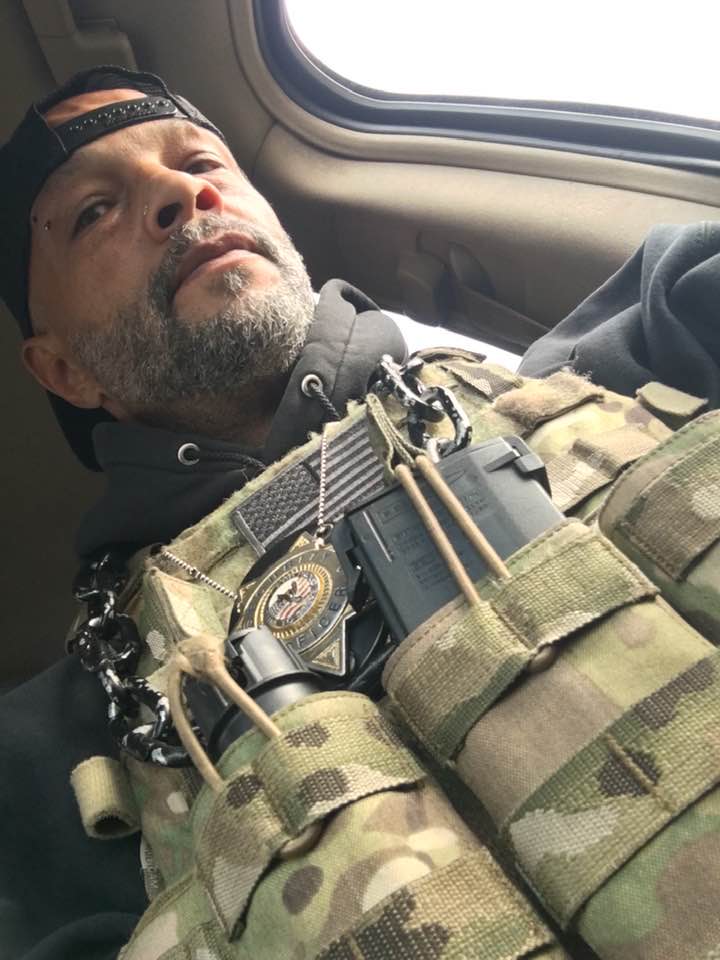
Coleman wearing a tactical vest
Coleman was given a property receipt of his firearm, but when he tried to get his property back, including his federal permit to carry so he could continue working, he was told that he couldn’t due to a charge of a misdemeanor and $1,000 fine, which has now been elevated to a gross misdemeanor and a $10,000 fine.
“Someone in my position at the school might be asked to put their gun in the car,” said Coleman. “At worst they would get a fine, but they wouldn’t be facing three years in jail.”
Coleman still has his legal right to carry, but is nervous about working in the same capacity. “This has messed with my whole self esteem,” he shared. “I’m just trying to do the right thing and do something that not everyone will do. Not everyone will jump in front of a bullet or use your body to get in harm’s way. This is what I do, this is my career, this is my job and this is what I’ve been doing for 30 years—protecting people,” he said.
The active seizure of his federal permit has affected Coleman’s work. He’s currently raising money for his legal defense and to help continue his work protecting impacted families of police violence.
“We know this is a case of retaliation,” said Toshira Garraway. “I was on the phone with Lee when he called the chief of police and Lee said he wanted to file a formal complaint for the treatment of him. It’s on camera. They threatened to run him over when he was asking questions and they confiscated his ability to work. And because Lee wanted to file a grievance against those officers, he now faces three years in prison.”
“Of course they are trying to disarm the movement and undermine our sense of safety,” said Jae Yates, “which is why we are fighting for the Civilian Police Accountability Commission (CPAC). It would allow us the ability to file grievances against any officer. Those grievances would then be investigated in transparency with the community with the democratically-elected commission. Under a CPAC system, Lee would be able to file a grievance without retaliation and the officer who threatened to run him over would have real consequences,” Yates explained.
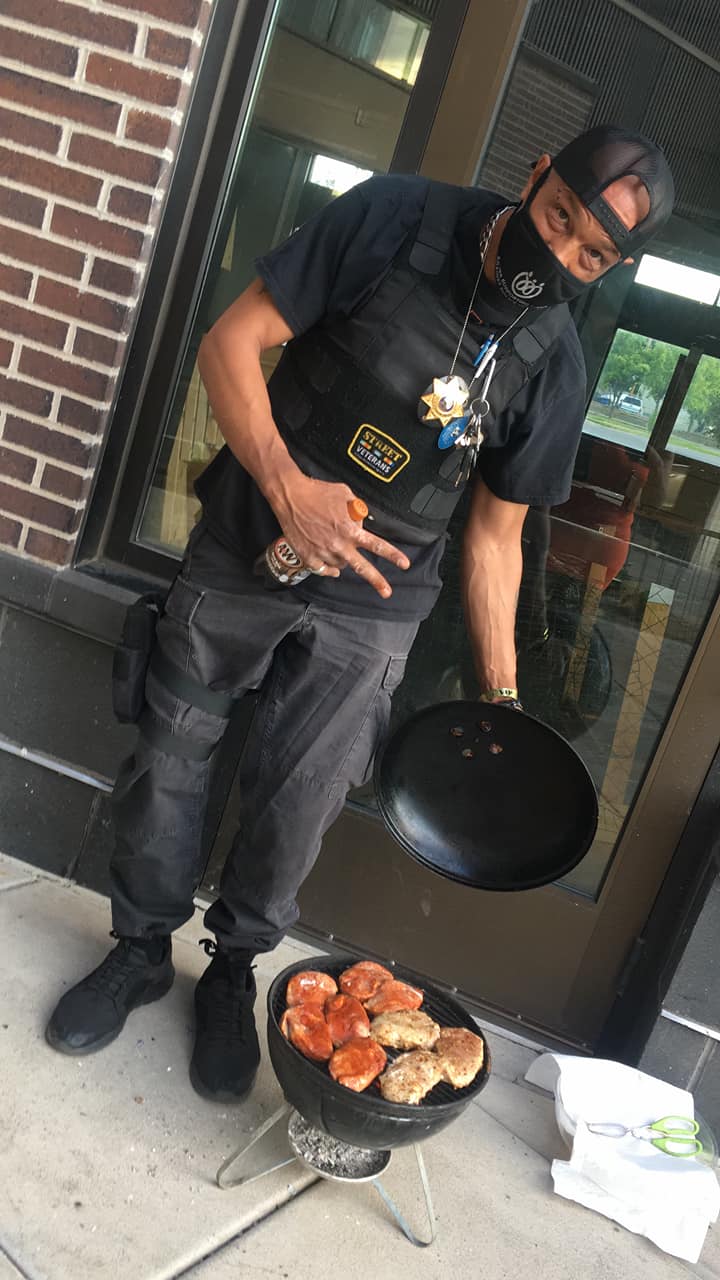
Coleman cooking for the community at GFS
The community is still asking for the release of the police body camera and squad car footage, especially from the sergeant when he threatened to run Coleman over.
The pre-trial date is scheduled for Dec. 12 at 1:00 p.m. at the Scott County Courthouse located at 200 4th Ave W, Shakopee, MN 55379. Lee Coleman is asking the community to show up.
Durban, South Africa – On Tuesday, Nov. 22, three of South Africa’s largest trade union federations in the Federation of Unions of South Africa (FEDUSA), the Congress of South African Trade Unions (COSATU) and the South African Federation of Trade Unions (SAFTU) initiated a one-day strike demanding a 10% wage increase from government. The strike came in response to the government’s recent announcement that it would only be offering 3% wage increase for its public sector workers. The union alliance representing a combined 800,000 public servants delivered their demands to the government giving them seven days to respond before escalating to further unspecified protest action. The Western Cape was the only province in South Africa that didn’t see protests related to the strike due to an unrelated taxi workers’ strike occurring at the same time which effectively shut down public transportation in the area.
Activists and organizers with the union movement argue that wage increases are necessary due to economic inflation and the rising cost of living. These economic pressures, initially caused by the COVID-19 pandemic, have only accelerated as a result of the ongoing Russian-Ukrainian war which has sent severe economic shock waves across the world. As such, the South African government is under steadily increasing pressure to cut spending – the reason for the Western Cape taxi strike is due to the collapse of the popular “blue dot program” which aimed to formalize and modernize the province’s outdated public transportation system.
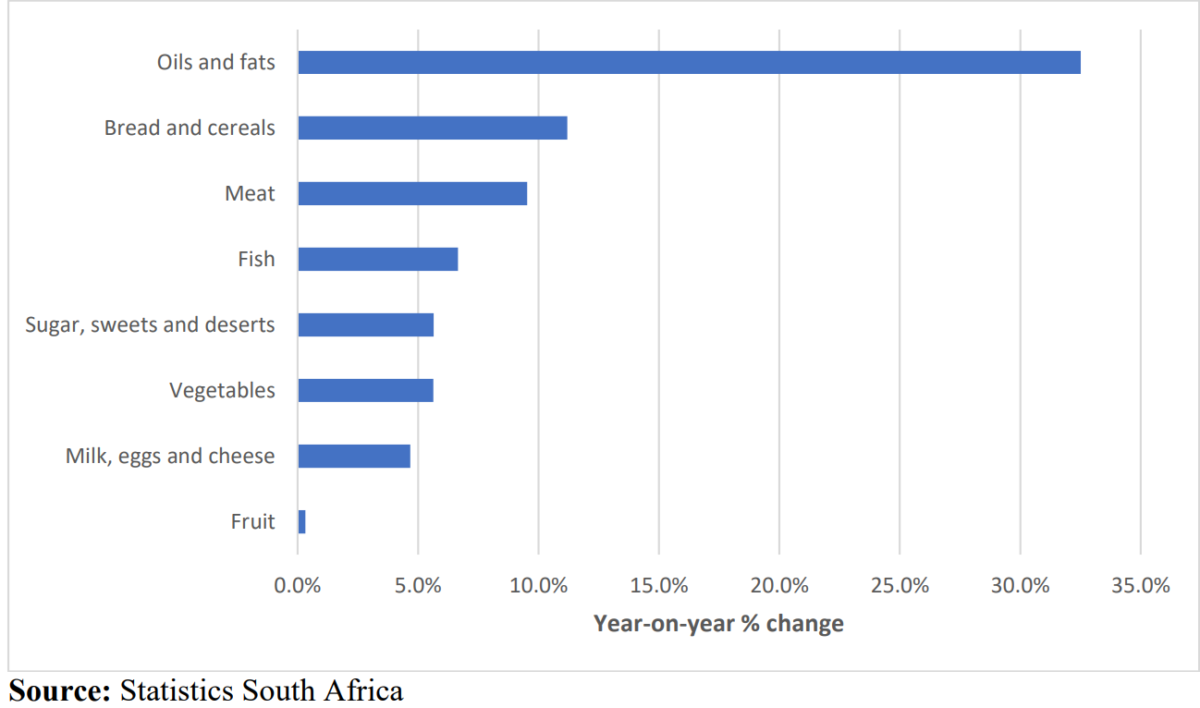
The country’s increasing struggles with keeping the lights on in the ongoing South African Energy Crisis is also having a significant impact on food prices, as agricultural businesses have passed the cost of having to constantly run backup generators on to the consumer. These generators generally run on diesel fuel, another essential resource which has been subject to enormous price hikes. As a result the government estimates that around half of South Africa’s total population is experiencing some form of food insecurity.
Graph showing inflation of specific food categories (Source: USDA)
Despite these disturbing statistics and increased union pressure, the government allowed the union’s seven-day deadline to pass without adjusting its offer. In response, union leaders met on Nov. 29 to discuss escalation plans, though to date, no further plans have been announced by COSATU, SAFTU or FEDUSA. This could be due to intensifying internal divisions within the union alliance, in particular, SAFTU.
Divisions In SAFTU
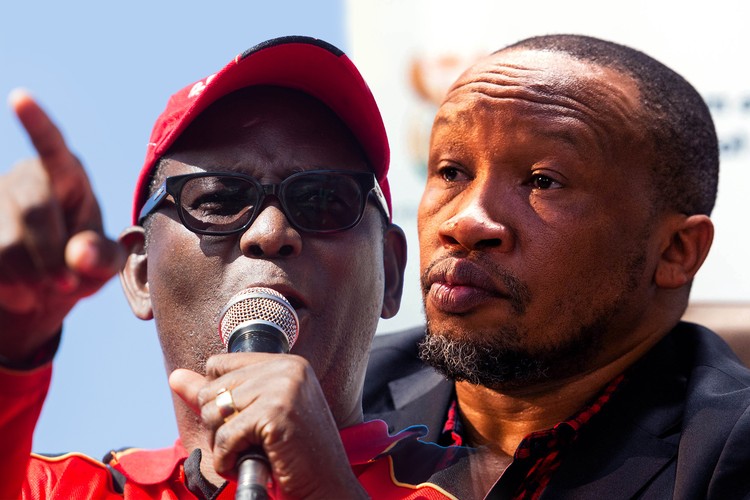
On Dec. 1, 2022 the South African Policing Union (SAPU) announced that it was leaving SAFTU for unclear reasons. A SAPU spokesperson went on to cite SAFTU’s increasing involvement in party politics as a prime reason for its decision to disassociate from the federation. Representing some 84,000 members, SAPU was one of the largest single unions in SAFTU. Its departure represented a tremendous blow to the federation. Some analysts believe that the police union’s sudden departure from the federation may be related to an ongoing internal dispute between SAFTU union leaders Zwelinzima Vavi and Irvin Jim.
Zwelinzima Vavi (left) and Irvin Jim (right) are two of South Africa’s most influential union leaders. The former allies now find themselves in the center of political battle that threatens to split SAFTU in two (Source: GroundUp Media)
Vavi formerly served as the secretary-general of the nation’s largest union federation, COSATU. He was later expelled from the senior position after publicly criticizing COSATU’s decision to expel the National Union of Metalworkers of South Africa (NUMSA) in 2014. He would later go on to join NUMSA in co-founding the country’s second largest union federation, SAFTU. He currently sits as the general-secretary for SAFTU, one of the most important leadership positions in the federation.
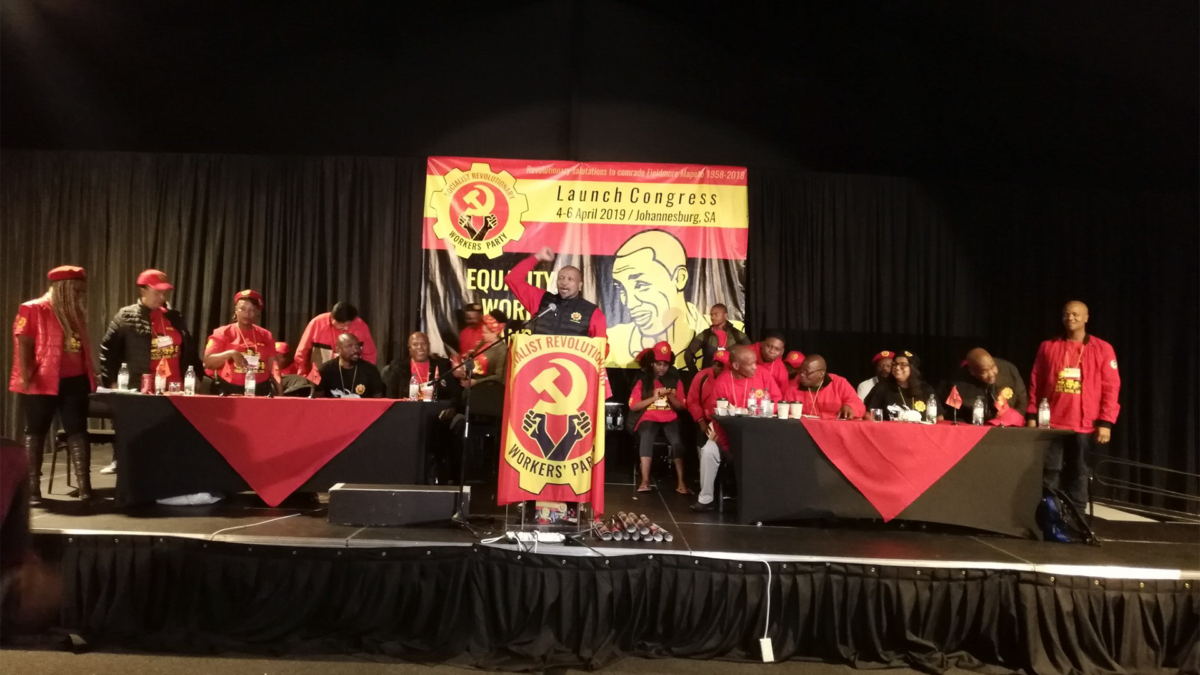
Irvin Jim is also a former member of COSATU and currently serves as the general-secretary for NUMSA, the largest single union in SAFTU. Jim also previously held posts within the South African Communist Party (SACP) and the ruling-party African National Congress (ANC), firmly cementing his position within the country’s political elite. The split between Jim and Vavi appears to originate from Jim pushing for SAFTU to get more involved in South African politics. In particular, Jim’s faction wants SAFTU to officially endorse NUMSA’s vanguard political party, the Socialist Revolutionary Workers Party (SRWP) a NUMSA front which seeks to challenge the ANC in national elections.
Launched in 2018 the SRWP contested the historic 2019 South African general election, but only earned 0.14% of the total vote failing to win a single parliamentary seat (Source: Lungisani Hlelezi @PeaceMa56101533)
This push, however, was firmly shut down by Vavi and his supporters who reiterate that SAFTU remains independent of any and all political parties. Jim and NUMSA responded by suspending Vavi in an attempt to push him and his allies out of SAFTU. This attempt failed as Vavi was soon reinstated and would go on to be re-elected as SAFTU’s general-secretary at the federation’s hotly contested 2nd national congress. Ultimately the union elections resulted in a 50-50 split between the two factions for control of SAFTU’s leadership positions, further exposing the internal divisions within SAFTU.
The Current Situation
Despite the bitter and complicated political battles within South Africa’s union movement, opposing sides will momentarily put their differences aside to fight a common enemy, hence the most recent joint one-day strike. However, this is not the first time such collaboration between these rivals has occurred. Two years ago, Unicorn Riot covered a previous one-day strike organized by SAFTU which had, at very least, the verbal support of COSATU and FEDUSA among others.
Since that 2020 strike, numerous other one-day strikes have been organized by these unions, each one failing to achieve its core stated goals. This, of course would change if the unions were to actually engage in a full blown indefinite strike, which would see all union workers withdraw their labor indefinitely until the unions’ demands are met. But despite repeated threats to do so, union leadership continues to hold back perhaps because of its own internal divisions, as well as the undeniably massive economic effects a such a strike would have not only on the economy but on the unions themselves.
For the time being, SAFTU has now switched focus to calling on embattled President Cyril Ramaphosa to resign over the ongoing “Phala Phala scandal.” The scandal came about after it was revealed that a robbery of the president’s game farm in Namibia took place on Feb. 9, 2020 where an alleged four million dollars (60 million rand) in cash was stolen from the premises. The suspects were eventually tracked down, interrogated and allegedly received separate payments to keep quiet about the affair. This was because the stolen foreign currency had not been formerly declared with the reserve bank, which is required for such a large amounts of money according to South African regulations. Ramaphosa acknowledges that the robbery did take place but counters that only $580,000 was stolen, and claims he kept it quiet because he didn’t want to the public to “panic.” The incident was only made public after the former head of the State Security Agency and Jacob Zuma ally, Arthur Fraser, filed a criminal complaint against Ramaphosa on June 1, 2022.
Although COSATU has stopped short on calling for Ramaphosa’s resignation, it has officially withdrawn it’s endorsement for him, an ironic twist of fate considering the billionaire President was once a leader in the union movement – Ramaphosa served as former secretary for the National Union of Mineworkers (NUM) and played a major role in the founding of COSATU itself.
By dumping Ramaphosa, it’s likely that COSATU and SAFTU believe this will usher in a new president who will be more receptive to the unions’ demands. Now that Ramaphosa has been reassured of his continued support from top ANC leadership, the chance of him being removed from office seems little to none.
Regardless of who the president is, the current strategy of initiating one-day strikes in hopes of negotiating better deals behind the scenes have not borne much fruit. Unless an increased direct action campaign occurs, the status quo is unlikely to change anytime soon. As the price of critical necessities rise to all time highs, it may only be only a matter of time before rank and file workers begin to escalate and take action on their own.
Minneapolis, MN – Activists are gathering at the office of Senator Amy Klobuchar (D-MN) calling on the Senate Judiciary Committee to sign a bill legalizing the status of over three million immigrants.
Pro-immigration activists are pushing for permanent legalization for around 2.7 million immigrants in the U.S. who are part of the American Dream and Promise Act (dreamers) and ~900,000 immigrants with temporary protected status (TPS). Unicorn Riot is live streaming the action:
Unicorn Riot's Coverage of the Sanctuary Movement and Immigration:
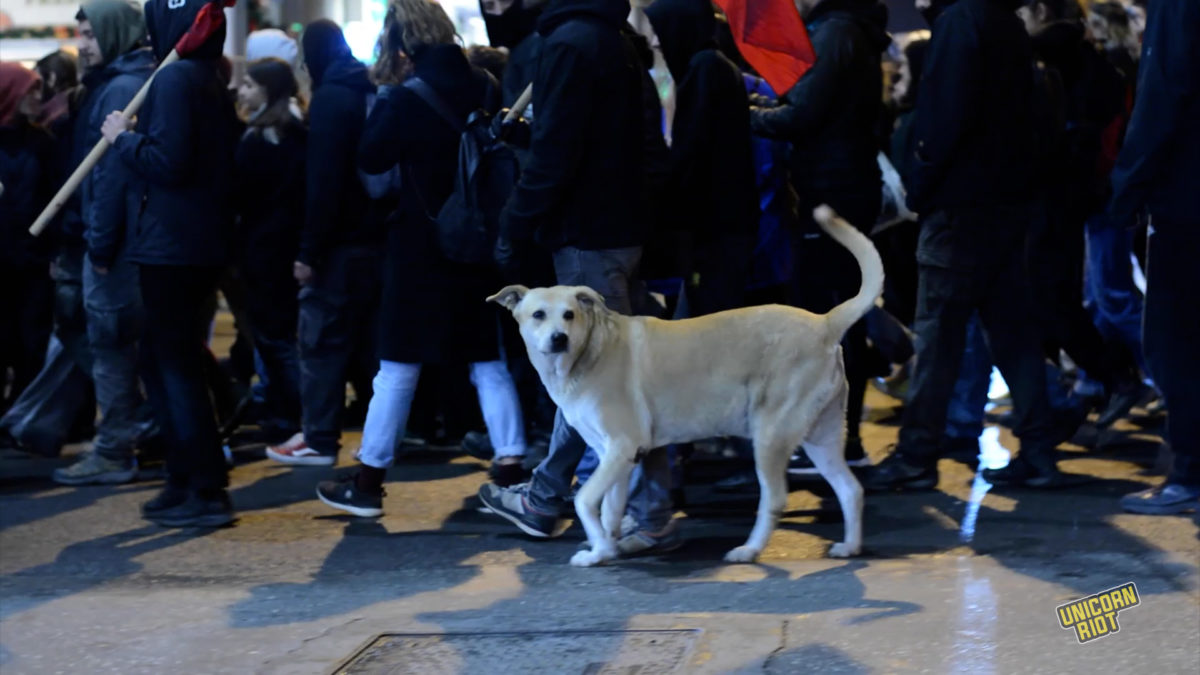
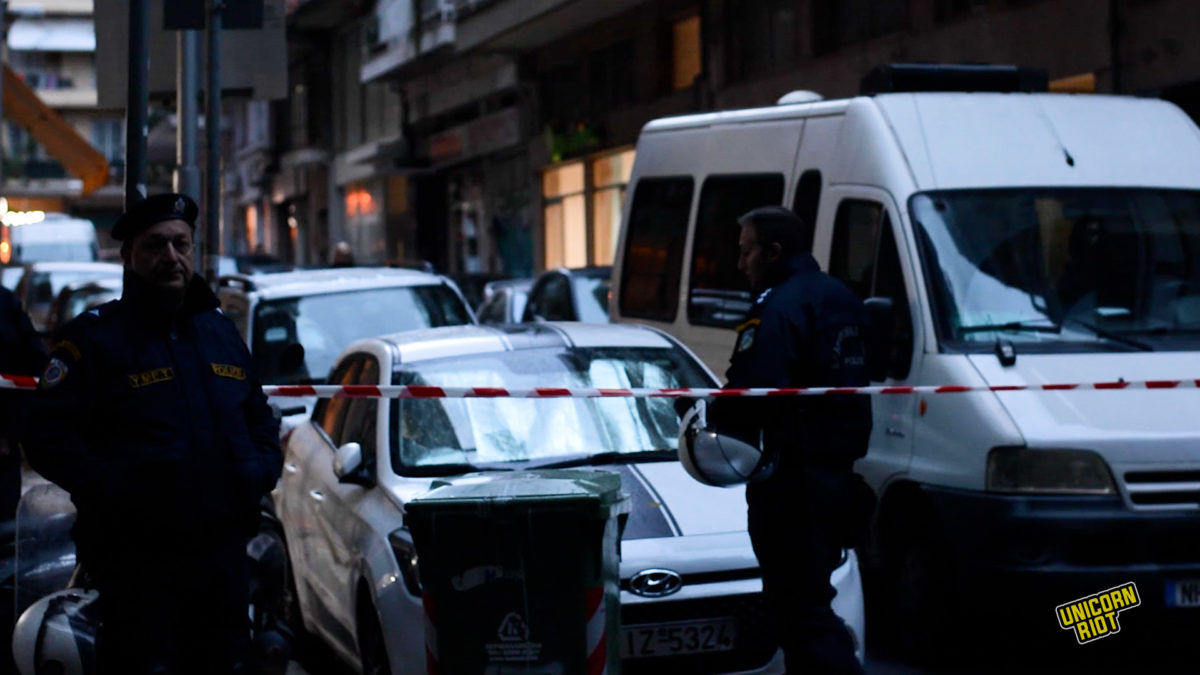
Thessaloniki, Greece – Greek police raided and evicted the Mundo Nuevo squat in Thessaloniki on Nov. 28. The squat began in November 2015 and held various political and cultural events over the last seven years in Greece’s second largest city. This is the fourth squat evacuated in Thessaloniki since the New Democracy government came to power and is among dozens of squats evicted throughout the country.
With the Greek government’s public image in question as it has been lately they’ve turned to attacking autonomous movements and their squats. Squats in Greece are typically abandoned buildings or structures reclaimed by anti-authoritarians and made into living spaces for refugees, meeting spaces, theaters, art and event spaces, etc. for the public.
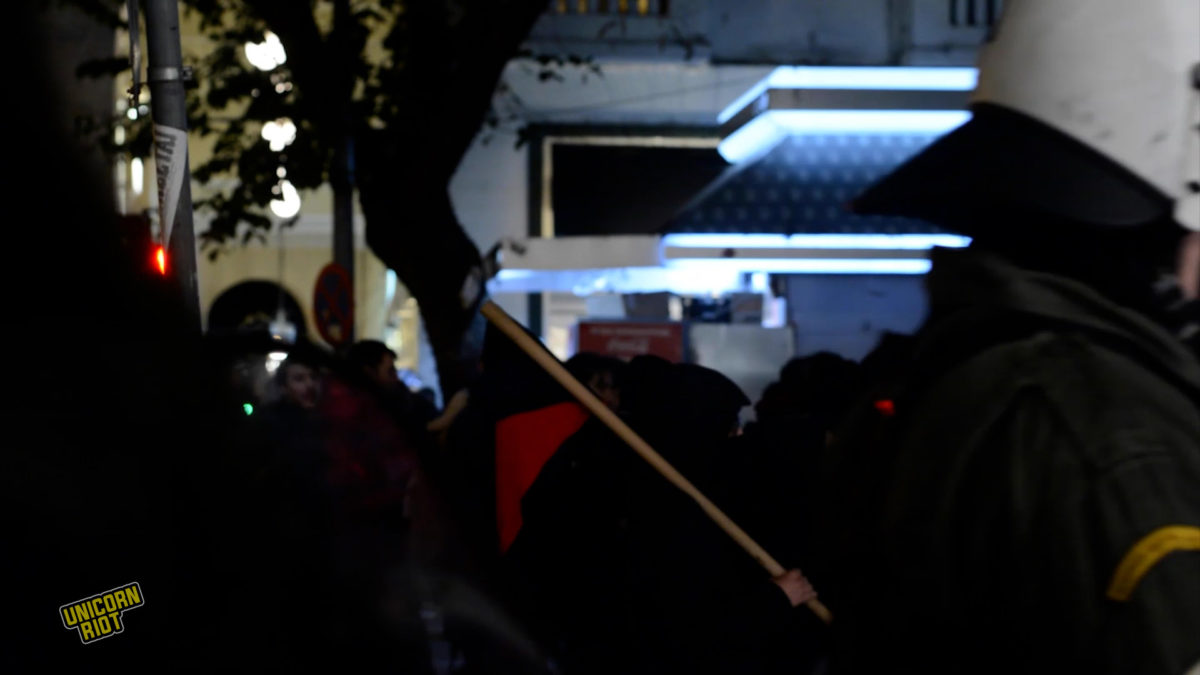
Unicorn Riot filmed some of the Mundo Nuevo eviction and the community response which featured hundreds marching through Thessaloniki in response.
New Democracy has ruled Greece since July 2019, when Kyriakos Mitsotakis was elected with a neoliberal program. The party quickly transformed into a pure far-right government. The Greek government failed to put much effort into protecting citizens during the pandemic. Instead, its solution to existing problems was adding more police units and committing more police brutality. Lately, the Greek government has been dealing with a spy scandal, which has been noticed globally.
Spy Scandal? – Time for a New Battle
It’s well known through the country that the main reason that the Greek government is focusing on the “squat issue‘‘ again is because of recent negative impacts on its public image. While we are approaching the elections – probably during spring 2023 – Prime Minister Mitsotakis is dealing with an ongoing spy scandal.
According to Greek media, the Prime Minister, along with his nephew and secretary, Grigoris Dimitriadis, purchased “Predator,” spying malware by Intellexa, and began spying on politicians, ministers, and journalists.
The scandal is leaving a stain on the image of the Prime Minister and corporate Greek media is tackling this by sharing new accomplishments of the government. This time the Greek government is once-again asserting the doctrine of “law and order,” trying to persuade its far-right audience that, aside from spying on its ministers, the government is attacking anarchists by evicting their squats.
Three Years After a Failed Ultimatum
Not long after taking power, the New Democracy government evicted several squats that were providing housing and safety for migrants and refugees. Over 500 refugees were evicted from their sanctuaries and placed into closed camps and detention centers from the summer of 2019 until the fall.
On Nov. 20, 2019, Michalis Chrysochoidis, the former minister of Civil Protection, delivered an ultimatum to every squat in Greece. In his press release he stated:
“We call everyone that has illegally squatted public or private buildings to evacuate them. […] If the buildings are private property, in order to stay you need to come to a rent agreement with the owners.‘‘
An ultimatum of 15 days, until the fifth of Dec. 2019, accompanied the end of the announcement. However, the ultimatum was not the end of the battle, but just the beginning of one.
In general, recent Greek governments – both of the leftist SYRIZA and the rightist New Democracy – have shown extreme zest for squat evictions.
A week before the Mundo Nuevo eviction, the Greek government evicted Prosfygika, a big house-squat that served as a safe living space for refugees in Athens. During the eviction of Prosfygika, police made 80 arrests. Οne of them was a Greek journalist, Nikos Pilos who also published a mini documentary on Profsygika:
The SYRIZA-ANEL government was the first to evict squats in Thessaloniki. On July 27, 2016, police raided and evicted three squats in Thessaloniki, all of them providing refugees with a safe space during the unprecedented refugee crisis, mostly from the war in Syria. The squats evicted early in the morning were: Orfanotrofeio (meaning: orphanage), Hurriya and Mandalidio. It is worth mentioning that none of the buildings housing the squats above were put to use until this summer when Mandalidio became a hotel.
Four years later in August 2020, the New Democracy government started evicting squats in Thessaloniki with Terra Incognita, continuing in 2021 with squat 111, and on the last day of the year they evicted the Biologiko squat inside the campus of Aristotle University of Thessaloniki, which had been alive for 33 years. After the eviction of Biologiko, tensions erupted between protesters and the police as riot police were newly established inside the campus on a permanent basis.
This year Mundo Nuevo was evicted on Nov. 28. The town of Thessaloniki is still hosting two squats: School, Yfanet and the recuperated factory of VIOME.
The squat Yfanet was targeted by the municipality for eviction, while “School” was attacked twice by fascists during nationalist demonstrations, while the police were present and watching the incident.
Fascists Burned Libertatia Squat
On Jan. 21, 2018, a group of 30 fascists heading to a nationalist demo attacked the squat Libertatia, a neoclassical building close to the center of Thessaloniki. Some of them managed to get in and 20 minutes later the building was burned. While attacking, the group chanted a famous fascist chant saying: “Anarchists and Bolseviks, this land is not yours.”
Although the squat was burned down, the anarchist collective running the squat managed to rebuild it and published a video showing the work they did. Police made several arrests, not for the ones that attacked the building, but for the ones that were rebuilding the structure, for illegal construction. The squat has not been active since.