Wednesday, December 7, 2022

Workers Turn Black Friday into ‘Make Amazon Pay Day’

“Make Amazon Pay” – “The Tower must go” – “The wrong Amazon is burning” – “Solidarity with Amazon strikers worldwide” – activists projected a series of giant slogans on the Amazon Tower being built in Berlin.

More than 100 people protested in solidarity with the Black Friday strikes by Amazon workers in Germany and around the world. The action, called “Make Amazon Pay,” was part of a global day of action against the large technology and logistics company, which is known for its anti-union policies. According to the initiative, actions took place in more than 30 countries worldwide.

“Amazon is not welcome in Berlin”

The activists, many of whom originated from the housing, climate and anti-gentrification movements in Berlin, had multiple reasons to participate in the Make Amazon Pay action. One of the primary concerns was the construction of the Amazon Tower next to a big shopping mall in between the popular neighborhoods of Friedrichshain and Kreuzberg. The tower, which is slated to be finalized in 2023, will be one of Berlin’s tallest skyscrapers. Amazon wants to use the building to set up a research and development center on about 55,000 square meters, using 28 of the 35 floors.

Locals and activists fear that the tower’s construction will exacerbate dramatically rising rent prices in the already highly gentrified neighborhoods and that material and social exclusion of the old tenants and workers will prevail. Additionally, many of them are critical of a company that is known for its union-busting, ecological damage and cooperation with racist state authorities. 

Before the COVID-crisis, a small wave of protests unified these perspectives, and organizers stated they hope to revive those connections on the road to the opening ceremony of the tower. Even if it is unimaginable to stop the construction of the tower, activists and locals say they hope there is still a chance to push the highly unpopular tenant Amazon away. The precedent has been set – when Amazon made moves to set up its HQ2 facility in New York City, continuous protests thwarted the plans. The company, which planned to operate out of a tower similar to the one in Berlin while its sprawling corporate campus was built, canceled the project in February 2019.

Organizing efforts among workers in Berlin have a promising future. At the Black Friday rally, Boris Bojilov, a union organizer from the services union ver.di spoke about the working conditions at Amazon and the current attempts to organize. So far, he said, ver.di has only achieved a higher level of organization and strike power in the large fulfillment centers, such as those in Bad Herzfeld or Leipzig.

Recently, however, there have also been attempts to organize workers in the small distribution centers, where many migrant workers are employed on the basis of temporary contracts. Until now it was extremely difficult to organize workers there as there is a high turnover rate and unions traditionally did not put a lot of effort into organizing temp workers. But as recently as June, ver.di succeeded in establishing the first ever works council in Germany at a distribution center in the small city of Wunstorf near Hannover. In Wunstorf, around 200 employees prepare tens of thousands of parcels every day for the subcontractors’ delivery teams. Now, works council elections are also taking place in Berlin-Mariendorf. Workers in Bojilov hope to develop a strike force and that next year’s Black Friday rally in Berlin will also be attended by strikers.     
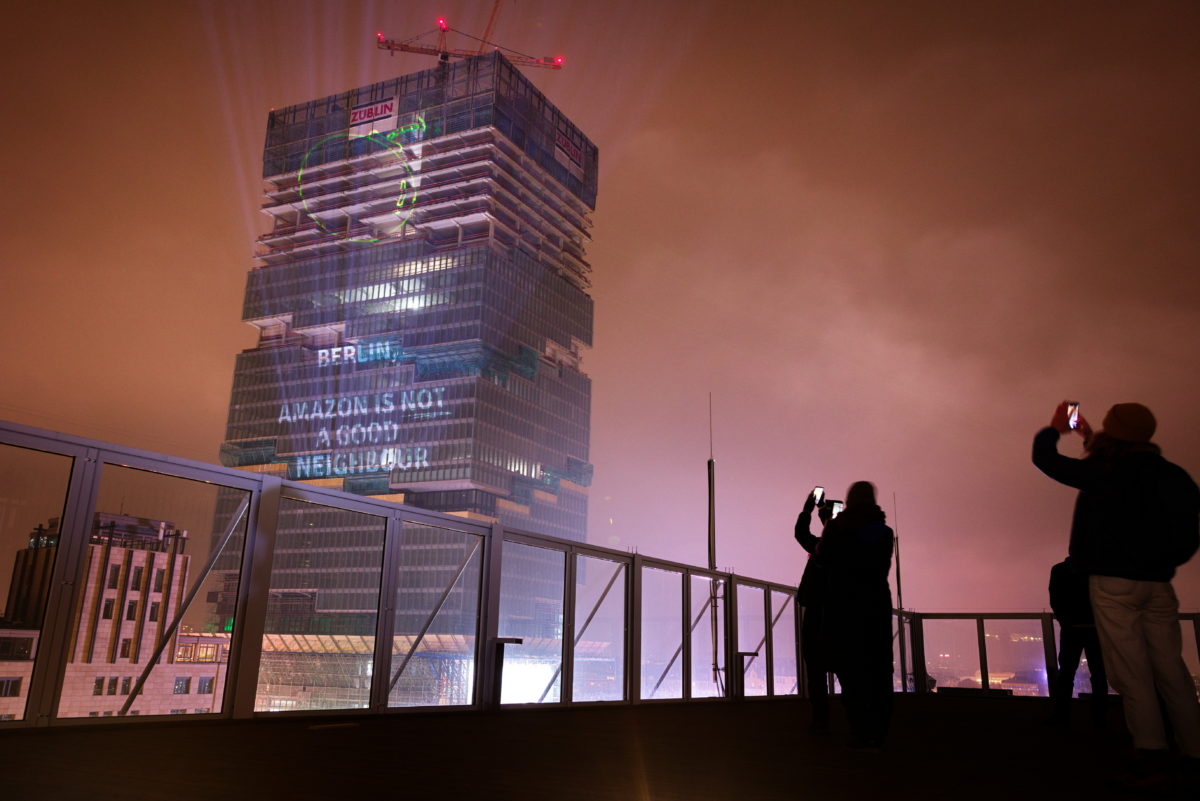
“Berlin, Amazon is not a good neighbour” is projected onto the Amazon Tower being constructed in Berlin, Germany – photo by Lukas Stratmann

Who is Behind the ‘Make Amazon Pay’ Campaign

The 2022 Black Friday international day of action against Amazon was organized by UNI Global Union, the global federation of service sector unions, and Progressive International, an alliance founded in May 2020 to unite and mobilize progressive forces around the world.

“We all know that the price of everything is going up, as is the temperature of our planet. Instead of paying its workers fairly, its taxes in full and for its damage to our environment, Amazon is squeezing every last drop it can from workers, communities and the planet.” Daniel Kopp, coordinator of Make Amazon Pay at Progressive International, said. “In the face of the cost of living scandal, global debt crisis and climate emergency, we are coming together to Make Amazon Pay.”

The Make Amazon Pay coalition is made up of over 80 trade unions, civil society organizations, environmentalists and tax watchdogs including Amazon Workers International, Oxfam, Greenpeace, 350.org, and Tax Justice Network. The coalition demands Amazon pays its workers fairly and respects their right to join unions, pays its fair share of taxes and commits to real environmental sustainability. This is the third year in a row that the coalition organized worldwide actions on Black Friday. The slogan “Make Amazon Pay” appeared for the first time during Black Friday protests in support of the German Amazon strikers in November 2017 when a local campaign organized a small blockade at a distribution center in Berlin and a so-called “traffic light strike” at a Fulfillment center in Leipzig.

An International Strike Movement

In Germany and France alone, workers in 18 warehouses went on strike in a cooperative effort between ver.di and the French Confédération Générale du Travail, or CGT, union.

“It was very important to celebrate this year’s day of action together, because you can’t confront a major global corporation like Amazon on a local, regional or national level alone,” Monika Di Silvestre, who is responsible for ver.di’s trade union work at Amazon, said.

Strikers from the fulfillment center in Koblenz visited their colleagues in France on the day of action; conversely, workers from the Metz site, which was on strike, visited Koblenz.

Amazon employees in Germany want collective bargaining security, a fixed income and good jobs. They have been fighting since 2014 and have secured some important successes. Hourly wages have increased and health protection has improved in some cases. But none of these successes are yet covered by collective agreements. Amazon can take it all back at any time.

And the company is doing just that. The hourly bonuses of two euros that Amazon paid to the more than 20,000 employees in Germany in the spring of 2020, during the first Coronavirus wave, were simply canceled that summer. French unions called for a higher cash bonus for the period preceding Christmas, during which employees at warehouses are asked to do a lot of overtime work.

As at every strike, Amazon announced that there had been no signs of disruption to operations.

“At Amazon, preparations for Black Friday week began months ago, and our teams are looking forward to processing customers’ orders in a timely manner,” Amazon’s press spokesman Michal Schneider said.

This does not mean that strikes haven’t affected individual fulfillment centers as minimal delivery delays and reduced capacities happen. But the biggest problem is that Amazon can overcome the strikes because of its wide and international distribution network. Most products can be delivered to German households from fulfillment centers in other countries like Poland or the Czech Republic who are not on strike.

Workers and activists also protested in different cities in the U.S. In St. Louis, several dozen workers left their work, an action which was the second wildcat strike in the facility. In North Carolina, Amazon employees joined activists in protesting for better working conditions at the giant sites near Durham and Raleigh. In New York, people protested outside Amazon founder Jeff Bezos’ private residence on Fifth Avenue.

Related [2019]: Amazon Workers Strike on Prime Day in Shakopee, Minnesota
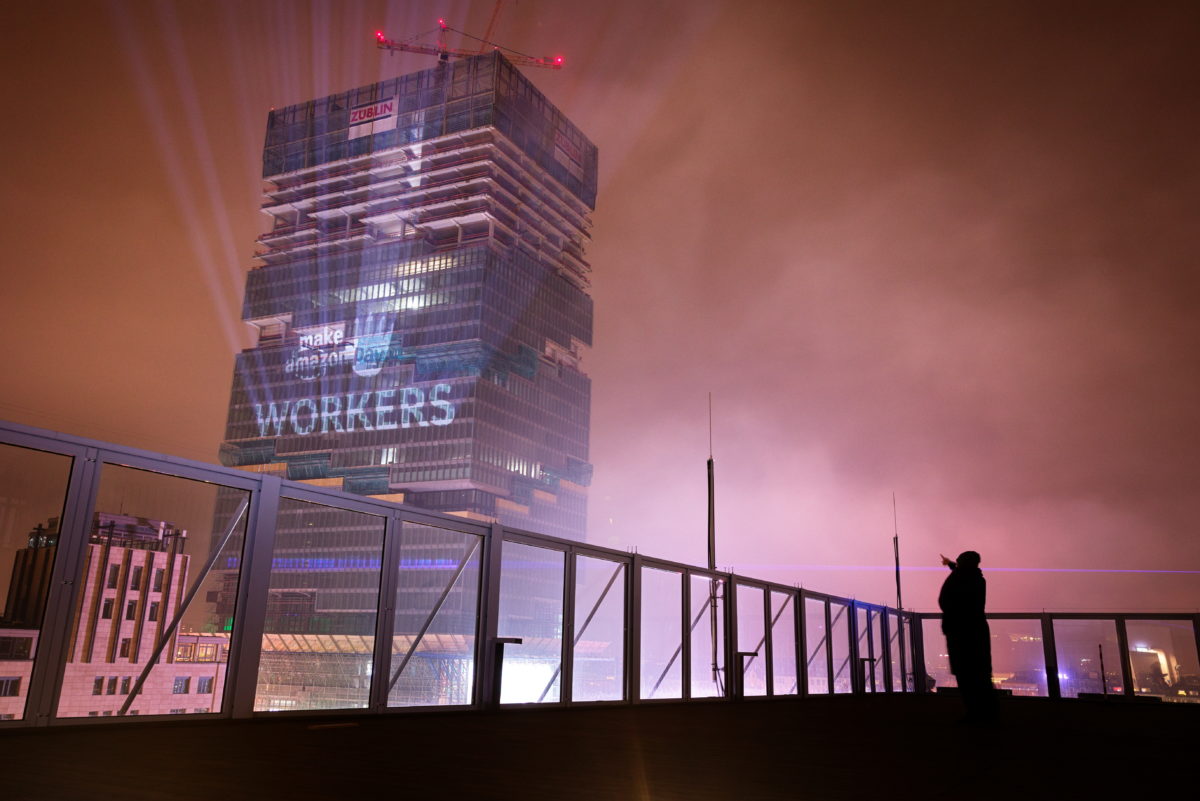
Make Amazon Pay – WORKERS is projected onto the Amazon Tower being constructed in Berlin, Germany – photo by Lukas Stratmann

Global Protests

In Bangladesh, thousands of garment workers in Amazon’s supply chain rallied for union recognition, better pay and conditions, and for Amazon to sign the Bangladesh Accord. Nazma Akhter, President of the Sommilito Garments Sramik Federation, detailed some of the issues workers in Bangladesh face. 

“Garment workers, like those I represent, toil to swell Amazon’s coffers often without any recognition that we are even Amazon workers. Amazon is the third largest direct employer in the world, but when you take us in the supply chain into account, it is even larger. At work we can face sexual harassment from management and victimisation when we try to organise in a trade union against that violence and for better pay and conditions.” 

“In Bangladesh, we are on the frontline of climate breakdown, so we know climate justice and social justice cannot be separated. We have to Make Amazon Pay all its workers a decent wage in dignified workplaces and for its environmental damage,” Akhter added.

In Japan, workers in the recently formed Amazon Workers Union protested in front of the headquarters of Amazon Japan in Tokyo. In India, thousands of workers, street vendors and supporters rallied in over 20 cities including outside parliament in New Delhi. In South Africa, the Liesbeek Action Campaign protested Amazon’s new African headquarters, which is being built on sacred land. In Ireland, environmentalists gathered outside Amazon HQ in Dublin against the new planned data centers in the city. Actions were also organized in Poland, the UK, Luxembourg and other countries.
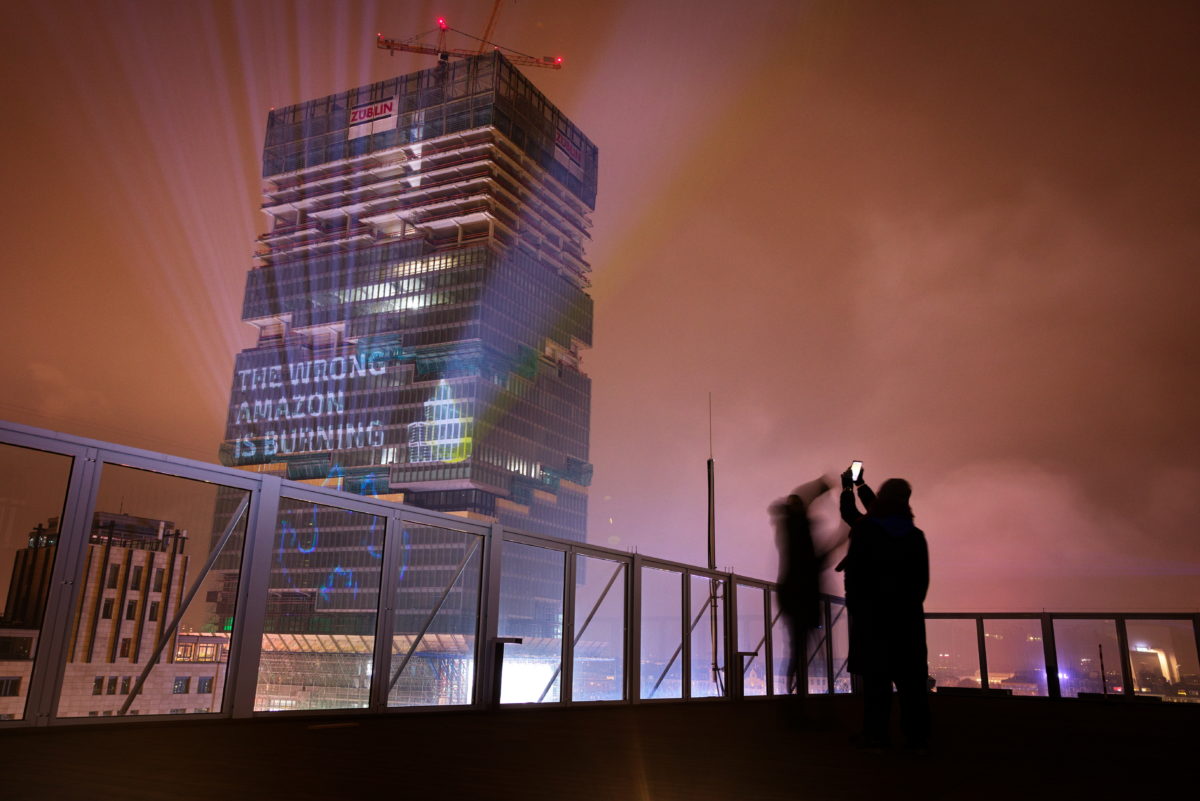
The wrong Amazon is burning is projected onto the Amazon Tower being constructed in Berlin, Germany – photo by Lukas Stratmann

Amazon’s Labor Regime

According to ver.di, the number of Amazon employees has steadily increased for years. In the span of a decade, Amazon’s workforce grew to 566,000 employees worldwide by 2017, up from 17,000 employees in 2007. In a total of 30 countries around the world, Amazon operates dozens of shipping centers. In India, for example, there are currently 41. In Europe, Amazon maintains locations in Germany, Austria, Switzerland, Poland, the Czech Republic, France, Italy, Spain, Holland and the United Kingdom, among other countries. In 2020, the total number of employees broke the one million mark for the first time. During 2021, the number of full- and part-time employees continued to rise, reaching a peak of around 1.6 million. In Germany, Amazon currently employs more than 20,000 people. In the USA, Amazon is the country’s second-largest employer with 800,000 employees.

Amazon’s fulfillment centers are the industrial factories of the current capitalist era. They are typically located in structurally weak regions where jobs are scarce. They are often located near small towns or on the outskirts of a big city with highway or rail access. Thousands of people working for Amazon perform strenuous and repetitive work every day on tight work shifts that require complete accountability for time and tasks. It’s a job that benefits a large part of society that orders goods on the internet or often relies on package delivery. Ordering from Amazon has become an important reproductive pillar like the post office or water utilities.

Adapted to today’s technological needs, the factory system has been modernized for the new capitalist era, and computerized algorithms and all-round control create the defining elements of this modernized factory system. Amazon’s “Chaos Principle,” the warehousing system organized by the algorithm, attempts to streamline the ordering process to speed up and meet delivery times. Every worker’s trip to the toilet, every cigarette, every conversation can, and in many cases will, be viewed. The possibilities of direct control have become cheaper and more widespread in recent decades. There is no longer even a need for the “theft protection” argument for installing cameras, which some employees had argued against in the past.

A study from 2016 by Sabrina Apicella at the Rosa Luxemburg Foundation explores the question of why there is actually a strike at Amazon in Germany. Her central argument is “that the transformation of sales work is characterized firstly by the introduction of technical and digital devices and software, and secondly by its Taylorization, i.e. the increasing fragmentation into its smallest components and artificial recomposition (outsourcing of customer contact, new hierarchies).” 

One of the findings of the study is that the strikers are not primarily concerned “only” with higher wages. Rather, the working conditions and the lack of ability for workers to have a say, are central. Workers have repeatedly emphasize that they feel like machines while working at Amazon. The workers perceive the tight work specifications and the technical control as an attack on their bodies, which are compared in serious jokes with robotization or even cyborgization, i.e. with an externally imposed mechanization.

For more media from Germany, see our Germany archive page.


Follow us on Twitter, Facebook, YouTube, Vimeo, Instagram, Mastodon and Patreon.

Please consider a tax-deductible donation to help sustain our horizontally-organized, non-profit media organization:

supportourworknew

The post Workers Turn Black Friday into ‘Make Amazon Pay Day’ appeared first on UNICORN RIOT.


by Unicorn Riot via UNICORN RIOT

New video by Unicorn Riot on YouTube - go check it out ;-)


Watch on YouTube here: ‘Make Amazon Pay’ Solidarity Rally for Amazon Workers Striking on Black Friday
Via Christian Gasper

Friday, December 2, 2022

Greek Students Riot on November 17, Commemorate Those Killed by the Junta

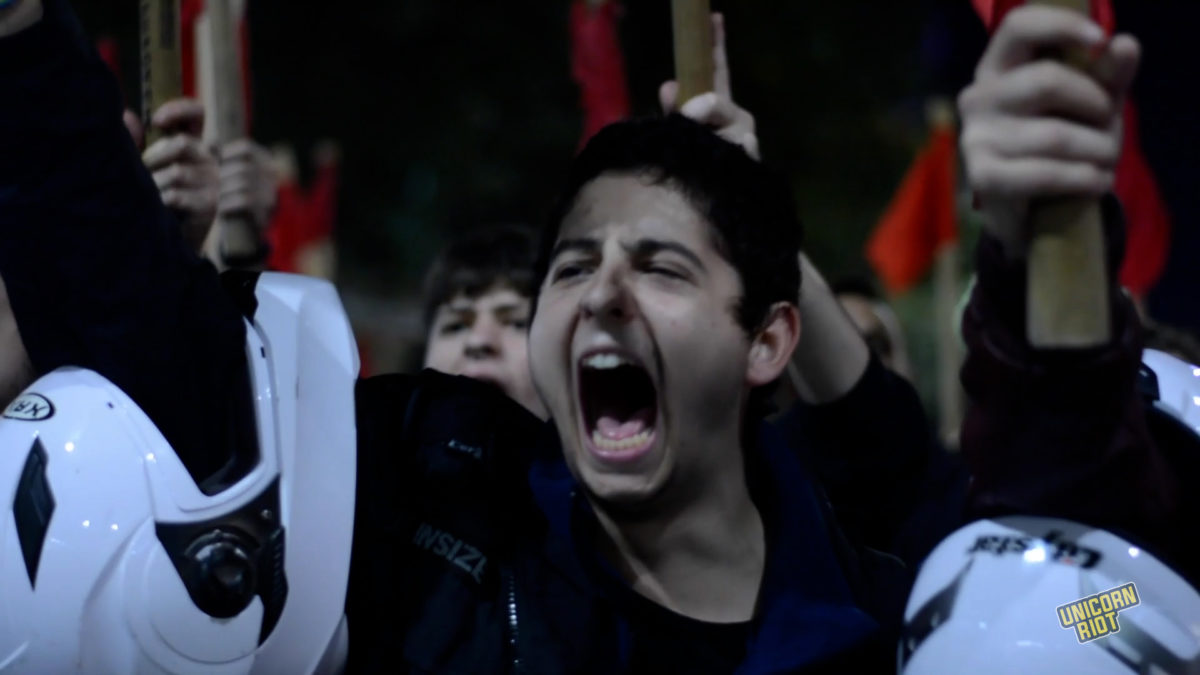
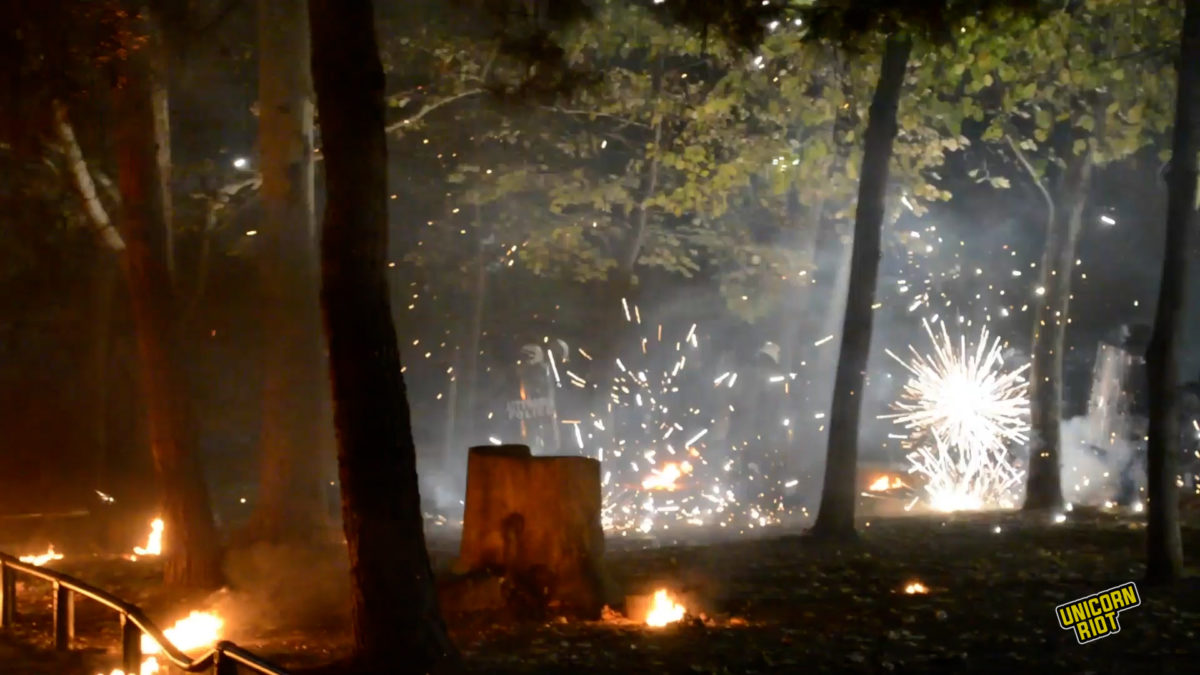
Thousands of demonstrators filled the streets of Greece’s two largest cities on Nov. 17 to commemorate the 49th anniversary of the uprising in which two dozen students were killed by the military junta at Polytechnic University in Athens. Heavy clashes went on through the night of the memorial protests, with youth using fireworks, homemade bombs, rocks, and other projectiles against riot police who shot a large water cannon and copious amounts of tear gas.

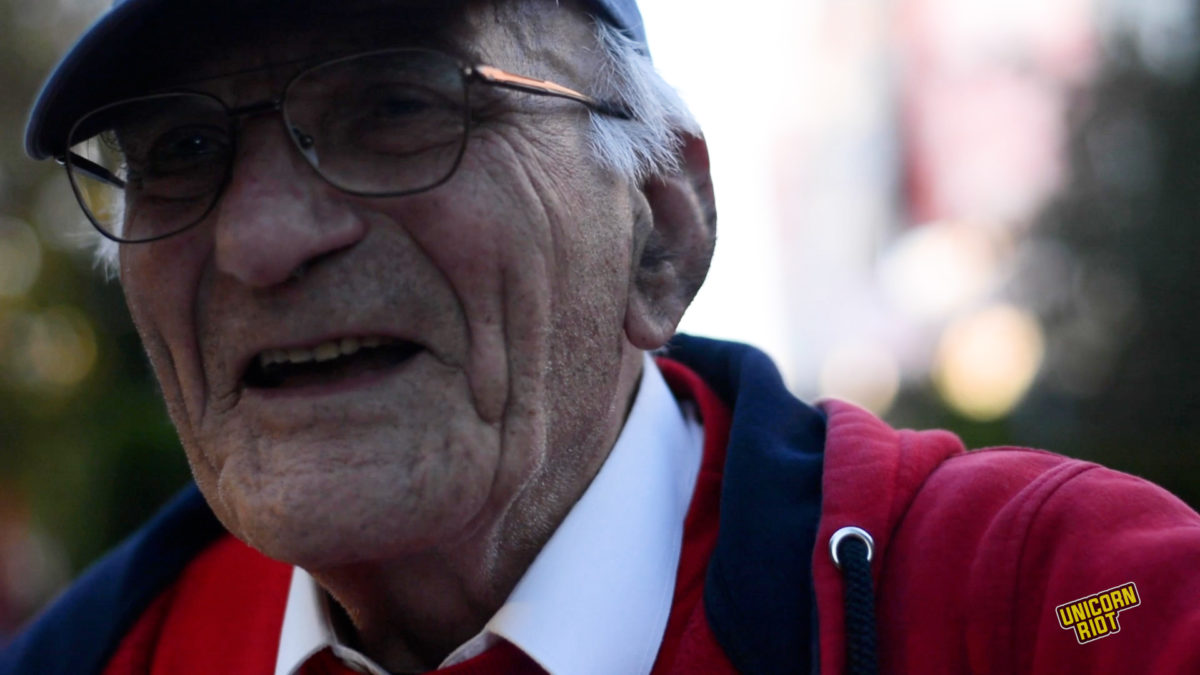
At the 2022 demo in Thessaloniki, Unicorn Riot heard from 89-year-old Theodoros Tellidis, who shared his memories of being exiled by the U.S.-backed military junta of 1967-1974.

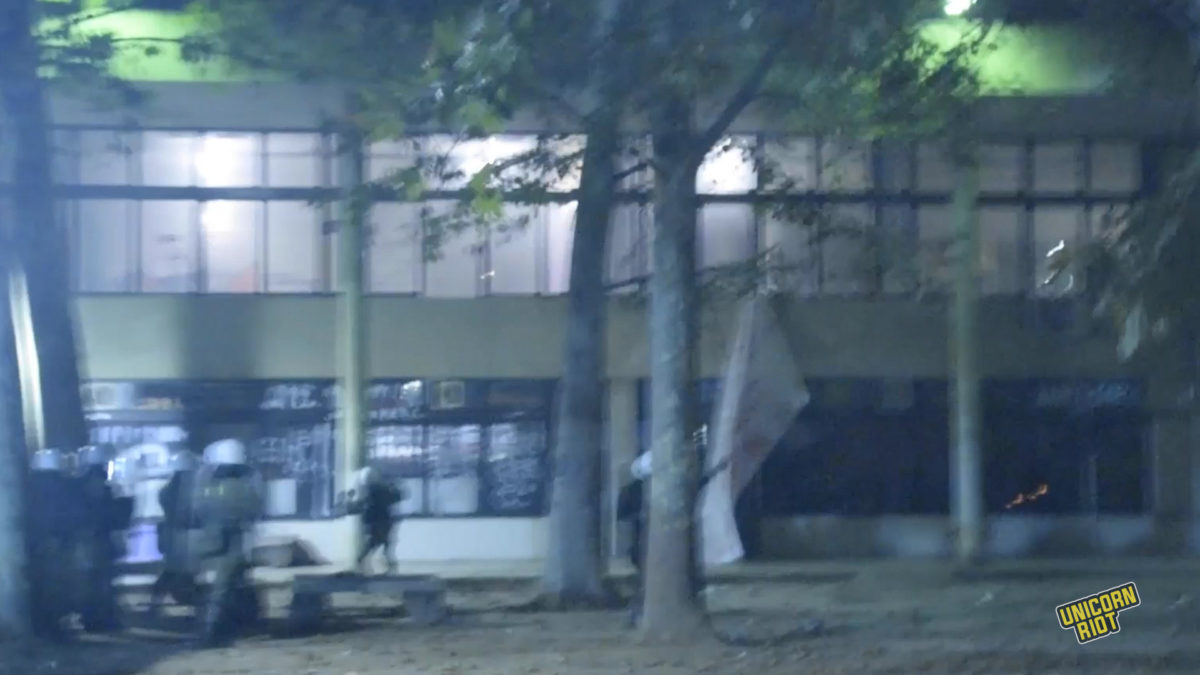
After the demo, Unicorn Riot filmed the clashes which also featured hundreds of students trapped in the university buildings and riot police throwing tear gas into the buildings.


The Military Dictatorship in Greece [1967-1974]

[The Dictatorship of April 21 / The Regime of the Colonels / The Junta]

The Coup d’Etat of April 21, 1967

For over seven years, from April 21, 1967 to July 23, 1974, Greece was ruled by a military dictatorship imposed by a military coup on April 21, 1967, hence the name “Dictatorship of April 21.” During the seven years of dictatorial rule, power was exercised directly or indirectly by a small group of rulers mostly made up of military colonels behind the coup and largely supported by the United States government along with clandestine Western army units.

While elections had been called for May 28, 1967, a group of army officers led by General Stylianos Pattakos and the colonels Georgios Papadopoulos and Nikolaos Makarezos seized power in the coup d’état on April 21.

Having secured about 100 armored vehicles in the capital area of Athens, the coup plotters moved in the early morning hours and initially seized the Ministry of National Defense. They then implemented a NATO contingency plan, code-named “Plan Prometheus,” resulting in the mobilization of all military units in the Attica region (which contains Athens). The NATO plan was designed for a forced takeover by the military in order to neutralize a communist uprising in the event that Soviet Army forces invaded Greece.

The military coup in ’67 was assisted by the highly secretive CIA and NATO-trained Lochoi Oreinōn Katadromōn (LOK) Mountain Assault Brigade. LOK was part of Operation Gladio, a network organized by the Central Intelligence Agency (CIA) to organize “stay behind” units after World War II. The CIA’s Gladio units were handed over to NATO in 1959. Gladio’s existence was revealed by Italian Prime Minister Giulio Andreotti in 1990; “Nato’s Secret Armies” by Daniele Ganser (PDF, 3MB) and a 1992 BBC documentary covers the infamous network in detail.

Background Historical Context

The Greek dictatorship of 1967-1974 is internationally regarded as another episode of the Cold War, in the confrontation between the East and West. 

This struggle often resulted either in the domination of communist forces, as in Vietnam/Cambodia, or in the military dictatorship of the most extreme pro-Western nationalists as in Chile and Argentina. A more neutral third group, the Non-Aligned Movement, formed in 1961 to collectively rebuff imperialism, U.S. and Soviet influence.

In the case of Greece, as in Spain and Portugal, the military undertook their actions to counter what they saw as a communist danger by restricting political freedoms and establishing dictatorships.

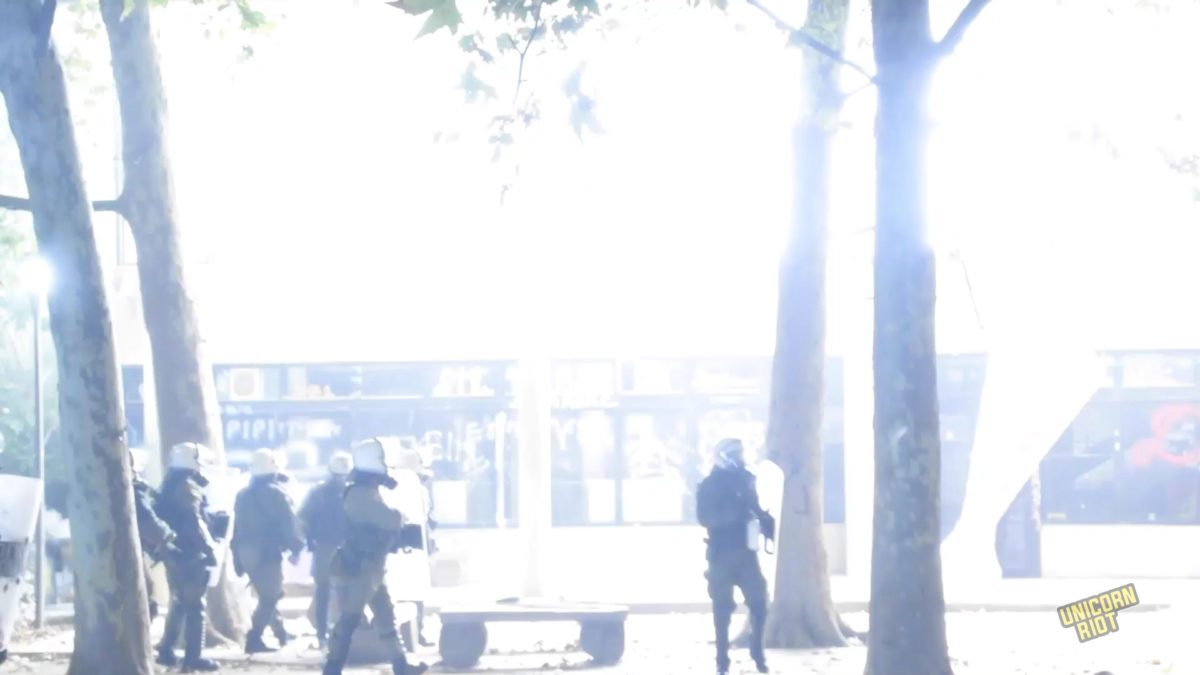
Fireworks explode in front of Greek riot police holding shields and wearing riot gear. Fires burn around trees from molotov cocktails thrown by demonstrators.
Fireworks explode in front of Greek riot police during Nov. 17, 2022 clashes in Thessaloniki, Greece

The War Against Political Opponents

Immediately after the enforcement of the regime, thousands of arrests were made, usually at night and without warrants. The majority of those arrested were deported, others were detained in detention centers and some were taken to emergency military tribunals.

The junta, throughout its duration, imposed relentless persecution against its political opponents, especially communists. They re-activated and extended the entire anti-communist legislative framework crafted years before using Emergency Law 509, which was known as Idionymon (or “special illegal act”) in the 1920s and used to target growing communist and anarchist movements.

The main methods of torture used by the security forces were physical abuse, beatings, phalanx (torture with continuous foot racking), severe isolation in squalid conditions, electric shocks, intimidation, humiliation, and mock executions. Medical personnel employed by the junta were often directly involved in torturing political dissidents.

Some were deported others were exiled. Such places were used in Greece for political repression and re-education torture camps. Many islands, especially in the Aegean, as early as the beginning of the 20th century were places of ektopismos (the exiling of individuals). Thousands were sent to islands during the Metaxes dictatorship of the 1930s.

A larger number of political opponents (tens of thousands) were exiled during the civil war (1946-1949), when new and larger torture camps were created. The measure of deportation remained in force during the early years of the post-civil war period. By 1967 it had become dormant, but during the period of the colonels’ dictatorship it was largely used again. It was finally abolished after the fall of the dictatorship in 1974.


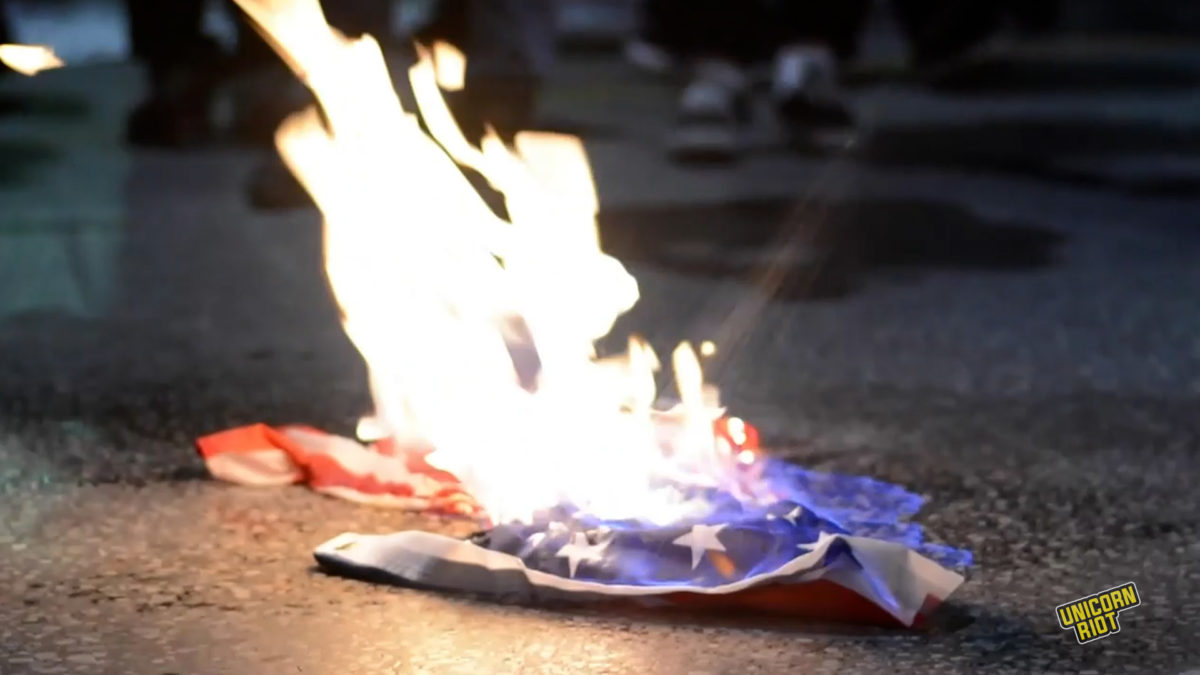
Flag of the United States is burned during the Nov. 17, 2022, demonstration against the former ruling military junta. The U.S. government supported the military coup in 1967 and the junta that followed.
Masses of communists gathered at the Nov. 17, 2022, demonstration against the former ruling military junta.

Related (2017): Greece: Political Prisoners Pt. 2 – Targeting of Anarchists & Autonomous Groups

Theodoros Tellidis, 89, who was exiled to Gyaros Island, smiles during Nov. 17, 2022, demonstration against the former ruling military junta (1967-1974).
Theodoros Tellidis, 89, points his finger in the air during the Nov. 17, 2022, demonstration against the former ruling military junta.

Gyaros, the ‘Island of the Devil’

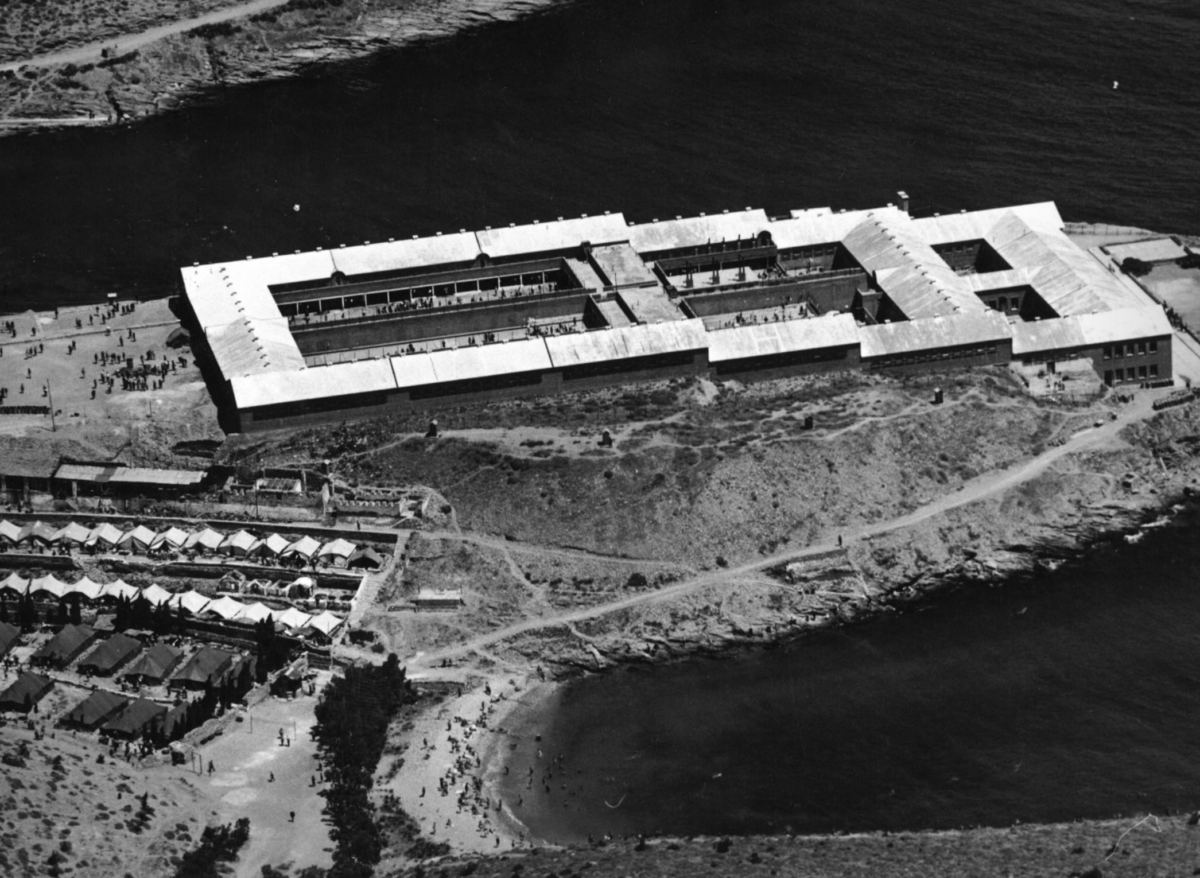
Gyaros was one of these islands on which exile camps were built. In 1947, the prison of Gyaros was also constructed. All the work was done by the exiled prisoners. 

During the dictatorship, thousands of dissidents were again exiled to Gyaros. For the first time, women, even pregnant women, were among them. 

Theodoros Tellidis, the elder Unicorn Riot spoke with on Nov. 17, 2022, was exiled by the junta to the Greek island of Gyaros.

In 1967, shortly after the establishment of the dictatorship, reporters from the German magazine Stern flew over Gyaros, took photographs and distributed them internationally. The evidence from Gyaros contributed to the subsequent exclusion of dictatorial Greece from the Council of Europe for human rights abuses.

Gyaros Island detention center was used as a torture camp on leftists for decades

The Fall of the Dictatorship

The Events at the Polytechnic University

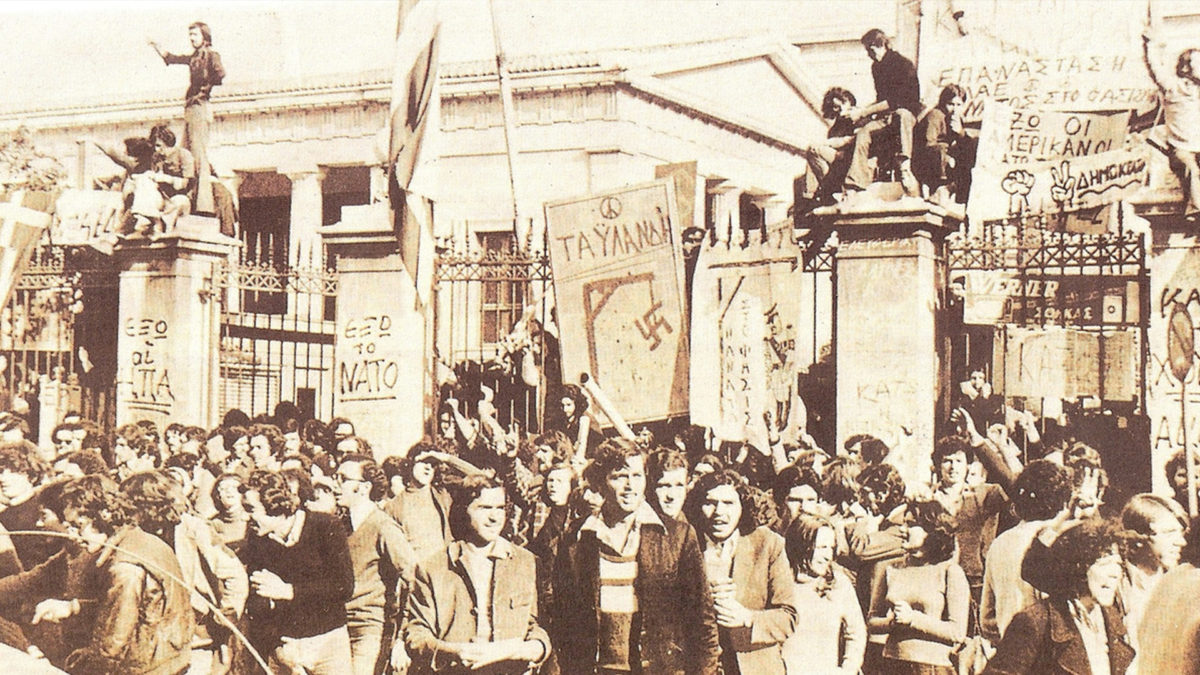
Ιn early 1973, after over six years of dictatorial rule, conflict between the state and students in Athens began to escalate. In an attempt to suppress a rising student movement the military junta implemented Decree 1347, cutting off the deferment of military service for students who were considered a threat to the regime. It achieved the exact opposite of its intended effect, strengthening mass student mobilizations.

Student anger began to grow, resulting in the first occupation of the Law School in February 1973, followed by a second occupation on March 14. Student protests against the new measure continued in the following months. On Tuesday, November 14, 1973, hundreds of students had gathered in the morning at the Law School building and held an assembly and a march in the surrounding area. In the afternoon and while the students had remained on the grounds of the university, the police director and the prosecutor ordered the students to disperse. A coordinating committee was formed and decided at 8:30 p.m. to occupy the university. 

From the early hours of the next morning, the support of Athenian society for the students was evident, with food, stationery and medicine being provided to the students. On Thursday, November 16, people remained on the side of the students while barricades began to be set up in the streets. The first clashes with the police were not long in coming and at 7 p.m. the first fatality of the clashes was announced.

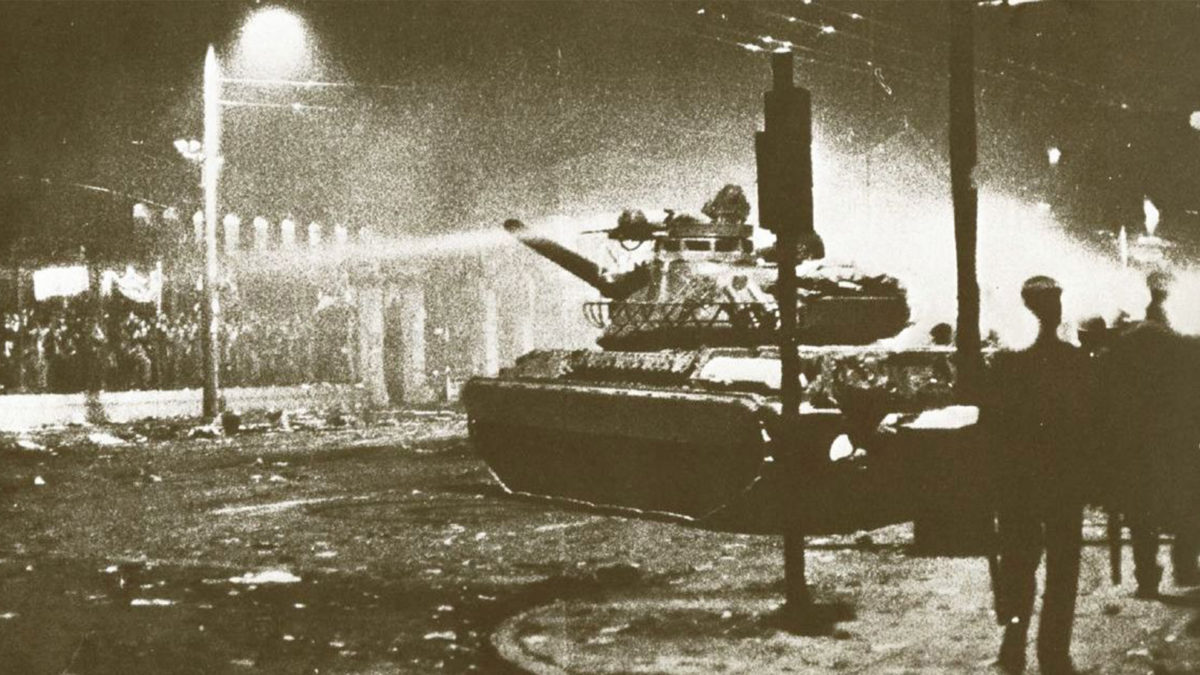
At midnight the first tanks appeared and by 1:30 a.m. the head of the army battalion gave the order to leave the building. The students refused and remained, chanting slogans such as “Down with the Junta and the Americans.” At 2:50 a.m. the commander in chief ordered the tank to tear down the gate of the Polytechnic. The military intervention in and around the Polytechnic that continued into the next day injured thousands and killed at least 24 people.

Greek students during Polytechnic uprising of 1973
An AMX 30 Tank sent by the government of the military junta into the gates of Athens Polytechnic University on Nov. 17, 1973. 24 civilians were killed.

The Ioannidis Coup d’état

The Polytechnic uprising occurred at a time when Colonel Papadopoulos was propagating a superficial liberalization of the regime. It triggered a series of events that put an abrupt end to these plans. Brigadier General Dimitrios Ioannidis used the uprising as a pretext to restore public order, and organized a coup d’état which overthrew Papadopoulos a week later on November 25, 1973. Ioannidis’ forces surprised Papadopoulos, who was placed under house arrest. 

On the day of the new coup, armored vehicles were deployed in the center of the cities. A curfew was announced by radio and stated the army was taking back the reins of power in order to ‘save the principles of the April 21 Revolution.’

Ioannides imposed a harsher dictatorship than that of Papadopoulos. He preferred to work behind the scenes and never held any official position in the junta.


Riot police throw tear gas and flashbang grenades into a building at the Polytechnic University on Nov. 17, 2022, during heavy clashes after the main demonstration against the former ruling military junta.
Flashbang grenades go off in a building at the Polytechnic University on Nov. 17, 2022, after riot police throw them at trapped demonstrators during heavy clashes after the main demonstration against the former ruling military junta.

Related (2018): Greek Police Attack Anarchists After Demo for Victims of 1973 Student Uprising

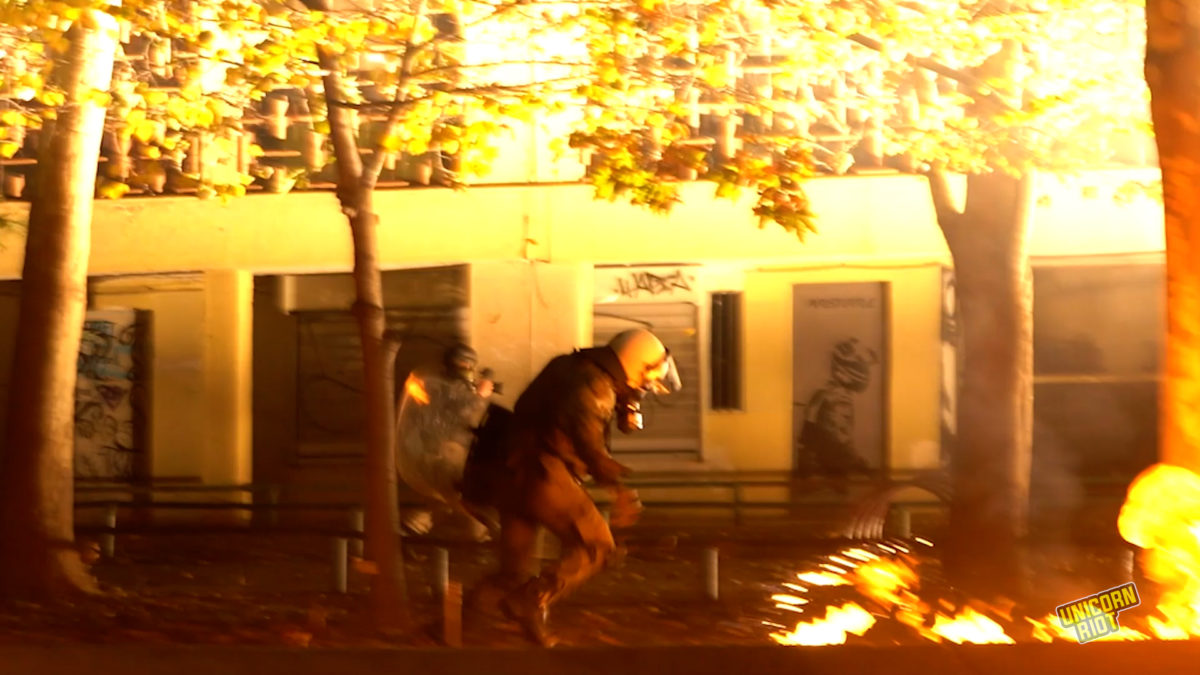
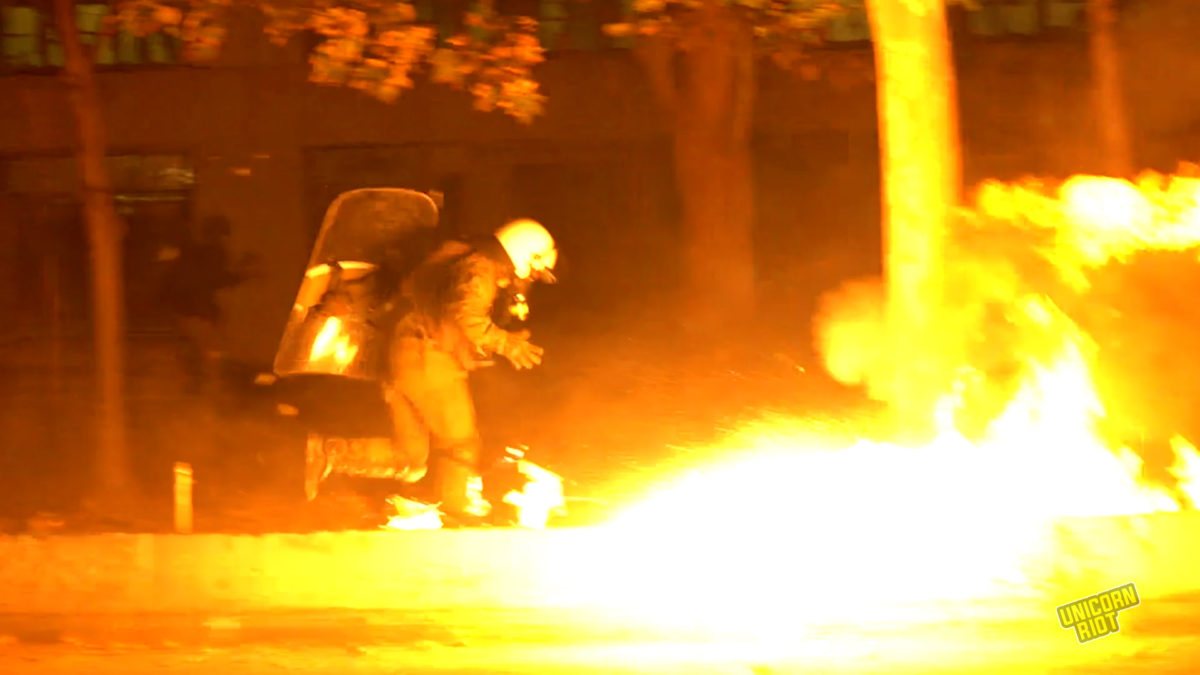
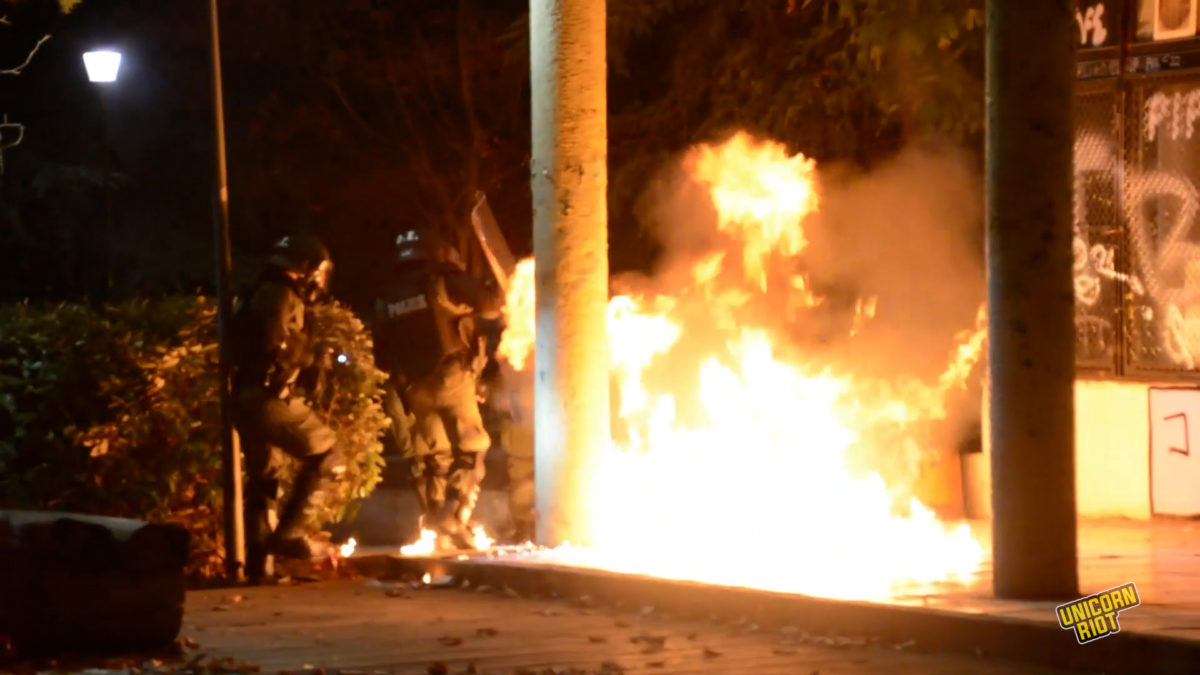
Riot police runs by fire at the Polytechnic University on Nov. 17, 2022, during heavy clashes after the main demonstration against the former ruling military junta.
Riot police runs by a freshly exploded firebomb at the Polytechnic University on Nov. 17, 2022, during heavy clashes after the main demonstration against the former ruling military junta.

The Coup of July 15 and the Turkish Invasion of Cyprus

The next year on July 15, 1974, on the island of Cyprus, a coup was carried out by the National Guard of Cyprus, the Greek Cyprus Force (ELDYK) and the far right organization EOKA B, at the behest of the Greek Junta. The aim was to overthrow the elected President of the Republic of Cyprus, Archbishop Makarios III, and impose unification with Greece. Cyprus gained independence from the United Kingdom in 1960.

The coup triggered a Turkish military invasion five days after the coup. Turkey claimed that the invasion was a peacekeeping intervention legitimized by Article 4 of the Treaty of Guarantee (Zurich-London Agreements). Within three days, Turkish forces occupied about 3% of the northern part of the island in Operation Attila 1, namely the town of Kyrenia and the surrounding area.

On July 23 a ceasefire was declared and both the Athenian dictatorship and the coup government in Cyprus collapsed. 

Two rounds of consultations followed in Geneva between Greece and Turkey. On August 14, the Geneva talks collapsed and Turkey launched a second operation, dubbed Attila II, during which it occupied 36.2% of the island and displaced 120,000 Cypriots, while a total of about 3,000 Greek Cypriots were killed.

The End of the Junta

The period of the military junta ended when the Ioannidis Junta collapsed on July 24, 1974 under the weight of the Turkish invasion of Cyprus.

Right wing politician Constantinos Karamanlis arrived in Athens on July 24 at the invitation of Phaedon Gizikis, the President of the Republic of the Junta, and was sworn in as Prime Minister. Karamanlis formed a Government of National Unity to restore parliamentary democracy.

On July 28, 1975, the so-called Trial of the Junta, i.e. the trial of the three coup plotters Stylianos Pattakos, Georgios Papadopoulos and Nikolaos Makarezos and their accomplices, began. They were charged with various crimes during the dictatorship, the violent destruction of democracy and their actions during the Polytechnic uprising. The trial lasted about a month, until Aug. 29 when the coup plotters were all convicted. The three perpetrators were sentenced to death, while all the soldiers were deposed and dismissed from the army with the rank of soldier. However, by a decision of the Prime Minister, the death sentences were commuted to life imprisonment. 

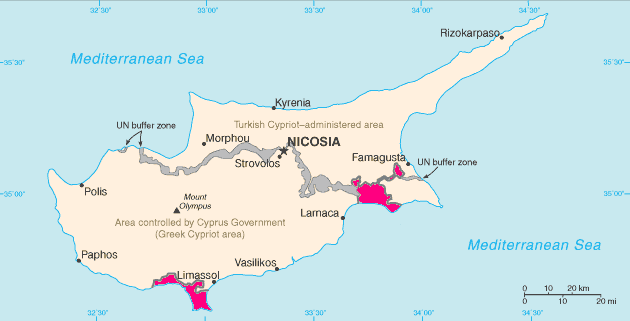
Current map of Cyprus political divisions and UN-administered buffer zone. Established by treaty in 1960, UK ‘sovereign base areas’ of Akrotiri and Dhekelia marked in magenta. Source: Wikimedia Commons based on CIA World Factbook

To this day Cyprus remains divided. A northern territory is controlled by the Turkish Republic of Northern Cyprus, which is only recognized by Turkey, while the southern territory is controlled by the Greek Cypriot government, the Republic of Cyprus. The United Nations controls about 4% of the island in between, and British military bases control another 2.8% of the island.

In 1999, then-United States President Bill Clinton visited Greece and apologized for the role that the U.S. government played in supporting the military junta.

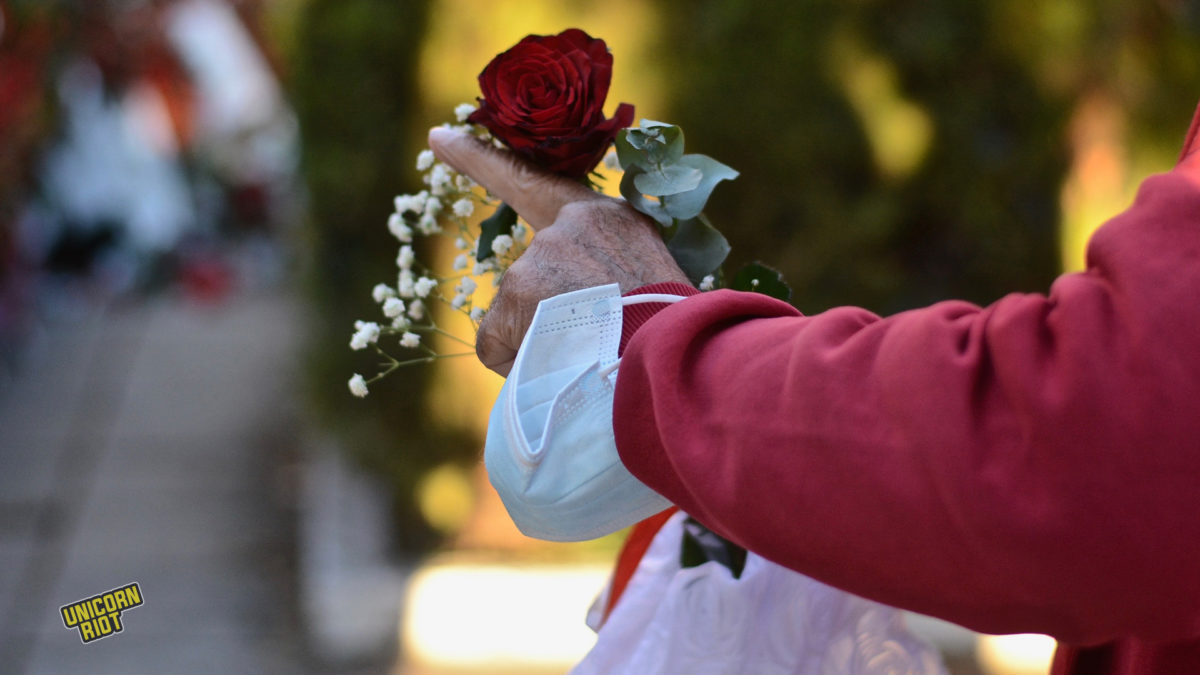
Yearly demonstrations are held in Greece on Nov. 17 that start in the morning with survivors of the junta, family members of those killed and community members laying flowers at Polytechnic University to commemorate the victims of the Regime of the Colonels. Heavy clashes are frequent in the night after large demonstrations during the evening. This year in Thessaloniki, there were no reported injuries from the clashes although demonstrators trapped in university buildings were tear gassed and suffered from breathing problems. Corporate news reported five arrests.

Riot police attempt to evade firebombs thrown at them on Nov. 17, 2022, during heavy clashes after the main demonstration against the former ruling military junta.
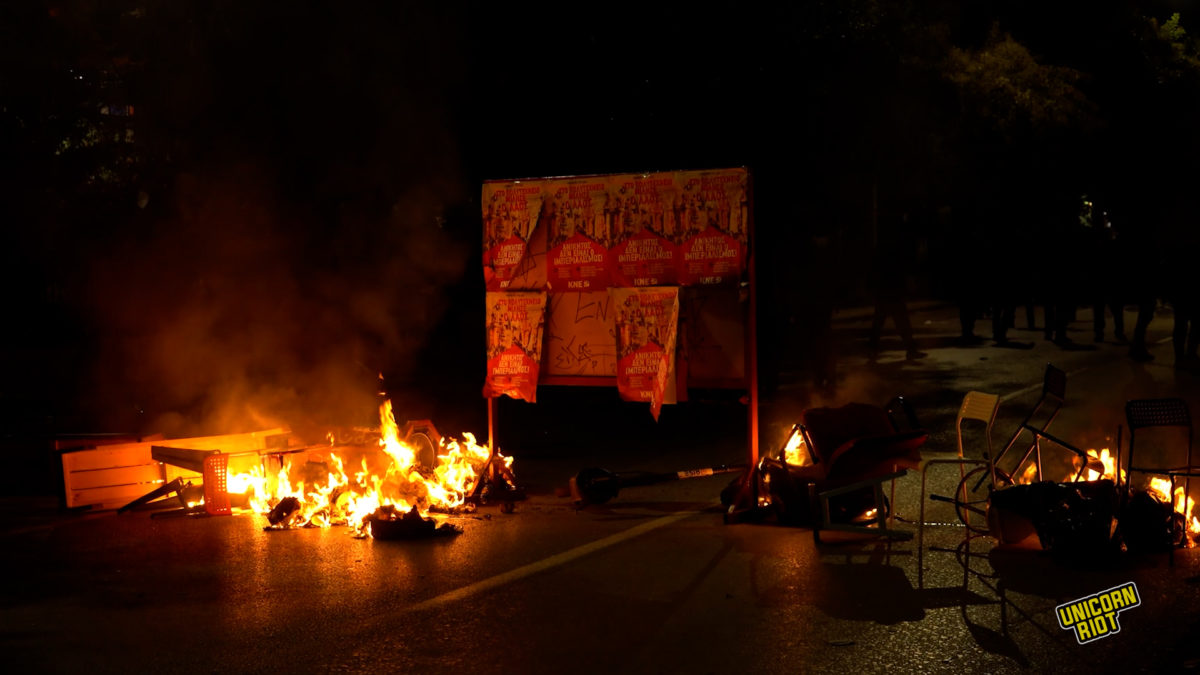
Burning barricades are placed in the street by students on Nov. 17, 2022, during heavy clashes after the main demonstration against the former ruling military junta.

Over the last couple of years, students at Thessaloniki University had been building a movement to combat the new far-right government’s education bill that allows police to be installed on school campuses. Universities in Greece had been an asylum without police since the junta lost power but are now back to policing schools. In May, riot police shot a student in the face with a projectile at point-blank range during a protest on campus. While the campus cops are the current reality, some are hoping the next government will strike down the laws that brought them back to the universities.

Niko Georgiades of Unicorn Riot contributed to this report.

For more media from Greece, see our Greece archive page.


Follow us on Twitter, Facebook, YouTube, Vimeo, Instagram, Mastodon and Patreon.

Please consider a tax-deductible donation to help sustain our horizontally-organized, non-profit media organization:
supportourworknew

The post Greek Students Riot on November 17, Commemorate Those Killed by the Junta appeared first on UNICORN RIOT.


by Unicorn Riot via UNICORN RIOT

Thursday, December 1, 2022

New video by Unicorn Riot on YouTube - go check it out ;-)


Watch on YouTube here: Queer Front Range Community Responds to Club Q Shooting
Via Christian Gasper

Queer Colorado Community Responds to Club Q Shooting

Colorado Springs, CO – In the days since the Nov. 19 shooting at Club Q that left five dead and 25 more injured, the local queer community and their allies have been commemorating the lives lost and comforting those affected. Billed as an all-inclusive nightclub, Club Q has long been a respite for the queer population in a conservative Christian city that’s home to prominent anti-trans and homophobic organizations.

The venue, which was hosting a punk and alternative show on Nov. 19, was set to host an all-ages drag performance the following day for Transgender Day of Remembrance—the annual observance honoring the memory of transgender people whose lives were lost in acts of anti-transgender violence. Minutes from the start of the annual commemoration, a shooter adorned with body armor entered Club Q.

The deadly attack was stopped by attendees at the show who beat the shooter, Anderson Aldrich, and confiscated an AR-15 style rifle and handgun, likely preventing further death and injury, according to club attendees.

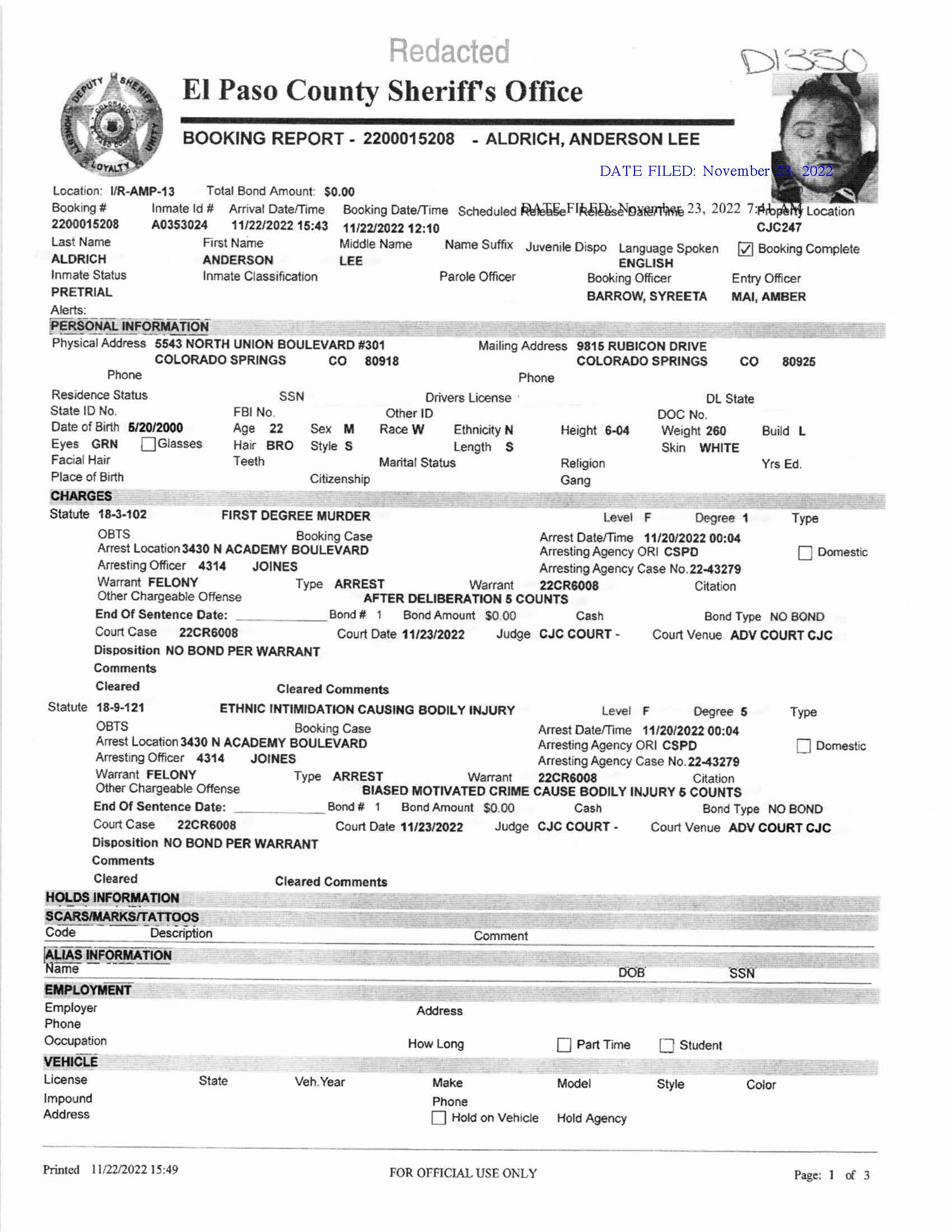
Aldrich was taken into custody the night of the shooting. On Nov. 22, Aldrich was booked without bail for five counts of first-degree murder (CO Rev Stat § 18-3-102 (2016)) and five counts of a bias-motivated crime causing bodily injury (CO Rev Stat § 18-9-121 (2016)), though formal charges have not been filed as of this story’s publication.


There have been multiple memorials and vigils across Colorado commemorating Daniel Davis Aston, Kelly Loving, Ashley Paugh, Derrick Rump and Raymond Green Vance. In Colorado Springs, a mural is being painted in their memory by a local artist known as Paes 164.

Mourners continue to place flowers, candles, rainbow flags, and other items at the entrance of Club Q. Community members have been gathering outside the venue and spending time with one another, maintaining its legacy of being a loving and comforting queer space.

There are two online fundraisers for the families of the victims and for the survivors, one through GoFundMe and the other through the Colorado Healing Fund. On Dec. 1, community members are having an in-person fundraiser in Colorado Springs for the Club Q employees who are currently out of work (the event page says armed security will be present).

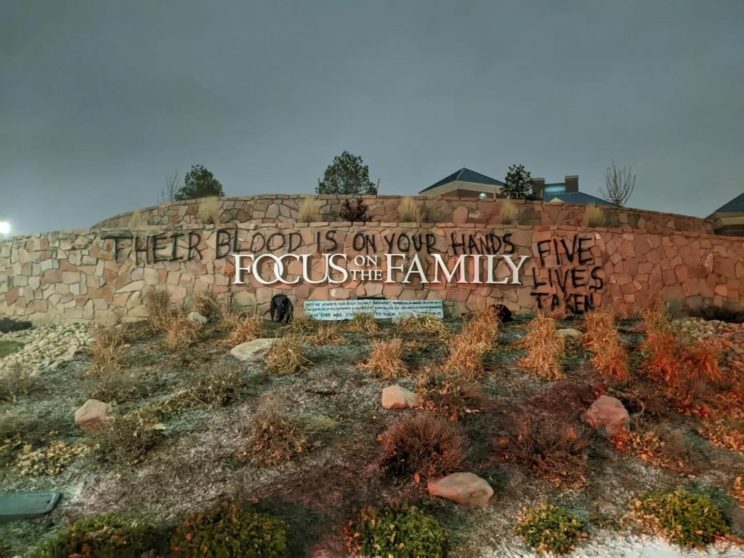
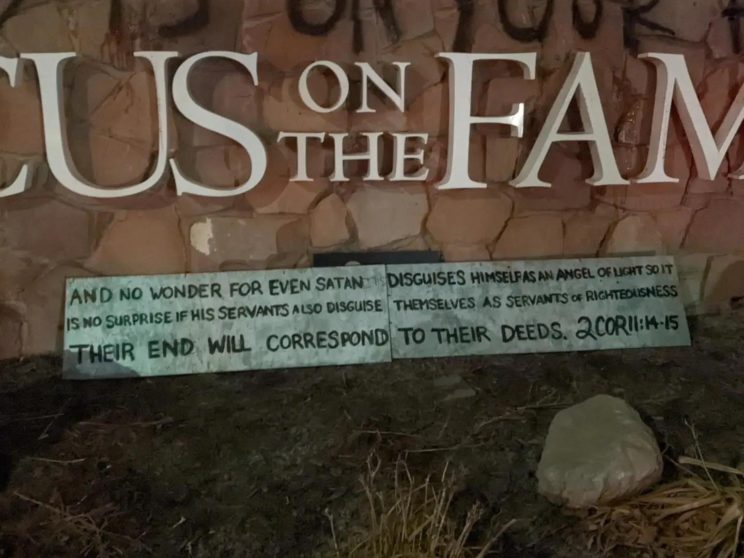
Other local queer community members responded to the shooting by taking a targeted action on Nov. 24. At the headquarters of the far-right Evangelical Christian lobbying and media organization Focus on the Family, a message was spray painted across the stone wall bearing their name, and signs quoting 2 Corinthians 11:14-15 were placed at the wall’s base.

The message read, “Their blood is on your hands, five lives taken.”

A press release and claim of responsibility for the act, shared anonymously with Unicorn Riot, attributed the act to “members of the Front Range queer community.”

“Their blood is on your hands, five lives taken,” was painted across a stone wall bearing the Focus on the Family name.
Two signs quoting 2 Corinthians 11:14-15 were also placed on the ground in front of the stone wall.

The anonymous group pinned responsibility for the killings on Focus on the Family specifically and groups that espouse similar beliefs in general. From the press release:

“It is important to us that you understand why Focus on the Family must be held accountable for the ramifications of their hateful theology. You have likely seen the onslaught of anti-trans legislation, of which Focus on the Family is a huge proponent, both in funding and propaganda.”

Family Policy Alliance, which is the 501(c)(4) lobbying arm of Focus on the Family, shares a campus with the Evangelical ministry at its Colorado Springs headquarters. The lobbying group is actively opposed to trans-affirming care and homosexuality.

On its “Help Not Harm” website page, Family Policy Alliance asserts that “there is no solid data that treatment with either puberty blockers, cross-sex hormones, or surgery reduces the risk of suicide.”

However, a 2020 study by the American Academy of Pediatrics found that transgender adults who received pubertal suppression hormone therapy as adolescents were less likely to experience suicidal ideation in their lifetime. And respondents to the 2015 U.S. Transgender Survey who had gender affirming hormone therapy or surgical care had lower frequencies of past-year suicide attempts compared to those who had not received the care they needed.

Family Policy Alliance preaches that “kids struggling to embrace their God-given bodies need real care,” and they believe gender-affirming care and treatment is harmful. Yet, according to The Trevor Project, which is the world’s largest suicide prevention and mental health organization for LGBTQ young people, the high rate of suicidal thoughts or suicide attempts are directly attributed to “how [LGBTQ youth] are mistreated and stigmatized in society.”

The LGBTQ advocacy organization found in their 2022 National Survey on LGBTQ Youth Mental Health that 45% of LGBTQ youth seriously considered attempting suicide in the past year, including more than half of transgender and nonbinary youth.

According to the Human Rights Campaign, politicians introduced over 300 anti-LGBTQ bills across the country in 2022 “instead of focusing on real issues like economic relief, healthcare or infrastructure.”

Focus on the Family president Jim Daly released a statement about the Club Q shooting on his website, saying how the tragedy “exposes the evil and wickedness inside the human heart. We must condemn in the strongest terms possible the taking of innocent life.”

Meanwhile, Daly and his ministry believe same-sex marriage is anti-family, and they “try to avoid language that affirms gender ideology,” such as using someone’s correct pronouns.

In January 2021, Focus on the Family’s media outlet The Daily Citizen posted to Twitter about President Biden’s nomination of Dr. Rachel Levine as the nation’s assistant secretary for health. The tweet, which was deleted by Twitter, described Dr. Levine as a “man who believes he is a woman.” Outraged by the social media platform’s deletion, Family Policy Alliance led a campaign against Twitter.

One article on The Daily Citizen claimed to “not [be] trying to be unkind to Dr. Levine” and that their “language and tone express both love and truth,” while also insisting that “Christians believe transgender identities are false.” Evidently, The Daily Citizen believes that through dehumanizing Dr. Levine and other people who are transgender, they can help them “embrace their true identity as a man or a woman.”

In the press release claiming responsibility for the Focus on the Family defacement, the anonymous group pinpoints this erasure of certain identities.

“Focus on the Family’s goal is to eradicate queerness. Tactics they use to achieve this include indoctrination, media saturation, falsified research, and conversion therapy.”

Aldrich’s first court appearance was on Nov. 23, before El Paso County Judge Charlotte Ankeny. The arrest affidavit and warrant were sealed at the request of the prosecution on Nov. 20. Aldrich is scheduled to appear again on Dec. 6


Follow us on Twitter, Facebook, YouTube, Vimeo, Instagram, Mastodon and Patreon.

Please consider a tax-deductible donation to help sustain our horizontally-organized, non-profit media organization:
supportourworknew

The post Queer Colorado Community Responds to Club Q Shooting appeared first on UNICORN RIOT.


by Unicorn Riot via UNICORN RIOT
Asking for Leonard Peltier’s Clemency, Senators’ Co-Sign Letter to President Biden

Washington, D.C. – On Nov. 29, 2022, seven senators’ including Elizabeth Warren (D-MA) and Bernie Sanders (I-VT) co-signed a letter to President Biden requesting the president grant clemency to political prisoner Leonard Peltier.

“We write to request that you grant clemency to Native American rights activist Leonard Peltier by commuting the remainder of his sentence. Mr. Peltier has spent more than half of his life behind bars. Now, at seventy-seven years old, he suffers from numerous health conditions, including a potentially fatal abdominal aortic aneurysm.”

U.S. Senators’ Letter to President Biden

The senators state that the very officials that put Peltier behind bars are now advocating for his release; this includes former U.S. Attorney James H. Reynolds, and the late Judge Gerald Heaney, who said “a healing process must begin.”

The letter continues with commending the Biden administration’s attempts to “right past wrongs of our government’s treatment of Native American’s, particularly through Secretary Haaland’s leadership and her Federal Indian Boarding School Initiative.”

The senators conclude by saying “Mr. Peltier’s continued imprisonment defies the promises of justice, and the power to exercise mercy in this case lies solely within your discretion.
Thank you for your attention to this matter.”

Peltier has been in prison since 1975, when the FBI and U.S. Attorney’s Office successfully prosecuted him for allegedly murdering two FBI agents based on mostly falsified evidence. The trial was marred by misconduct and Peltier’s decades-long parole process has been so problematic that United Nations legal experts called on Biden to release him immediately.

The more time that’s gone by, the more people have demanded Peltier’s release. This includes Native American elected officials, celebrities, and human rights leaders.

Tuesday’s letter marks the first time that some senators have publicly pressured Biden to release Peltier. Senators Warren (D-MA), Markey (D-MA) and Smith (D-MN) have now added their names to the cause.

The full letter can be seen below.

Unicorn Riot spoke with Jean Roach who is a board member of the Leonard Peltier International Defense Committee. She is a “survivor of the 1975 Oglala shoot-out.” Roach says she was 14 when the firefight happened. She describes how the letter came about:

“Okay, so basically, Ruth Anne Buffalo who represents North Dakota representatives did a lot of work. Got like, got all the Democratic caucus of American Indians deciding unanimous resolution last summer. She got several members, representatives and senators before. But we have the whole national Democratic membership by unanimous resolution to present it at their next national convention. So we have a lot of support, but they still continue to ignore this.”

Jean Roach, Survivor of the 1975 shoot-out at Oglala with Leonard Peltier

At the White House Tribal Nations Summit on Nov. 30, there were zero remarks or mentions of Leonard Peltier made by President Joe Biden. Many took to social media to express their views.

Three weeks before the senators sent Biden the letter, activists on the Leonard Peltier Walk to Justice arrived in D.C. after walking 1,103 miles from Minneapolis. The walk’s aim was to raise awareness to Peltier’s case and demand clemency and his release from prison. Unicorn Riot covered the walk at the beginning and ending stages.


Follow us on Twitter, Facebook, YouTube, Vimeo, Instagram, Mastodon and Patreon.

Please consider a tax-deductible donation to help sustain our horizontally-organized, non-profit media organization:
supportourworknew

The post Asking for Leonard Peltier’s Clemency, Senators’ Co-Sign Letter to President Biden appeared first on UNICORN RIOT.


by Unicorn Riot via UNICORN RIOT